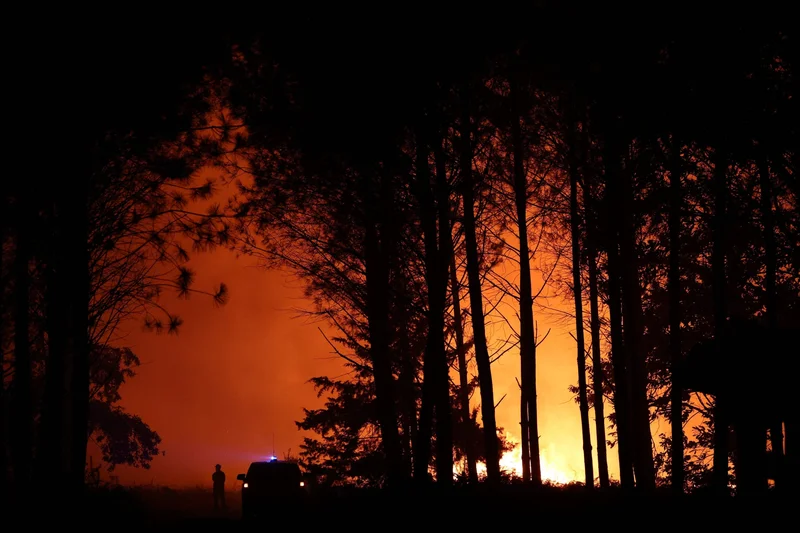
Wildfires tore through parts of Europe on Friday as another wave of record-breaking heat left forests tinder-dry, forcing evacuations in France, Germany, Croatia and Greece and putting firefighters under growing pressure.
France was among the hardest hit, with a new blaze racing through the pine forests of the southwestern Landes region and forcing 525 people to leave their homes in the village of Luglon. About 500 firefighters, backed by six aircraft, were battling the flames, regional officials said.
The fire had burned about 1,100 hectares (2,700 acres) by Friday and advanced to within 2 kilometers (1.2 miles) of Luglon's center, regional official Gilles Clavreul said. Roads north and south of the village were closed as authorities moved residents to safety.
"The situation is unfavorable," Clavreul told reporters.
The Landes region has been repeatedly battered by wildfires this summer. Nearby areas around Arcachon Bay were devastated by two major fires in late July that burned more than 50,000 hectares (124,000 acres) and prompted the evacuation of as many as 220,000 people.
The latest blaze came as France endured what officials described as an unprecedented wildfire season. The area burned so far has surpassed the previous national record set in 2022.
France's exceptionally dry conditions have made its extensive pine forests especially vulnerable to fire. Temperatures approached 41 degrees Celsius (106 degrees Fahrenheit) Thursday in several parts of the country, including Aquitaine in the southwest and the Rhone River valley in the east. Similar temperatures were expected Friday before cooler conditions arrived over the weekend.
The fires have not been confined to southern Europe or traditionally fire-prone areas. Flames have also spread through northern France and Brittany, regions that normally experience cooler and wetter conditions.
In Germany, a wildfire in the Hürtgen forest in North Rhine-Westphalia state forced all 1,800 residents of the nearby village of Gey to evacuate as flames threatened homes.
Nearly 300 hectares (740 acres) of forest were burning Friday morning. Firefighting efforts were complicated by unexploded World War II ammunition scattered through the forest, authorities said.
Explosions could be heard as the ammunition detonated in the heat and flames, forcing firefighters to keep their distance from some areas. The fire moved to within about 300 meters (1,000 feet) of Gey, while a change in wind direction overnight increased the threat to the village.
Hundreds of emergency personnel were deployed, with the German army sending tanks and firefighting helicopters providing aerial support. Authorities said the cause of the fire remained unknown and further evacuations had not been ruled out.
In Croatia, a wildfire near the coastal town of Omis forced more than 1,000 people to flee overnight as strong winds pushed flames into a residential area.
Fourteen people were hospitalized, seven of them in life-threatening condition early Friday, according to authorities. The fire approached the town center, damaged homes and other property, burned cars and caused power outages in parts of Omis.
Local media showed residents packed into a sports hall after being evacuated. Witnesses told public broadcaster HRT that some people jumped into the sea as boats caught fire.
Firefighters had brought the blaze under control by Friday morning, but crews and aircraft were sent farther south to battle another wildfire that broke out overnight on the Peljesac peninsula.
Albania was also fighting multiple fires, with 11 active blazes reported Friday. Authorities said the largest, in the Gure-Lure area, had been contained near residential areas, reducing the immediate threat to homes.
Three people have been prosecuted in connection with a fire that engulfed part of Lura National Park. Authorities said they were suspected of failing to take adequate measures to protect the area under their responsibility from fire.
In northern Greece, more than 300 residents and vacationers were evacuated by sea Thursday after a wildfire swept through a pine forest and threatened homes along the coast.
The latest fires came as Britain recorded its hottest day of the year Thursday, with temperatures reaching 38.1 degrees Celsius (100.6 degrees Fahrenheit) in west London.
Wildfires raced through parts of the West Midlands, destroying several homes and prompting a major emergency response. Simon Tuhill, chief fire officer for the region, described the blazes as among the most significant incidents the service has ever handled.
A total of 1,017 wildfires have been recorded in England and Wales this year, according to the National Fire Chiefs Council.
The extreme heat and fires are being intensified by human-caused climate change, which is increasing the frequency and severity of heat waves and leaving landscapes dangerously dry.
Many European countries are particularly vulnerable because buildings and infrastructure have historically been designed for colder climates, while air conditioning remains less widespread than in hotter parts of the world.