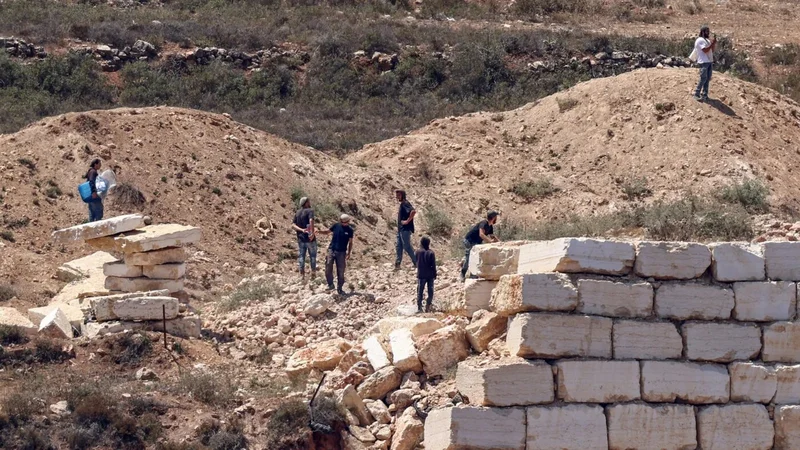
Palestinians in West Bank village remain under Israeli settler siege for sixth day
Palestinian families in the occupied West Bank village of Qusra have remained under siege by Israeli settlers for a sixth day, despite an Israeli army operation that was supposedly launched to remove the settlers.
Israeli activists attempting to deliver food to the families on Friday were stopped by Israeli forces, according to local media reports.
The siege began on Sunday, when a group of settlers surrounded three homes on a hilltop in Qusra, near Nablus. They erected tents at the entrances in what residents said appeared to be an attempt to force the families out and take control of their homes.
Residents said the settlers had cut off water and electricity to some of the properties, leaving families, including children, trapped inside and struggling to obtain food and medicine.
When the families called the Israeli army for help, soldiers arrived but, according to footage online, were seen drinking and praying with the settlers rather than removing them.
After the incident attracted international attention, the Israeli army said it had launched an operation to remove the settlers and declared the village a closed military zone.
But the settlers have not been removed, and no arrests have been reported.
Footage shows Israeli settlers surrounding a Palestinian family’s house, breaking down a stone barrier in the village of Qusra in the occupied West Bank.
— Middle East Eye (@MiddleEastEye) August 12, 2026
This comes amid a surge in deadly settler violence across the occupied West Bank. pic.twitter.com/UFAWGi4JZ0
Instead, Israeli forces deployed large numbers of troops to the village, forcing about 20 Palestinian families from their homes and taking over several properties, which were converted into military positions.
The army said the deployment was intended to prevent clashes between Palestinian residents and settlers.
Israeli forces later withdrew from some of the homes, allowing families to return.
Constant attacks
Qusay Abu Rida, who is sheltering in one of the besieged homes, said settlers had repeatedly targeted the property for months.
The house was built in 2023 and belongs to his brother, who lives in the United States. During previous attacks, settlers broke through the gate, damaged security cameras and stole belongings from outside the house.
This situation forced Abu Rida and his family to move into the house four months ago to protect it. During this time, they have faced numerous forms of harassment aimed at forcing them to leave.
“They would constantly come into the yard, shouting and vandalising things. Then, on Sunday, they came and erected a tent directly in front of the house, cutting off our electricity and water,” he told Middle East Eye.
Two other homes have also been surrounded by settlers.
According to Abu Rida, the soldiers in the area have made no real attempt to remove the settlers. Instead, they placed further restrictions on the besieged families.
“The soldiers forcibly evicted us from my house and my neighbour Yousef’s house and moved us to his brother Rizq’s house. They cut off all our essential supplies and prevented us from leaving, even to collect necessities from our homes,” he said.
On Thursday evening, Israeli forces withdrew from Abu Rida’s home after causing damage inside.
Security-camera footage documenting the settlers' siege was also reportedly destroyed by the soldiers, who dismantled the settlers’ tent but remained in the area.
The tents have since been erected again.
Abu Rida said the treatment of the families echoed what happened to the al-Tubasi family in nearby Jalud last month, where settlers repeatedly attacked the family home until its residents were forced to leave.
The settlers then took control of the property, he said, in full view of Israeli forces.
Homes left damaged
On Thursday morning, more than 1,000 Israeli soldiers entered Qusra, according to local media reports.
Abdul-Azim Wadi, head of the village council, said the military liaison had informed local authorities that troops intended to seize 16 homes. In the end, eight were taken after their residents were ordered out.
Wadi said the army did not explain the seizures, telling residents simply: “Leave immediately. This house is under our control.”
Some of the seized properties were later vacated by the soldiers, but residents returned to find extensive damage.
“In one house, they stole $1,500 and destroyed all the furniture,” Wadi told MEE.
“In another, they stole some of the contents.”
He said each home was entered by dozens of soldiers. In some properties, troops wrote “We will return” on the walls.
Fears of wider control
The Ras al-Ain area, where the Abu Rida and Hassan family homes are located, has faced a series of settler attacks since December. Residents say the attacks are aimed at forcing them from their homes and taking control of the land.
Hani Odeh, an activist in Qusra, said the situation was “heartbreaking”, with settlers and soldiers taking turns putting pressure on residents to leave.
Northern Qusra is now the only part of the village where residents can expand, he said. The other three areas have been taken over by Israeli forces and settlers, with Palestinians barred from accessing them.
“Now they even want to control the northern part because it overlooks five villages south of Nablus, including Jalud and Awarta,” Odeh said.
“It is classified as Area B, and the nearest settlement activity was at least 15km away.”
He said the encroachment began months ago, when a settler started grazing livestock in the area. Other settlers later joined him and began attacking Palestinian homes, apparently seeking to drive residents out.
'The soldiers do not have the authority to remove the settlers; they only oppress us'
-
Hani Odeh, Qusra-based activist
During the siege of the three homes, settlers and soldiers prevented supplies from reaching those trapped inside, Odeh said. Residents even tried to bring food in an ambulance, but soldiers stopped and turned it back.
“This whole situation is worrying all the residents of Qusra,” he said. “We don’t know where the settlers will go next after attacking homes in an area classified as Area B. The soldiers do not have the authority to remove the settlers; they only oppress us.”
Under the 1995 Oslo Accords, the West Bank was divided into Areas A, B and C as a temporary administrative arrangement that remains in place.
Area A is under full Palestinian Authority control for civil administration and internal security and includes major Palestinian cities.
Area B is under Palestinian civil administration, while security responsibilities are shared with Israel. It includes smaller towns and rural villages.
Despite the accords, Israeli forces have operated inside Areas A and B for years.
Area C, which accounts for about 60 percent of the West Bank, is under full Israeli civil and security control.
Most Israeli settlements and military bases have traditionally been located in Area C, built on Palestinian land. In recent years, however, settlers have increasingly expanded their attacks and sought to establish a presence in Area B.
Settler violence
Qusra has a long history of settler attacks, and the latest incidents come amid a sharp rise in violence across the occupied West Bank.
The UN Office for the Coordination of Humanitarian Affairs (Ocha) said it had documented more than 1,330 settler attacks resulting in casualties or property damage across 250 Palestinian communities since the beginning of 2026, as of 20 July.
The incidents amounted to more than six attacks a day.
At least 18 people have been killed and 880 more wounded during settler attacks in 2026.
More than 2,300 Palestinians had also been displaced in 2026 as a result of settler attacks and related access restrictions, according to Ocha.
Around 700,000 Israeli settlers live in the occupied West Bank and East Jerusalem across roughly 300 settlements and outposts. The settlements are regarded as illegal under international law, according to the International Court of Justice.