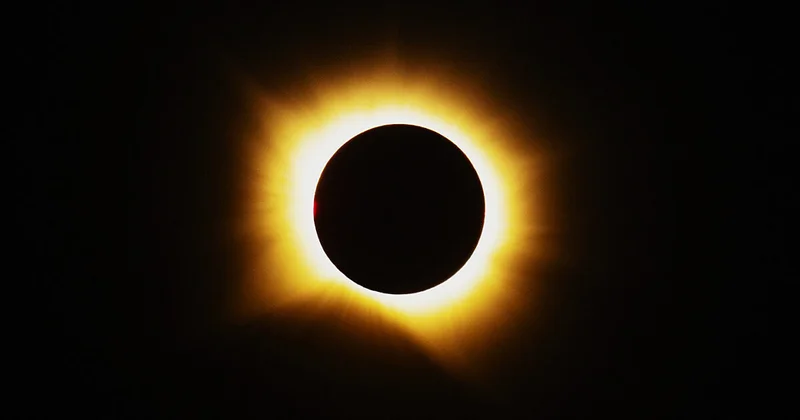
Space Snapshot
A total solar eclipse stunned millions around the world. The eclipseâs path of totality â where the Moon was seen completely blocking the Sun â passed through Iceland and Spain, while a partial solar eclipse put on a dazzling display over parts of North America and Europe. It was the first total solar eclipse visible from continental Europe this century. Check out our favorite pictures from the eclipse. Image credit: NASA
Fact Worth Sharing
The next total solar eclipse is on Aug. 2, 2027, and will sweep through parts of Europe, Africa, and the Middle East. It will offer the longest totality visible from land this century. This interactive map lets you preview what the eclipse will look like.
Mission Briefings
NASA and the European Space Agency chased the Moonâs shadow. During Wednesdayâs eclipse, the space agencies sent jets to fly along the path of totality and take measurements of the Sun using automated instruments. Since a total solar eclipse offers a unique opportunity to observe the outer atmosphere of the Sun more easily, researchers take advantage of it to learn more about how our star works. Image credit: NASA's Scientific Visualization Studio
A vest flown on Artemis I could shield future astronauts from radiation. When NASAâs Artemis I mission went around the Moon, it carried a mannequin-like experiment wearing a specially designed vest made of high-density polyethylene. A new study shows that the vest was effective enough at blocking radiation that it could be used by future crews, particularly to protect long voyages from sudden bursts of solar radiation.
Space agencies are adapting to the loss of Gateway. Since the Gateway space station was put on indefinite hold as part of major revisions to the Artemis program, NASAâs international partners have been trying to adapt. Now, the European Space Agency has announced it will convert some of its Gateway contributions into three lunar missions that will fly through a NASA commercial contract program, plus a potential standalone communications satellite near the Moon. The Canadian Space Agency said it would adapt its Canadarm3 robotic arm for commercial space stations.
From The Planetary Society
Congress is listening and responding to public concern about proposed new grant rules, but the work isn't finished yet. This week, the Senate voted overwhelmingly to pause a harmful rewrite of how the U.S. government funds research. The proposed changes would have been devastating for science and let political appointees decide which grants get approved regardless of their scientific merit. Until the House of Representatives agrees on that same aspect of the bill, though, the fightâs not over. Join us in advocating for Congress to protect science. Image credit: Martin Falbisoner
What do birdsong and astrophotography have in common? As this weekâs Planetary Radio shows, a solar eclipse offers a unique opportunity for both. Join host Sarah Al-Ahmed as she discusses how birds respond to solar eclipses with David Mann, inventor of a birdsong recording device and guest investigator at the Woods Hole Oceanographic Institute. Then, hear from astrophotographer Andrew McCarthy about his experience chasing beautiful shots of solar eclipses in 2024 and 2026.
Win a trip for two to Egypt to view the 2027 Solar Eclipse!
One lucky winner will receive a trip for two to Egypt with Sirius Travel to view the 2027 Solar Eclipse, a pair of Celestron EclipSmart 10x42mm Solar Porro Binoculars, and an astronomical watch from Earth Moves. Learn more and enter to win today. Use code TPS25 for 25% additional entries! (Image shown is a simulation.)
What's Up
Super-bright Venus is stunning in the early evening west. In the pre-dawn, reddish Mars can be found in the east, and yellowish Saturn will be high in the sky. Find out what else to look forward to in our guide to Augustâs night skies.
Help save space missions. Join today!
If you are not already a member, we need your help! Funding for space science is not guaranteed. It requires the voice of passionate advocates like YOU.
NASA funding must grow, not shrink, if the agency is to succeed in returning to the Moon, exploring the Solar System, and seeking out life beyond Earth.
We must prevent future budget cuts. When you become a member of The Planetary Society, you join the worldâs largest and most influential space advocacy nonprofit. Will you join us and support a future full of space exploration?
Wow of the Week
This feature of the Carina Nebula is nicknamed the Treasure Chest â instead of dubloons, itâs filled with stars. The Chest is a cloud of gas and dust with a billowing tail, which leads astronomers to label it a âcometary globule.â This image was taken in the near-infrared by the NASA/ESA/CSA James Webb Space Telescope. Image credit: ESA / Webb, NASA & CSA, M. Reiter
Send us your artwork!
We love to feature space artwork in the Downlink. If you create any kind of space-related art, we invite you to send it to us by replying to any Downlink email or writing to [email protected]. Please let us know in your email if youâre a Planetary Society member!