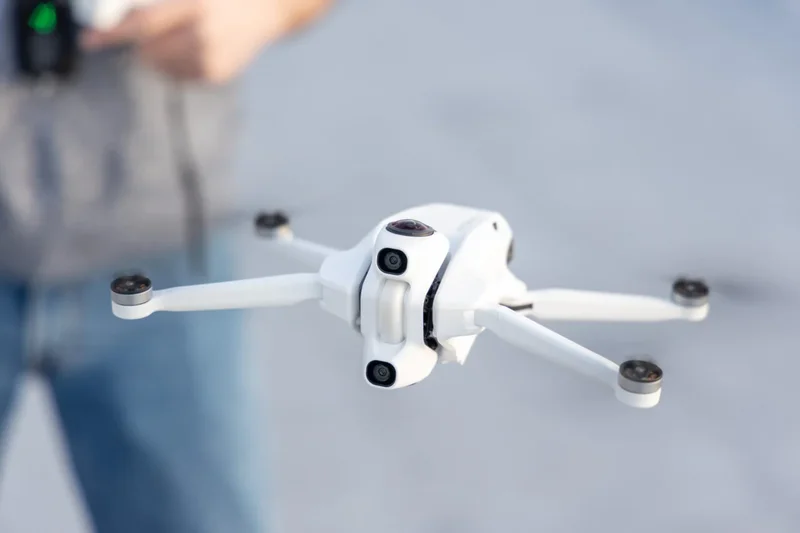
President Donald Trump is using his usual economic cudgel to take another chunk out of the consumer drone industry. The White Houseâs new tariffs specifically targeting overseas drone makers won’t just impact mammoth cargo or military drone parts. Trump’s new import taxes will likely ensure the few drones you can still buy in the U.S. cost way moreâif you can buy one at all.
Trump said Thursday these new 100% import taxes would target any drone with thermal imaging capabilities or any part of a UAS (unmanned aerial system) weighing more than 25kg, or just over 55 pounds. While that mostly accounts for massive-scaled drones, weâll also see a 25% tariff on smaller-scaled drones “that are smaller in size and lack certain capabilities that particularly implicate national security, and on other drone components.” Essentially, any drone that weighs less than 250g, or 0.55 pounds, will now be subject to these new import duties. Here’s a hint: that’s most consumer drones.
These tariffs will simultaneously impose a 15% duty on South Korea, Taiwan, Switzerland, Liechtenstein, and EU nations for âcriticalâ drone components and software. The U.K. will see a 10% import tax instead. The worldâs most popular dronemaker, DJI, is based out of Shenzhen, China, and itâs likely going to take the full brunt of the U.S. antipathy toward foreign drones.
Commerce Secretary Howard Lutnick suggested that UAS and its parts represented a national security risk. While the subject of the White House seemed targeted to those large-scale drone parts mostly used by militaries, officials claimed the U.S. âtoo reliant on foreign sources of UAS and UAS components.â
Itâs the same old story, one that already resulted in DJI having practically all its current products banned from coming to the U.S. Any recent DJI drones, like its recent Lito 1 and Lito X1, will not receive clearance from the Federal Communications Commission (FCC). However, DJI is still allowed to sell its older drones and camera products that previously received FCC licenses, though that may change. The FCC is currently seeking public comment on whether it should ban previously cleared drones from the U.S. market. DJI hopes U.S. customers will take its side.
There is only one drone maker available in the U.S. that promises anything close to the same capabilities as DJIâs UAS. Antigravity, a company spun out of fellow action camera maker Insta360, launched its A1 360 camera drone late last year. DJI followed up with its own UAS sporting a 360-degree lens system. Both those drones weigh less than the 250g cutoff.
Gizmodo reached out to Insta360 and DJI for comment, and weâll update this story if we hear back. Even if both companies are loath to say it, new tariffs will inevitably lead to higher prices. There are effectively no U.S.-based drone companies that have the specialized sensing and obstacle avoidance technology that makes these consumer drones so easy to use.
Even if the White House admits these consumer drones aren’t a big threat to national security, the White House imagines we’ll see a U.S.-based UAS industry crop up overnight. So who is currently making drones in the U.S.? Trumpâs sons, Eric and Don Jr., are both invested in a Florida-based military dronemaker, Powerus. The AP reported in April that the company was pushing to sell drones to several Gulf nations surrounding Iran. Thatâs as Trump conducts his ongoing war in the country that still has no end in sight.