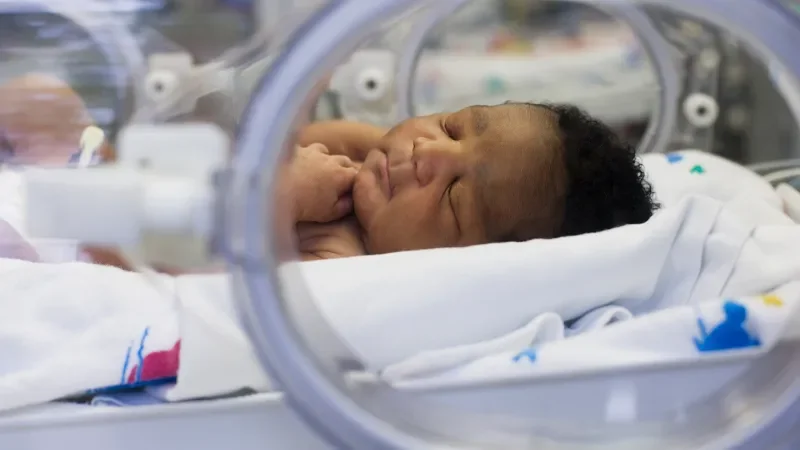
Necrotizing enterocolitis, a life-threatening inflammation of the intestine that mostly affects premature babies, can strike with almost no warning. But a quick scan using only infrared and visible light could someday detect the condition, a new study suggests.
Within the next year, researchers are planning to launch a large test of the technology in the wake of a pilot study in premature infants that showed it was safe and feasible. Of 96 infants, the scans correctly identified the 10 babies with necrotizing enterocolitis — although they also returned a significant number of false positives, pediatric surgeon Seth Goldstein and colleagues reported in February in the Journal of Pediatric Surgery. If the results hold up and can be refined, “I’d like to see it in at every NICU bassinet and just a part of the routine,” says Goldstein, of Lurie Children’s Hospital of Chicago.
Necrotizing enterocolitis, or NEC, is one of the most feared diagnoses in neonatal intensive care units because of its more than 20 percent mortality rate and sudden onset. The disease, which eventually kills intestinal tissue, can first appear with mild symptoms like a distended abdomen and progress quickly to severe disease. It is estimated to affect up to five percent of all premature infants and 10 percent of those born weighing less than 1,500 grams, or about three pounds and five ounces.
Early-stage NEC can be treated with antibiotics and by switching a newborn to intravenous feeding;, but once it becomes severe it often requires surgery to remove part of the intestine. What triggers NEC is not fully understood, but formula feeding is a known risk factor.
Preterm infants’ thin skin is partly transparent to visible and infrared light, Goldstein says. NEC also darkens their intestines as they lose blood supply. This combination of factors pointed him toward a light-based tool.
“If I can detect that color change through the abdominal wall without opening it, then I [can] screen for early changes,” he says.
In the pilot study, Goldstein and his colleagues at Lurie Children’s and Northwestern University in Evanston, Ill. used a probe to illuminate the babies’ bellies with infrared and visible light and a spectrometer to measure how much light was reflected back at different wavelengths. They used a machine learning model to analyze the results. In their planned future study, Goldstein and his colleagues hope to show that their approach can detect NEC before babies show any symptoms by observing a much larger group and scanning them more regularly. They were able to show that kind of early detection in a previous study on mice that were scanned daily.
The team is also working to develop a low-cost handheld device to make the technology accessible to neonatal intensive care units.
Though the study works as proof-of-concept, it includes “too few cases to know how it would perform in the real world,” says Ravi Patel, director of neonatal clinical research at Emory University in Atlanta, adding that false positives raise the concern of overtreatment.
But Patel says that the technology is “worth looking into more.”
Researchers are currently pursuing several other new avenues to prevent NEC. Those include developing new probiotics and looking for biomarkers that could show up in blood. Early detection and prevention is crucial, Patel says, because NEC-specific treatments remain so limited.
“There’s zero drugs that are available, once a baby develops NEC, to prevent the worsening of the disease,” he says.