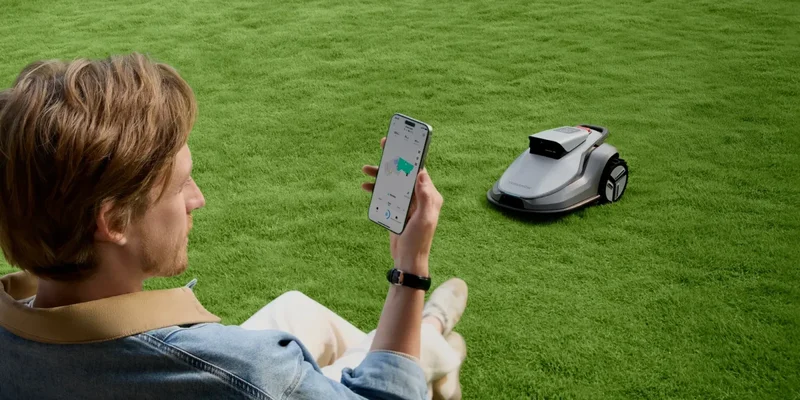
Earlier this year, I replaced my battery-powered push mower with an iPhone-controlled robot lawn mower. That machine creates a virtual map by letting you manually steer it around the perimeter of your yard. Once everything is configured, it takes over mowing duties on a schedule.
More recently, I’ve been testing another system called the TerraMow V1000. It takes a substantially different approach to navigation, and after several weeks of testing, I think it may be the more user-friendly option for a lot people.
Camera-powered automatic mapping
The biggest difference between the TerraMow V1000 and the Anthbot M9 I reviewed earlier this year is how each machine understands your yard.
Anthbot M9 uses an RTK reference station for positioning. Its setup process had me manually steering the mower around the perimeter from my iPhone to create the initial map.
TerraMow V1000 instead uses what the company calls its TerraVision 2.0 system. Three cameras let the mower map the lawn automatically and navigate without a buried perimeter wire or separate RTK antenna.
The automatic approach took a lot longer to create my initial map. However, I think it is probably easier for someone who is less interested in tinkering with technology.
To test that theory, I let my mom in another state set up and use TerraMow V1000 without my assistance. She reported back that everything worked great. I’m less certain that she would have had the patience to manually drive a robot around the full perimeter first, manually marking areas to avoid.
Automatic mapping did introduce one quirk in my front yard. There is no fence or other physical divider between my lawn and my neighbor’s lawn, so TerraMow initially added part of their yard to my map.
I fixed this in the app by marking that section as off-limits. Still, lawns without distinct visual boundaries may require extra attention during the initial mapping process.
Seeing through the mower’s cameras
TerraMow’s cameras also enable one of my favorite features. The iPhone app can show you a live view of exactly what the mower sees while it works.
During testing, I used iPhone Mirroring on my Mac to keep that view open in a large window. I could work inside while watching the mower travel around the backyard from its own perspective.
It is not a feature you need for autonomous mowing, but it makes the robot more interesting and occasionally helps explain why it slowed down or avoided something. Anthbot M9 does not provide an equivalent camera view.
The two iPhone apps otherwise share many of the same ideas. Both let you schedule jobs, adjust mowing behavior, create zones, mark areas to avoid, and remotely steer the mower.
TerraMow has one particularly good twist on that last feature. In addition to traditional left and right virtual controls, its app offers a one-handed joystick mode. You can hold your iPhone normally and guide the mower with your thumb.
Manually mowing from an iPhone is not the main purpose of either system. Ideally, the robot should follow its schedule without requiring any input. Still, TerraMow’s joystick is delightful for cleaning up a missed patch.
At times, it felt like I was basically controlling the robot with my mind (in a delightful way). I could walk beside the mower with my iPhone down at my side, barely moving my thumb, while the machine followed my direction.
Every robot mower app should copy this control.
A more aggressive mower
TerraMow V1000 also feels more aggressive than Anthbot M9. In my testing, it cut lower and made more noise while working.
I would not describe TerraMow as loud. The difference is noticeable, though. Anthbot can operate so quietly that it is easy to forget it is running, including when it uses its headlight to mow after sunset.
Because TerraMow depends on its cameras for navigation, it requires daylight to work reliably. That makes daytime scheduling more important.
The V1000 itself feels durable and substantial. It is also physically larger than the Anthbot M9. TerraMow includes a protective garage that covers the charging dock, while Anthbot sells its garage separately.
Most importantly, TerraMow proved dependable. I relied on it for weeks at a time without needing to take over normal mowing duties myself.
When an adaptive map becomes too smart
The same visual intelligence that makes TerraMow easy to set up can occasionally work against it.
The mower continuously adapts its map based on what it sees. After each job, saving those changes can take a while, temporarily preventing you from doing anything else in the app.
I also encountered an interesting edge case after several days of rain. Puddles formed in part of the yard, and TerraMow understandably avoided that area during its next job.
The grass in the skipped circle then grew taller. Over time, the mower appeared to treat that growth as something it should continue avoiding, leaving the patch untouched even after the ground dried.
I resolved the problem by using the app’s remote control to manually mow through the taller grass. Once the patch looked like lawn again, autonomous mowing resumed there normally.
Regular edging also helped TerraMow confidently reach the perimeter. Tall grass along an indistinct boundary could otherwise look like an obstacle instead of part of the mowing area.
Anthbot’s approach felt less adaptive. It relied more heavily on the boundaries and obstacles I defined myself. That requires more work up front, but it can also prevent the map from changing its mind about a patch of grass.
9to5Mac’s Take
After using both systems, I prefer TerraMow’s camera-based approach for most people.
A buried perimeter wire would be a nonstarter for me, while installing an RTK reference station adds another piece of hardware that must be positioned, powered, and maintained. TerraMow avoids both requirements.
Its visual navigation is not flawless. Initial mapping took longer, an invisible property line required manual correction, and its adaptive behavior once mistook overgrown grass for a permanent obstacle.
Those issues were manageable. In return, TerraMow V1000 delivered simpler setup, dependable autonomous mowing, a fascinating live camera view, and the best manual controls I’ve used in a robot mower app.
I genuinely enjoy yard work, but mowing is the repetitive part. Offloading it to a robot gives me more time for landscaping, edging, and detailing while still keeping the grass tidy.
TerraMow V1000 does that job well enough that I can recommend it, especially to someone who wants robot mowing without burying wires, installing an RTK antenna, or manually tracing the entire yard from an iPhone.
Amazon currently offers TerraMow V1000 for $999 after applying a $200 coupon on the site. You can also find it on TerraMow’s website.
Do more with your Apple products