Discrete Fourier Transform by Hand ✍️
Calculating AI by Hand: 19 of 28
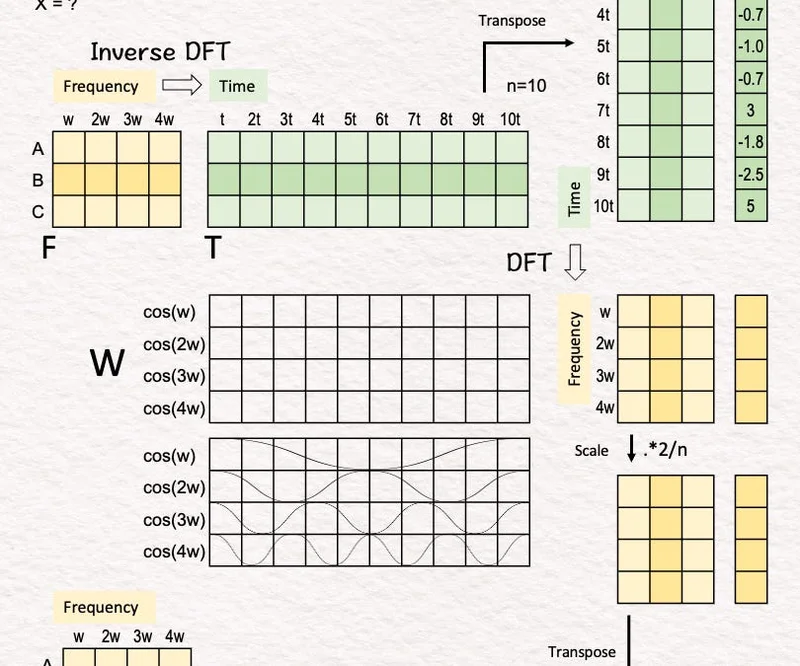
In signal processing, the Discrete Fourier Transform (DFT) is no doubt the most important method. But the math involved is extremely complex, literally, involving a summation over a complex number term e^(-iwt), where e is the Euler number, i is the imaginary unit, w is the angular frequency, and t is time.
I developed this exercise to demonstrate that underneath such complexity, DFT is just a series of matrix multiplications you can calculate by hand. ✍️ Once you see that, it should not surprise you that a deep neural network, which is also a series of matrix multiplications, with activation functions in-between, can learn to perform DFT to process and analyze signals so effectively.
💡 Learned vs. Fixed: U-Net learns its filters from data to process a signal in the spatial domain. The DFT is the classical opposite, a fixed transform, designed by hand rather than learned, that views the same signal in the frequency domain as a combination of cosine waves.
How does DFT work?
Setup
Step 1 of 12: Given
- Signals A, B, and C in the 🟧 frequency domain:
- A = cos(w) + 2cos(2w)
- B = cos(w) + cos(3w) + cos(4w)
- C = -cos(2w) + cos(3w)
- Each signal is a weighed sum of four cosine waves at frequencies 1w, 2w, 3w, and 4w.
- We will apply Inverse DFT to convert the signals to time domain representations, and then demonstrate DFT can convert back to their original frequency domain representations.
- Signal X in the 🟩 time domain. X is sampled at 10 time points 1t, 2t, …, 10t:
- X = [-2.5, -1.8, 3, -0.7, -1.0, -0.7, 3, -1.8, -2.5, 5]
- Suppose X is also a weighted sum of the same four cosine waves, but we don’t already know their weights. We will apply DFT to discover them.
Step 2 of 12: Frequency Matrix (F)
- Write the coefficients of A, B, C as a matrix F. Each signal is a row. Each frequency is a column.
- A → [1, 2, 0, 0]
- B → [1, 0, 1, 1]
- C → [0, -1, 1, 0]
Step 3 of 12: Cosine → Discrete
- Sample from the continuous cosine waves at discrete time points 1t, 2t, 3t, to 10t.