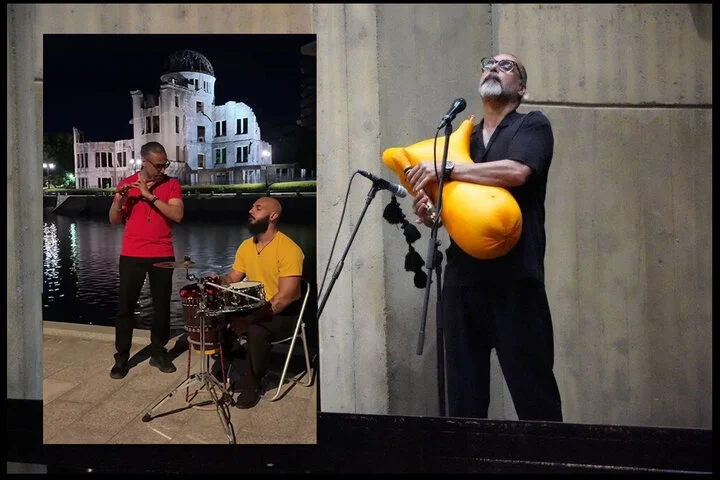
Mohsen Sharifian echoes Iranians’ message of peace, friendship in Hiroshima
TEHRAN – Mohsen Sharifian, the musician and researcher of regional Iranian music, echoed the message of peace and friendship of Iranians with a musical performance in Hiroshima, coinciding with the anniversary of the atomic bombing.
Sharifian, who has carried out numerous international activities in recent years in promoting the music of southern Iran, traveled to Japan for the third consecutive time on the anniversary of the Hiroshima atomic bombing. Through his musical performance at Hiroshima’s Peace Memorial Park — and beside the only building that survived the atomic bombing — he sought to carry the message of peace and friendship from the people of Iran to the world, Mehr reported.
In addition, Sharifian, along with Sadegh Hosseinpour, a percussion player, performed in a joint session with a group of Japanese artists in Tokyo — performances in which Iranian and Japanese music stood side by side, with the southern Iranian bagpipe (ney-anban), one of the most distinctive instruments of southern Iranian music, sounding alongside the koto, shamisen, and other instruments of the Japanese artists.
“Story of a Shepherd,” composed by TSUMUZI, the Japanese composer and musician, in the form of a duet between the ney-anban and the violin — bringing together two distinct musical traditions in a shared performance — was among the pieces performed in this special program.
In another segment of the program, Sharifian also performed one of the well-known melodies of Japanese music with the ney-anban. In this context, “Haru yo, Koi” (Come, Spring), a work by Yumi Matsutoya, the famous Japanese singer and composer, was the piece rendered this time through the sound of the Iranian bagpipe.
Sharifian described his performance of this Japanese melody with the ney-anban as an experience that transcended a mere musical performance, speaking of the tranquility, order, and beauty of the land of Japan — an experience in which a Japanese melody was re-interpreted through the sound of a signature instrument from southern Iran.
Regarding this performance, Sharifian stated: “My presence in Hiroshima, coinciding with the anniversary of one of the most tragic events in contemporary history, has in a way deepened the meaning of these performances; because in this program, music was used not as a tool to recall war, but as a language for expressing peace, friendship, and the coexistence of nations.”
According to him, these joint performances can be regarded as an example of cultural dialogue between Iran and Japan through music — a dialogue in which differences in language, instruments, and musical traditions not only do not create an obstacle, but instead become a platform for mutual understanding and connection between the two cultures.
Another noteworthy point is that the ney-anban, an instrument deeply rooted in the musical culture of southern Iran and one of the symbols of Bushehr and Persian Gulf coastal music, transcended its geographical boundaries in these performances, taking its place alongside Japanese instruments and the violin to narrate melodies from two lands on a single stage.
SS/SAB