Rain may bring disease-carrying mosquitoes. But the lack of it could have been a factor that led to the first urban yellow fever outbreak in Brazil in decades.
In 2015, an El Niño powered an abnormally strong drought in central South America, and monkeys and mosquitoes on the hunt for water may have brought the virus into Brazilian cities, researchers report August 14 in Science Advances. Computer simulations hint that infected nonhuman primates moving into urban areas from dry forests and bite-happy mosquitoes perhaps trying to avoid dehydration may have helped drive yellow fever’s spread. During the outbreak, which began in late 2016, more than 2,000 people fell ill and nearly 750 people died.
The simulations hint that dry periods can raise the risk of yellow fever, something to watch as climate change is expected to bring more frequent droughts.
The study is “a step in the right direction,” says Nikos Vasilakis, a virologist who studies viruses carried by mosquitoes at the University of Texas Medical Branch at Galveston. The team’s findings provide a framework for researchers to gather additional data from forests and cities to further test the simulations’ predictions in the real world.
The outbreak was complicated. The changes in animal behavior during the drought most likely collided with other factors, such as low vaccination rates among people and deforestation. “I think of drought as the spark. The setting was there,” says Joelle Rosser, an infectious diseases physician and epidemiologist at Stanford University.
Drought can raise the risk of some infectious diseases, including viruses spread by mosquitoes. West Nile virus, for instance, may spread more during dry times, perhaps because water scarcity concentrates infected birds and mosquitoes around limited sources. And in Brazil, the El Niño brought dry conditions slightly more extreme than a once-in-a-century drought.
Brazil had not had an urban yellow fever outbreak since 1942. Aedes aegypti, the yellow fever mosquito, once spread the virus widely among people in parts of the Americas and Africa. Mosquito control with insecticides and an effective vaccine beat back the disease in the Americas. Now, the majority of reported cases are in Africa.
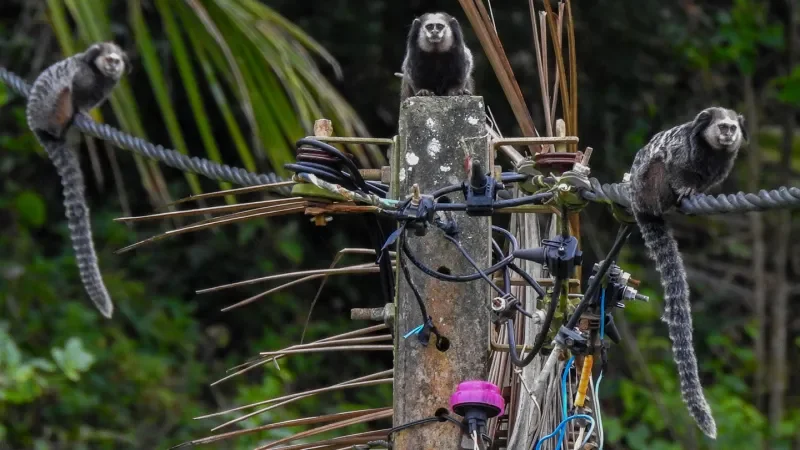
Yellow fever isn’t isolated to A. aegypti and humans, however. It has another cycle of infection in the forest. There, mosquitoes in the Haemagogus genus and others spread the virus, largely among howler monkeys, marmosets and other nonhuman primates. Infections in monkeys often serve as a harbinger: Sick and dying animals are a sign that yellow fever is spreading and, if the virus gets picked up by A. aegypti, that it can kick-start an urban outbreak in people.
But during Brazil’s outbreak, A. aegypti was not the primary species spreading the disease, studies show. This mosquito’s populations had been greatly reduced in the wake of the Zika outbreak that had recently hit the region. Instead, the yellow fever outbreak seemed to be driven by Haemagogus mosquitoes from the forest.
“It was this once-in-a-century drought coinciding with this really unusual once-in-a-century outbreak,” says Jamie Caldwell, a disease ecologist at the High Meadows Environmental Institute at Princeton University.
With information on primate mortality, human yellow fever cases and drought data, Rosser, Caldwell and their colleagues ran the computer simulations forecasting how a yellow fever outbreak might unfold if forest creatures moved toward urban areas in search of water or if forest mosquitoes bit hosts more frequently, possibly to prevent dehydration. The team then compared those predictions to real-world data from both humans and monkeys in the 2016–2019 outbreak.
Simulations that included both animal movement and mosquito biting patterns were the best match for how the virus spread in the Brazilian state of Minas Gerais, where the outbreak started, compared with those that left out either behavior. The finding suggests that dwindling water sources brought forest creatures closer to the city and yellow fever with them.
Boosting vaccination rates across the region, as well as vector control, helped rein in the outbreak.
It’s interesting that mosquitoes biting more often isn’t the only proposed behavior change behind the outbreak. It seems that infected monkeys needed to move toward the city, too, says Sadie Ryan, a medical geographer at the University of Florida in Gainesville.
Understanding these behaviors is important because, “what was once in a century will now be four times in a century,” Ryan says. “We’re going to be seeing more scenarios where it gets drought-y enough for long enough that it’s going to promote [similar types of] coincidences.”