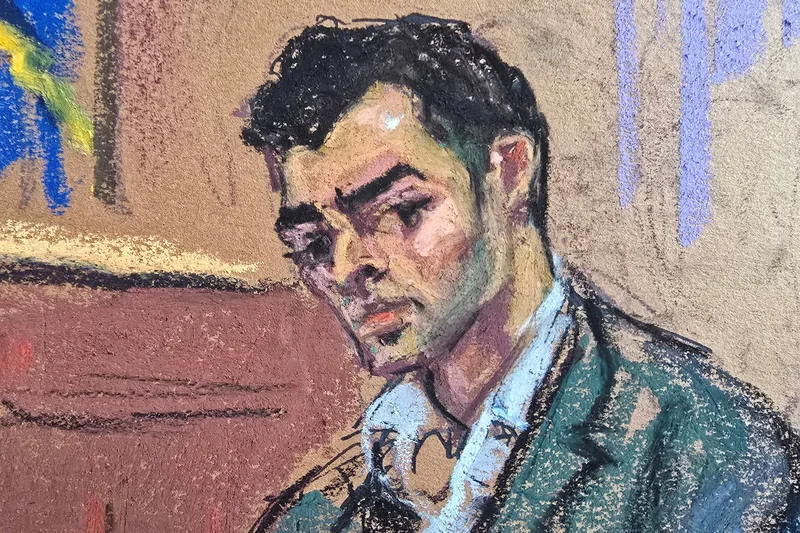
Luigi Mangione, the 28-year-old accused of shooting a health insurance executive in the back two years ago, has pleaded guilty to murder in the federal trial brought by the U.S. Department of Justice. “I shot Mr. Thompson and he died,” Mangione told the court. “I understood that my actions would place him in fear of death or serious bodily injury. I knew what I was doing was illegal.”
Mangione pleaded guilty to interstate stalking resulting in death, which carries a maximum sentence of life imprisonment, and to a second count of stalking through the use of interstate facilities resulting in death. Although he faces a potential life sentence, the federal indictment ultimately did not include murder charges. Judge Margaret M. Garnett is scheduled to sentence him on December 18.
The move is widely interpreted as an attempt by Mangione to avoid the separate state trial by invoking the principle of non bis in idem (double jeopardy), which prohibits a person from being tried twice for the same offense.
Mangione’s case is one of the most widely followed criminal cases in the United States. A member of a wealthy Maryland family and a graduate of the University of Pennsylvania, he is accused of killing Brian Thompson, the chief executive officer of UnitedHealthcare, one of the country’s largest health insurers.
Surveillance footage showed that on the morning of December 4, 2024, a hooded gunman approached Thompson in midtown Manhattan and shot him twice in the back as he walked toward a hotel where he was scheduled to speak at the company’s annual investor conference.
The shooting occurred during the final weeks of the Biden administration. Prosecutors in the Southern District of New York initially took charge of the case, charging Mangione with weapons offenses and second-degree murder, among other crimes.
A few months later, after Donald Trump returned to the White House, he directed then-attorney general Pam Bondi to seek the death penalty. “He shot someone in the back, as clear as you’re looking at me or I’m looking at you… he looked like a pure assassin,” Trump said in an interview with Fox. “There’s not a question - he openly walked up to a man and shot him right in the middle of the back.”
Federal prosecutors later brought nine counts against Mangione, including stalking resulting in death, a charge that could have supported a capital sentence. However, Judge Garnett dismissed several federal counts, including the one that exposed him to the death penalty.
Officials in the Attorney General’s Office, led by Bondi, filed up to nine charges against Mangione, including harassment of Thompson leading to death, which would have required the death penalty if convicted. U.S. District Judge Margaret M. Garnett dismissed some federal charges, including the one that carried the death penalty.
State prosecutors, however, have already argued that the federal plea does not eliminate the state case because it addresses a different legal harm and therefore may proceed to trial.
Mangione has become a cult figure for many Americans who see him as a vigilante acting against the U.S. healthcare system. He reportedly suffered from chronic back pain and felt mistreated by insurance providers. His case reignited debate over high healthcare costs and insurers’ frequent denial of coverage claims.
Mangione was arrested five days after the alleged killing at a McDonald’s restaurant in Altoona, Pennsylvania, roughly 230 miles west of New York City. During the arrest, which later became the subject of legal controversy because officers did not have a warrant, police said they recovered a 3D-printed handgun, a silencer, false identification documents, and a red notebook describing plans to kill the insurance executive. According to investigators, officers also found a handwritten 262-word note in which Mangione took responsibility for the killing.
Mangione’s lawyers sought to suppress the evidence, arguing that it had been seized without a warrant. The items were logged as evidence at the police station before a warrant was obtained. In May, a New York judge issued a split ruling: the homemade firearm and notebook were excluded, but prosecutors were allowed to use the silencer and a USB drive containing documents related to the planning of the attack.
Sign up for our weekly newsletter to get more English-language news coverage from EL PAÍS USA Edition