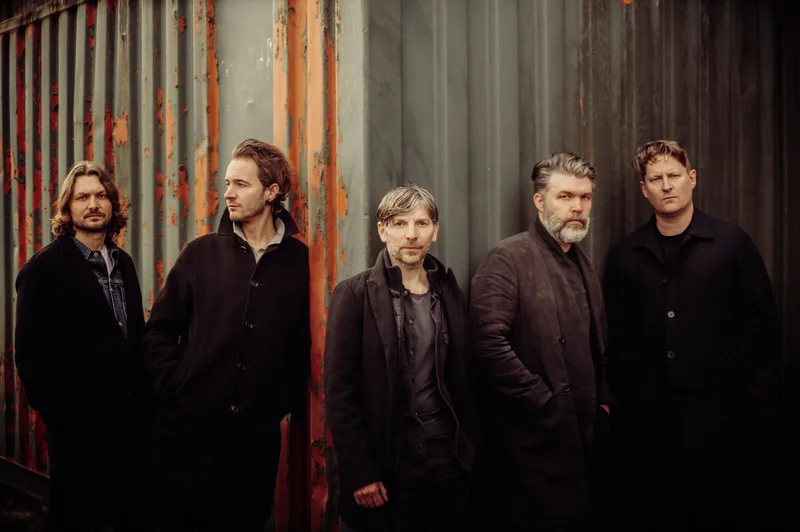
When Editors arrived on the music scene in 2005 with their debut album, The Back Room, they were part of a wave of bands that defined the sound of the second half of the 2000s. Their post-punk sound fit perfectly with the energy of the moment, leading them to be categorized alongside other bands of that time like Interpol and their British compatriots, Bloc Party. Now, 20 years later, the band is no longer just part of a collective; they have defined their own history and found new nuances and sounds within their group dynamic.
The most recent proof is Surface, Echo & Sound, their eighth studio album, set to arrive on all platforms on October 30. The work, which EL PAÍS had the opportunity to hear in advance, is a change of course for the band. For the first time, the group adopts a special closeness with an unexplored acoustic sound that not only massively moves away from their latest work, EBM (in which they experimented with an industrial electronic sound), but also shows that veteran bands can create their best work after maturing, both musically and personally.
EL PAÍS spoke with lead singer and lyricist Tom Smith and guitarist Justin Lockey, founding members, in the west of Mexico City, to discuss the self-revolutionary new album and their nearly quarter-century of history.
Question. How did the decision to approach a more acoustic sound come about?
Justin Lockey. Actually, we didn’t talk about it; we just arrived at it. Tom brought the songs into the room, and we all sat around and spent quite a lot of time throwing ideas around until they clicked. Coincidentally, most of them were based on an acoustic guitar. By building the band around that, the acoustic guitar ended up being probably the main instrument of the record; it’s on almost every track.
Tom Smith. I think we all harbored ideas of doing something more organic, since our last three albums were very electronic, especially EBM. A big factor as well was that Benjamin John Power couldn’t commit to being involved with us for this record. It wasn’t a creative disagreement; it was just a fact that he couldn’t spend time in the studio with us because he was too busy. So, without Ben, the idea of becoming more organic just grew into a natural thing. I had also just made a solo acoustic record, and coming off the back of that to meet in the room with the guys, I still had some of that energy in me. It just felt like the right thing to do with these songs.
Q. In certain songs, a very 1980s new wave sound is also noticeable. Was there any specific influence from that era?
J.L. We love many bands from that era: Echo & the Bunnymen, The Cure, R.E.M. They are the bands that made us want to form a band in the first place, so at some point, that’s going to seep into the music.
T.S. Even the last track on the record — which is presented in a purely acoustic way — could be a Bonnie Tyler-style power ballad if it were treated differently. The melodies naturally have something that connects with that eighties sensibility, and I think that’s something I carry within me as a songwriter that suits all of our tastes as well.
Q. The term “dark” is often used to describe your sound, but on this album, it doesn’t feel that way as much. Do you think the acoustic aspect results in a lighter sound?
T.S. Some of the themes and my way of singing will always place the songs in a slightly darker place; I’m not a pop singer and I never will be. But you’re right. Presenting them with acoustic guitars and a bit more space dissolves that darkness. EBM was hard and dark, while the organic instruments here dissipate that feeling and distribute it across the whole thing, making it more textural rather than a concentrated goth-wave.
Q. What themes did you want to explore in the lyrics of this album?
T.S. I have always tried to write songs that connect with people on an emotional level. I don’t sit down and think: “I have to explore such and such a specific theme.” But there is a lot of fear in this album, and it’s about trying to find comfort — and even celebration and euphoria — in spite of that. It’s about finding common ground with people who are all feeling a similar way, and how that connection proves empowering in the face of encroaching, terrifying things.
Q. Tom, as you mention, part of the album’s atmosphere also seems influenced by your solo album. What did you learn from that project that you were able to bring back to the band?
T.S. The song The Rush was actually from that session. Beyond that, I fell in love with the feeling of just singing a song with an acoustic guitar in front of an audience. That basic human connection of singing and seeing people connect with it was something that had been lost a bit in Editors’ concerts. Performing night after night feeling completely vulnerable, stripped of noise, drama, and lights, was terrifying at first, but I loved it. It was really rewarding.
Q. How do you hope the album experience translates to the live tour?
J.L. I’m looking forward to it. It’s probably one of the few records since The Weight of Your Love that we can translate to a stage quite easily and watch grow from there. We don’t have to dismantle the songs to work out how to play them live; we can just rock up on stage and play the parts we recorded. It feels a bit more mature and adult, for lack of a better word. I absolutely loved touring EBM, but it was loud and confrontational from start to finish. This is completely the opposite.
Q. Next year the band will celebrate its 25th anniversary. At this point, what is easier and what is more difficult compared with your early days?
T.S. It’s harder to be away for long periods. We all have kids and families now.
J.L. But it’s easier to enjoy it without the ego getting in the way. I used to struggle a lot with anxiety, but in these summer festivals, I’ve managed to get out of my own way. You see things differently as you get older, and you can let certain things go, which makes it more enjoyable. For me, the hardest part was those first couple of records, when I was essentially a boy. But throughout the middle period of the band, I grew to enjoy being on stage and performing more and more. Now I feel comfortable on stage; it’s no longer a scary place for me. That maturity combines perfectly with this record. It’s not complicated: we’re just a good band doing our thing.
Q. What has changed the most in your dynamic within the studio as bandmates?
T.S. We are annoyingly democratic. I suppose I’m the “leader” in the sense that I write the ideas that become songs, but what I compose at the beginning doesn’t look like Editors at all. I can’t do it without them. Once I hand it over to the others, it becomes a democratic process. If a band has a dictator driven by ego, those creative relationships don’t tend to endure.
Q. Do you think your audience has also changed over time?
T.S. There are people who have been there from day one, young people joining now, and even the children of our original fans coming to the concerts. When I toured with my solo record, it was very intimate. I was selling T-shirts after the show and chatting with people. Half of my repertoire included Editors songs from the last 20 years, and there were fans telling me exactly what a song meant to them and when they discovered it. Being so close to people who have followed us for nearly 25 years left a huge mark on me. Music is the soundtrack to people’s lives during difficult and fun times, and that is amazing.
Q. Do you think you will continue to experiment with this acoustic sound for the next record, or will you look to explore new terrain?
J.L. We’ll see where it lands.
Sign up for our weekly newsletter to get more English-language news coverage from EL PAÍS USA Edition