At just after five o’clock on Wednesday afternoon in a crowded dive bar in Chicago, what is believed to have been the city’s final barrel of Schlitz beer was tapped, served and emptied.
The frothy send-off, held at Glunz Tavern in the city’s Old Town neighborhood, appeared to mark the end of a 177-year-long run for Schlitz, “the beer that made Milwaukee famous,” as one of Chicago’s stalwart pours.
Schlitz-themed celebrations have been held across the city this summer after the Pabst Brewing Company, the beer’s brewer, announced in May that the company would be putting the brand on hiatus due to rising production and shipping costs, NBC’s Corky Siemaszko reports.
“We coordinated it to celebrate the beer being such a part of our history,” Christopher Donovan, the Glunz Tavern’s co-owner, tells Block Club Chicago’s Matt Niendorf. “The brewery specially secured it for people who had supported the brand over the years.” Across the city, Chicagoans have paid their respects to Schlitz at a variety of establishments in recent weeks with special promotions, merchandise sales and “final calls.”
“It’s been part of the beer culture for so long,” John Almonte, co-owner of the Bridgeport neighborhood’s Electric Funeral Bar, which held one such event, told Fox 32 Chicago’s Dane Placko in May. “It’s kind of amazing it’s going away, know what I mean? It’s just been there your whole life.”
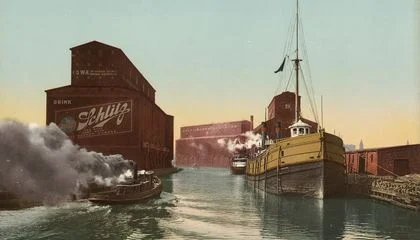
Beyond its reliability as a cheap thirst-quencher and keystone for collective nostalgia, Schlitz’s long history has been closely intertwined with some of Chicago’s most important events—both famous and infamous—as well as its architectural landscape.
Founded in Milwaukee in 1849 by a German immigrant named August Krug (Joseph Schlitz, who began as Krug’s bookkeeper, took over the company in 1856 and renamed it after himself) the brand’s popularity exploded across the region in the aftermath of tragedy. When the Great Chicago Fire of 1871 destroyed several of the city’s breweries, Schlitz stepped into the void. Some accounts hold that the company sent beer and drinking water to aid residents in the fire’s aftermath; what is certain is that Schlitz’s Chicago sales doubled by 1872.
Fun fact: Breweries and beer gardens run by German immigrants transformed Chicago
By 1860, Chicago had more than 50 breweries, many founded by German immigrants who helped popularize lager beer throughout the city. German immigration helped shape Chicago’s social drinking culture, with breweries and beer gardens becoming "third spaces" for residents of German neighborhoods.This local importance was made clear to international audiences at the 1893 World’s Columbian Exhibition, which for five months turned Chicago into “the White City.” Schlitz spent $20,000—more than $740,000 in today’s money—on a professionally designed pavilion inside the fair’s massive Agricultural Building, offering patrons pours of Schlitz beers.
“There was an exhibition piece I needed to do for the Manufacturer’s Building, the Schlitz Brewery trademark of a huge globe with a buckled belt around it,” wrote Richard W. Bock, the sculptor tasked with the design, in his memoir, according to City of Chicago documents. “This globe was supported by four female figures in playful poses representing the four hemispheres. At their feet were gnomes. Flanking this centerpiece were four pedestals constructed of beer kegs, three to a pedestal, and on top of each a herald blowing a trumpet.”
Art historians have noted that this ornate commission was the genesis for many subsequent high-profile artistic and architectural collaborations around Chicago.
“It was Bock’s first use of a globe and supporting figures, a motif that he would employ several times in sculpture for Frank Lloyd Wright,” historian Donald P. Hallmark wrote in a 1971 edition of the Prairie School Review. “The ideas used in the exhibit for the Joseph Schlitz Brewing Company remained in Bock’s mind for many years and did not disappear as quickly as the actual sculpture did upon the completion of the fair’s run in late 1893.”
Many of these symbols, with the Schlitz name prominently displayed, would go on to adorn the facades of Chicago’s neighborhoods. Between 1897 and 1905, the Schlitz company built 57 brewery-tied houses across the city. In establishments like these, beer companies supplied owners with everything they needed to operate a bar, with the caveat that they could only serve that brand’s brews, CBS News’ Adam Harrington reports. They ceased operation during Prohibition, and new state laws made tied-houses obsolete. Today, 41 of these former Schlitz tied-houses still stand. Ten of them, as well as one brewery stable, have been designated as Chicago landmarks; some are still even pubs or restaurants.
At Glunz Tavern, Schlitz’s history was not lost on the patrons who made the journey to share in the beer’s final barrel.
“I’m chugging my first to make sure I get a second,” one customer told Block Club Chicago.