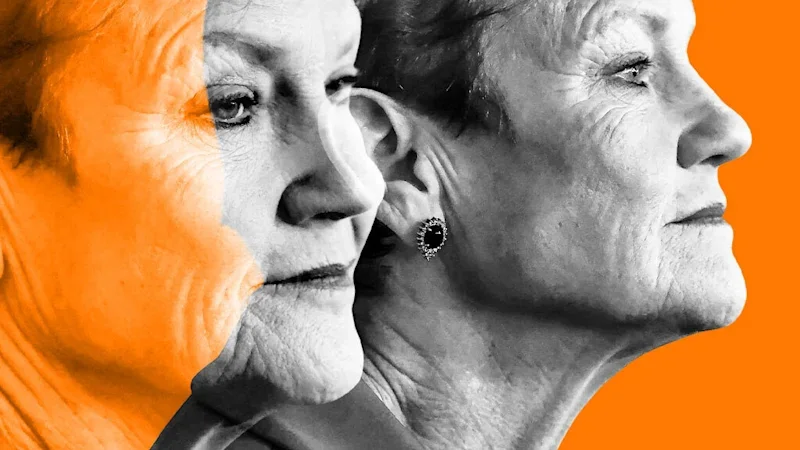
Who are we becoming as a nation? The question of our political identity as voters had a simple answer before Pauline Hanson finally cracked the populist code in 2026, after almost three decades on the electoral fringe.
Before this year, Australia’s democracy was defined by the absence of extremism. Liberal prime ministers sat consistently to the centre-left of their Conservative and Republican peers in Britain and the US, while Labor’s were to the centre-right of British Labour and less ideological than the US Democrats.
The flipside of our gold coin of moderation was the leaders and parties that Australians rejected. The Liberals lost winnable elections when they imported American agendas, to deregulate the workplace or to wind back Medicare, as John Howard learnt twice, from opposition in 1987 and in the defeat of his government in 2007. Labor failed when it tried to redistribute income, most recently under Bill Shorten in 2019.
Our system of compulsory preferential voting had reinforced our egalitarian and obedient national temperament by pulling the major parties towards the centre while creating a barrier to entry to those on the hard right.
So what changed this year to elevate One Nation above the Coalition and up to level-pegging with Labor in the national opinion polls? How did One Nation suddenly break out of its Queensland-centred political identity to seize its first House of Representatives seat at the by-election for Farrer, in southern NSW, and come within a single win of claiming the formal opposition from the Liberals in South Australia, the state traditionally considered one of our most socially progressive?
All this before the Victorian showdown in November, where the polls, if they are to be believed, point to the first three-way contest since the early years of federation when the establishment side of politics was represented by two competing Liberal parties, the Protectionists and the Free Traders, while the trade union-backed Labor was the rising political force on the left.
Understanding Hanson’s late career surge, and the implications for both our politics and our sense of self as a nation, starts with a reminder of her role as an electoral wrecking ball in the late 1990s, when she threatened Howard’s first-term Coalition government. For Howard, Hanson was an accident waiting to happen. Liberal Party pollster and strategist Mark Textor explained it to me long after her insurgency had passed into political history: “Why did Hanson flatfoot Howard? Because Howard, after attacking Paul Keating from the right, was being attacked from the right.”
Hanson had caught the anti-incumbent wave that wiped out the Keating Labor government in 1996. Preselected by the Liberal Party to run for the safe Labor seat of Oxley, south-west of Brisbane, she had her endorsement withdrawn after she ignored repeated warnings to tone down her comments to the media. She said, among other things, that the government had created racism “by looking after Aborigines too much”. Howard said her removal from the Liberal team proved that his party would “govern for all Australians”.
Howard assumed the seat was unwinnable, so the gesture was aimed more at seats, like his own Sydney electorate of Bennelong, which were diverse and socially progressive. Hanson, though, won regardless. While she sat in parliament as an independent, she posed no obvious threat to Howard’s landslide majority. The Coalition held 94 of the 148 seats in the Parliament. But that changed from the moment Hanson launched her One Nation party in 1997.
Hanson drew her initial support mainly from Coalition voters in regional Queensland and NSW. Then-PM Howard thought he could retrieve those votes through the distribution of preferences, so he treated her supporters as his own. But that approach risked the Liberal Party’s standing in the cities. Many of his colleagues, including then-treasurer Peter Costello and then-foreign affairs minister Alexander Downer, had urged him to denounce Hanson from the outset.
Howard’s great fortune as prime minister was seeing the Coalition lose the Queensland state election in June 1998. That campaign served as a crash test for his plan to treat Hanson as a fellow political traveller, with the Liberals and Nationals placing One Nation ahead of Labor on their how-to-vote cards.
The Queensland state parliament was particularly vulnerable to a hostile takeover. The main parties were tied at 44 seats each, with the sole independent, Liz Cunningham, providing her support to the Coalition led by the Nationals’ Rob Borbidge. Hanson was not a candidate at the state election, but she was treated like visiting royalty as she toured the state. Her anti-establishment message inspired Queenslanders to cast a system-shaking protest vote. Her One Nation party claimed 11 seats, five from the Nationals and six from the Peter Beattie-led Labor opposition.
Hanson’s 11 seats would have held the balance of power if the Liberal vote hadn’t collapsed. The Liberals, the junior partner in the Coalition, lost six seats to Labor: four in Brisbane and one in each of the coastal cities of Cairns and Townsville. This left Labor with the same number as it started, 44. The Nationals lost a further seat to the independent Peter Wellington, reducing the Coalition total to just 32. It was Wellington who provided the vote that made Beattie premier.
When Howard and his advisers processed the Queensland result, they confronted a stark political choice between the blue-collar males who had abandoned Labor at the 1996 federal election and the traditional Liberal middle-class base. Should they continue to chase the battlers in the regions as they swung from Labor to the Coalition and ultimately to One Nation, or double back to the suburbs? By chance, there were two unresolved policy questions that sat between the two constituencies. Howard’s 10-point plan to restrict native title following the High Court’s Wik decision remained stalled in the Senate. He could follow up on his threat of a double-dissolution election and run a culture-war campaign with race at its heart, or he could run a tax reform campaign centred on a 10 per cent goods and services tax.
The question answered itself. A race-based campaign would elevate Hanson to equal status with Howard and risk a repeat of the Queensland catastrophe. The GST would cut her out of the debate.
Textor said the goal was to “repolarise” the electorate into a traditional left-versus-right contest on the economy. “We had to refocus the agenda on an economic agenda, not Hanson’s fragmented social agenda. You couldn’t just do that by having a normal economic plan. You had to have what the movie-makers would call ‘a bit of tension’ in there.
“And that was the intuition of John Howard. He said [the GST] gave his pollster a heart attack, and it certainly did for a while. But it had enough tension to take the [focus] off Pauline Hanson’s social debate and move the tension into an economic debate, which was much safer territory for Howard given that he was a former treasurer and knew the stuff intimately.”
Howard reached back to the examples of Bob Hawke and Paul Keating to save his first-term government. By showing both sides of the budget – the national interest sacrifice represented by the GST and the reform bonus of personal tax cuts – Howard gave voters the respect they had grown accustomed to under the previous Labor government. Textor said: “What we decided to do was not sell the detail of the policy but sell the fact that the policy represented true leadership, which was reflecting the best part of the Keating years and the Hawke years.”
At the 1998 election, Kim Beazley’s Labor opposition needed to pick up 26 seats to form majority government. It fell just eight seats short of that improbable target, claiming 17 from the Coalition as well as Oxley from Hanson. The third-party vote was 20.4 per cent, then the largest of the postwar era. One Nation accounted for almost half of that – 8.4 per cent – but it was left without a seat in the House of Representatives. Hanson had moved from Oxley to contest the new seat of Blair, west of Brisbane. She recorded the highest primary vote – 36 per cent – but the Liberal candidate, Cameron Thompson, overtook her with preferences from the Labor and National parties. The One Nation Senate vote was a fraction higher at 9 per cent, but it delivered just one senator in Queensland. The Australian Democrats had 8.5 per cent of the vote but won four spots, giving them the balance of power in the upper house. That was the difference placing One Nation last on how-to-vote cards had made to the Parliament: Hanson became a one-term MP and her party had no leverage in the Senate.
The unique circumstances of the 2001 election cut Hanson out of the debate again, even though this campaign was fought on her preferred ground of immigration. Howard’s so-called Pacific Solution, which prevented asylum seekers from landing in Australia, restored the government’s electoral support after a difficult start to the year. The Tampa episode on its own may not have been sufficient to ensure the government’s re-election with an increased majority. But in confluence with the September 11 attacks on the US and the deployment of Australian troops to Afghanistan, it allowed Howard to use border protection to repolarise the electorate to the Coalition’s advantage.
Hanson complained that Howard had pinched her ideas, but he had no reason to engage in this argument. Voters tend to rally around the incumbent when they perceive an external threat. After the election, Howard told me that “we have seen off our Le Pen”, referring to Jean-Marie Le Pen, founder of France’s far-right National Front party.
Hanson’s return to the political stage in 2016, as a senator, was wedged between two populist earthquakes: the British vote to leave the European Union and Donald Trump’s election as US president. If there was a Brexit-style backlash brewing against immigration, Hanson would have reflected it in her party’s vote. But One Nation’s constituency in 2016 was half the size of its previous peak. The primary vote in the Senate was 4.3 per cent, compared to 9 per cent in 1998.
In fact, the 2016 federal election made history in the other direction, because this was the first to be decided by New Australia, at the cultural tipping point when those born overseas or with one migrant parent were about to claim the majority of the population. Chinese Australians were “without a doubt” the difference between majority and minority government for Malcolm Turnbull, according to Paul Erickson, who was the ALP’s assistant national secretary for the 2016 campaign. Labor lost the Chinese-Australian vote again in 2019, a crucial and under-reported factor in Scott Morrison’s “miracle” election win.
Nothing in Pauline Hanson’s first nine years as a senator between 2016 and 2025 hinted at what was to come in her 10th. The clue, instead, was in her party’s foundation – because there is a remarkable symmetry in One Nation’s resurgence in South Australia in March this year with its stunning debut at the Queensland state election of 1998.
The primary vote for One Nation was almost identical: 22.9 per cent in SA in 2026 and 22.7 per cent in Queensland in 1998. The difference was the SA vote broke more cleanly for the incumbent Labor Party along the city-country divide. Peter Malinauskas’ government picked up five seats from the Liberals in Adelaide and lost none the other way to secure a second-term landslide, with 34 of the 47 seats in the SA parliament. The key to this victory was the capital: Labor won 32 of Adelaide’s 33 seats, but just two of the 14 in the rest of the state. The Liberals lost a further six seats outside Adelaide: three to One Nation and three to independents. This left the Liberals with just five seats. One Nation won four seats in total, one from an independent, while independents also finished with four seats.
The result mirrored Labor’s federal triumph last year, when Anthony Albanese’s government won 94 of the 150 seats in the Parliament. Sixty-four of those seats were in the capital cities, based on the boundaries used in the Australian Electoral Commission’s results maps. The Liberals, by contrast, were reduced to just six capital city seats: three in the whitest parts of Sydney and one each in Melbourne, Brisbane and Perth.
The Liberal Party’s review into the 2025 election contained a telling admission that nothing had been learnt from the autopsy of their previous defeat. “Our observations about the election results are consistent with those made after the 2022 federal election; foremost, that the Liberal Party continues to lose support to key voter demographics and in metropolitan Australia.”
The party’s standing with young people, women and multicultural Australians remained concerning, with the “multicultural problem appear[ing] to outweigh the gender problem”. The party’s “capacity to thoughtlessly offend groups, including the Chinese” cost them seats in Melbourne and Sydney that they should have saved. Repeating a finding from 2022, the review said: “It is undeniably true that no party in Australia can expect to win government without holding a substantial share of metropolitan seats.” That lesson applies equally to One Nation.
History repeats, first as the GST, then as negative gearing. Howard had ruled out a GST before the 1996 election, declaring it would “never, ever” be Liberal policy again after the John Hewson-led opposition had lost the so-called unloseable election in 1993. Albanese made the equivalent commitment to preserve the negative gearing and capital gains tax concessions for property investors during his successful 2022 and 2025 campaigns, after voters had twice rejected Labor’s plan to scrap them in 2016 and 2019. Where Howard asked the electorate for permission to bring the GST back from the policy grave, the Albanese government’s changes to negative gearing and capital gains tax will be old news at the next election, which is due in 2028.
The tax reforms introduced in Treasurer Jim Chalmers’ May budget and passed into law before Parliament went on its winter break are aimed predominantly at urban voters – another echo of Howard’s GST. The difference is that the Liberals are not a serious part of the three-way contest, while One Nation continues to cannibalise the Coalition base in the regions. Echoing Howard, Albanese and Chalmers want to repolarise the electorate into a centre-left versus hard-right contest on the economy.
The thinking, which has been detailed to me by a number of Labor sources, is that the step-up in One Nation’s support comes from two distinct sections of the electorate. The first, which Labor has no realistic prospect of competing for, are former Coalition voters in the regions who no longer believe their old team can win the next election. The second are Labor voters in the outer suburbs and provincial centres who see Hanson as a convenient means to smash the system.
On the evidence so far in 2026, Australia is creating a multi-party system with Labor as the establishment party in the cities in competition with the Greens to its progressive left and the teals to its small-l liberal right, and One Nation as the regional insurgent in competition with the Liberals, Nationals and independents to its left.
This is the paradox of Hanson’s late career surge. She hasn’t suddenly joined the mainstream. Rather, she is exploiting the collapse of the two-party system, mainly at the expense of the Liberal and National parties. The nation at large is more diverse, and more urbanised than it was 30 years ago. Hanson is relevant today only because the party of Robert Menzies, Malcolm Fraser and John Howard has forgotten the secret of its postwar success that built an electoral bridge between city and country.
This is an adapted extract from Three Shocks by George Megalogenis (Penguin Random House), out August 18.
Read more from Good Weekend magazine:
Read more from
Good Weekendmagazine: