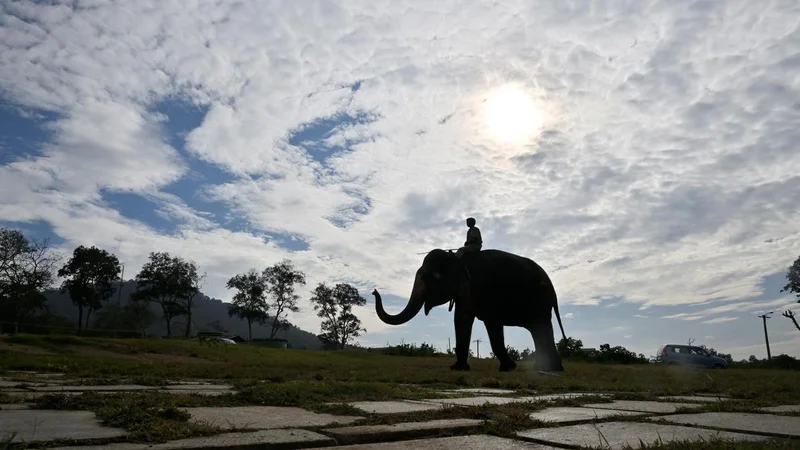
“Long before biodiversity became a science, Indigenous communities knew the forests by heart. They carry generations of knowledge about elephants, grasslands, forests, medicinal plants, wildlife, water and seasons, shaped by centuries of living with nature. Across the world, Indigenous Peoples are guardians of some of the Earth’s most precious ecosystems and its remaining biodiversity. Their deep connection with the land, passed down through generations, offers invaluable lessons in living sustainably with nature. On World Indigenous Peoples’ Day, let us honour their wisdom and resilience, amplify their voices, protect their rights and, above all, learn from them,” tweeted Supriya Sahu, Additional Chief Secretary, Government of Tamil Nadu turning the spotlight on the indigenous communities, the unsung heroes who dedicate a lifetime caring for the animals.
This World Elephant Day, we look at the mahouts (elephant trainers) and cavadies (assistants) from tribal communities who form the backbone of captive elephant care in Tamil Nadu at some of the oldest elephant camps in the country known for working with rescued conflict animals.
Kaatunaickers, Kurumbas, and Malasars: Theppakadu camp
Tucked away amidst the Mudumalai Tiger Reserve (MTR), along the banks of the river Moyar, is the Theppakadu Elephant Camp, one of the oldest camps in Asia that dates back to the 1920s where as many as 27 elephants are rehabilitated. The tribal communities of Kaatunaickers, Kurumbas, and Malasars have been the caretakers for generations. The Oscar-winning documentary The Elephant Whisperers featuring Bomman and Bellie, and their unbreakable bond with Raghu, an orphaned elephant, was filmed at the camp highlighting the bond humans and animals can share. The mahouts are drawn mostly from local tribal communities like Malasars and Irulas. The maintenance of the camp and training of elephants is done as per the traditional knowledge of tribes.
It is the only camp where elephants are trained without using conventional tools like ankush (a stick with a pointed hook). Some of the oldest caretakers like C Mari, a mahout for three decades fondly talks of 65-year-old Kamatchi, captured from Pollachi and elephants named Senthilvadivdu, Cheran, and Bama he took care of for years, like his children.
Forest officials share how the tribal people gained traditional wisdom of elephant behaviour, a combination of science and compassion, handed down generations, in taking care of the elephants. As a retired mahout M Maran from the Nilgiris who oversees the training at the camp, and has worked there for 38 years, puts it, “Once the rescued elephants are placed inside stalls, we offer sugarcane and nurture our bond. We teach a few commands, pat them and treat them with love. They reciprocate.”
Malasars: Kozhikamuthi elephant camp at Anamalai Tiger Reserve (ATR)
“There’s no path we have not trodden in this forest. My ancestors and their elephants have roamed the forests and created the path for us. We blindly follow.” Actor Nasser’s calming, emotion-packed voice speaks for 51-year-old Mani, the caretaker of Kaleem, a 53-year-old elephant. Mani calls Kaleem his older brother. Malasar, a six-minute conservation film, narrated by actor Nasser, available on YouTube shows not just the sacred bond between elephants and the Malasar tribes of the Anamalai Hills but also the need to protect the tribe’s identity and conventional wisdom.
The Malasar tribes give their youth and an entire lifetime caring for the animals. Malasars use as many as 60 commands and the elephants respond to them, but beyond that they share an intricate bond. While their conventional wisdom is irreplaceable, they take care of the largest mammal on earth, day in and out, with a lifetime of dedication.
At Kozhikamuthi, one of the country’s oldest elephant camps, tribal mahouts take care of over 20 elephants. The camp has been upgraded with modern amenities, including an elephant viewing gallery and a visitor walkway. An exclusive Mahout Village houses over 47 mahouts and cavadies (assistants) from the Kozhikamuthi Malasar tribal settlement.
Recognised as one of the earliest known groups living in the Anamalai Hills across Tamil Nadu and Kerala, Malasar community has a deep historical connection to the ATR. British forest authorities recruited Malasars for their exceptional tracking skills, and knowledge of wild elephants to transport heavy timber and clear paths. The community plays an active role in wildlife management, earning national honours such as the Gaj Gaurav Award for elephant conservation.
It is the only camp where elephants are trained without using conventional tools like ankush (a stick with a pointed hook). Some of the oldest caretakers like C Mari, a mahout for three decades fondly talks of 65-year-old Kamatchi, captured from Pollachi and elephants named Senthivadivdu, Cheran, and Bama he took care of for years, like his children.
Forest officials share how the tribals gained traditional wisdom of elephant behaviour, a combination of science and compassion, handed down over generations, in taking care of the elephants. As a retired mahout M Maran from the Nilgiris who oversees the training at the camp, and has worked there for 38 years, puts it, “Once the rescued elephants are placed inside stalls, we offer sugarcane and nurture our bond. We teach a few commands, pat them and treat them with love. They reciprocate.”
Is technology a solution for man-elephant conflict?
Even as the world observed Elephant Day on August 12, a tragedy unfolded on a railway track in the Tamil Nadu side of the Kerala-Tamil Nadu border in the early hours of August 13. An elephant mother and her calf were killed when they were hit by the Mangaluru-Chennai Superfast Express on the Walayar-Palakkad forest stretch. Only in February, another young elephant was run over by the Yesvantpur-Kannur Express, also near Walayar.
Mitigating human-elephant conflict has been among the key priorities of Project Elephant by the Ministry of Environment, Forest and Climate Change. A flagship elephant conservation initiative by the Government of India, it provides the necessary funding and technical backing for various States. In the recent past, the project has been supporting various technology-driven solutions for man-animal conflict. This includes AI-enabled monitoring and early warning systems.
In Coimbatore, for instance, that is constantly in the news for negative human, elephant interactions, AI-based systems that have been installed by railway tracks in the Madukkarai forest range, have proven that elephant deaths can be reduced with technology. However, scientists warn that technology has to be used with proper planning and on-field study.
M Ananda Kumar, scientist, Nature Conservation Foundation points to the August 13 tragedy as a case in point. “Elephant deaths do occur despite these AI systems,” he says. “Technology is just a tool. It has to be used in conjunction with constant monitoring of elephant movement.”
Fencing across forest fragments, for instance, may “deflect elephant movement into roads, leading to more conflict,” he says. Most technology-driven solutions, points out Ananda Kumar, do not consider the elephant’s perspective. Their design takes into consideration only manmade structures and the comfort and everyday lives of people. But what about elephants? “Mitigating human-elephant conflict will be possible only if there is an understanding of both species,” he says.
In a country as vast as India with a varied landscape, a one-stop monitoring system will not work. This calls for solutions tailored to suit every region. He explains that what works in a place like Valparai, with its mosaic of forest fragments, eucalyptus trees, tea plantations, and a river that passes by the landscape, may not work in other places.
In Valparai, according to Ananda, years of planning and implementing alert systems by involving all stakeholders, such as locals, plantation companies and the Forest Department has reduced human-elephant conflict to a bare minimum. “If you ask people there, they would say it is bears and leopards that cause problems and that elephants do not do so,” he says.
Published - August 15, 2026 12:51 am IST