Bitcoin miners ‘stole power worth B280 million’
1,900 mining rigs seized from Samut Sakhon warehouses after unusual consumption detected
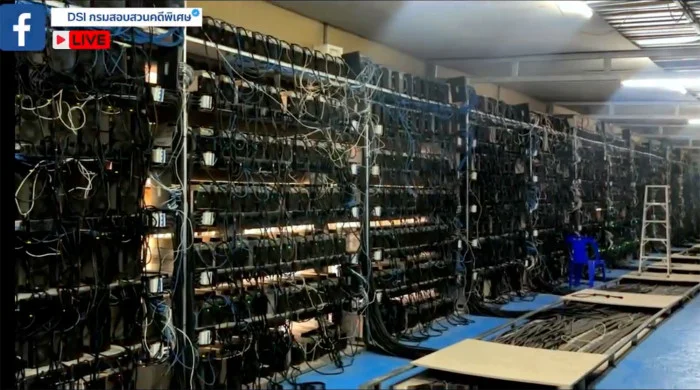
Racks filled with cryptocurrency mining machines are seen inside one of two warehouses in Samut Sakhon found to have illegally tapped electricity to power a bitcoin mining operation. (Screenshots from DSI Facebook page)
The Department of Special Investigation has seized about 1,900 cryptocurrency mining machines after uncovering large-scale electricity theft estimated at 280 million baht linked to illegal bitcoin mining in Samut Sakhon.
Authorities are now searching for the investors and operators of the network, Prime Minister Anutin Charnvirakul said on Thursday at a briefing held to announce the results of Operation Silent Volt, a joint investigation by the DSI and the Provincial Electricity Authority (PEA).
The raids were carried out on Tuesday at seven locations in Samut Sakhon and Nakhon Pathom provinces, including two warehouses suspected of housing mining operations and five homes and offices linked to investors and operators.
Mr Anutin said he had instructed all relevant agencies to work closely together to expand the investigation, prosecute those involved and identify the network’s financiers and organisers.
The Customs Department was also ordered to examine the importing of cryptocurrency mining equipment, including how the machines entered Thailand, how they were declared and their intended purpose.
High-voltage power bypass
The case began with a report from the PEA office in Nakhon Pathom, which had detected unusual electricity consumption patterns at several warehouses, according to Pol Maj Yutthana Praedam, the DSI director-general.
Subsequent investigations found evidence suggesting that the sites had been used for crypto mining for more than a year and that the activities may have been linked to an organised criminal network.
Joint inspections found that electricity had been tapped directly from a 22-kilovolt high-voltage distribution system, bypassing official electricity meters by connecting to the high-voltage side of transformers. (Story continues below)
The DSI and the PEA seized about 1,900 cryptocurrency mining machines from two warehouses in Muang district. Authorities estimate the value of the equipment at 200 million baht, while losses from stolen electricity are believed to exceed 280 million baht.
Investigators also searched five homes and offices connected to individuals involved in the business. Several suspects were identified and a large quantity of documents and other evidence was seized for further examination.
The evidence could lead to additional prosecutions against members of the network and potentially against public servants found to have been involved, Pol Maj Yutthana said.
Electricity bills of just B25,000
PEA governor Mongkol Treekijjanon described the scheme as a serious economic crime with far-reaching consequences.
He said a legitimate bitcoin mining operation using about 2,000 machines would normally generate electricity bills of around 22 million baht per month. However, the premises under investigation reportedly paid only 10,000 to 25,000 baht a month for electricity.
“This has caused substantial economic damage, deprived the state of significant revenue and affected the stability and security of the country’s electricity system,” Mr Mongkol said. (Story continues below)
Prime Minister Anutin Charnvirakul, accompanied by DSI and PEA senior officials, announces the results of Operation Silent Volt at a media briefing on Thursday in Bangkok.
Cryptocurrency mining is an extremely electricity-intensive activity because the billions of calculations involved require huge amounts of computing power. Studies in the US have shown that even highly efficient mining setups would consume about 155,000 kilowatt hours (kWh) of electricity to mine a single bitcoin.
In Thailand, assuming a power tariff of 4 baht per kWh, that works out to 620,000 baht. The average household power bill in Thailand has been estimated at 750 baht a month.