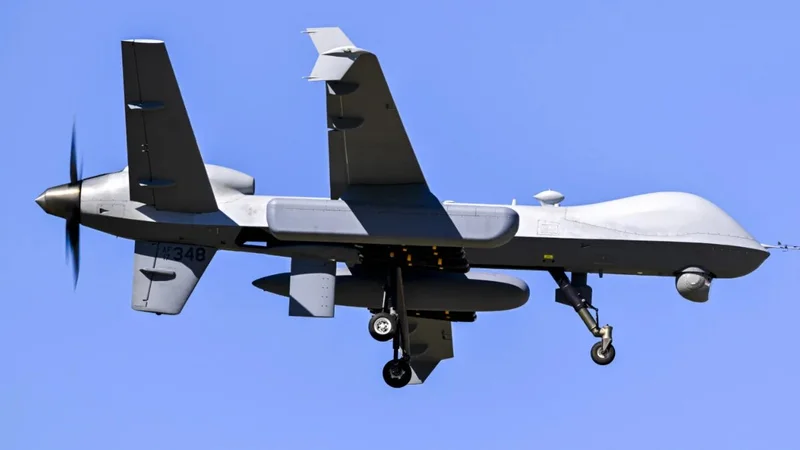
US has lost roughly 25 percent of its Reaper drones in Iran war: Report
The US-Israeli war on Iran has depleted or destroyed more than $1.3bn worth of the US's MQ-9 Reaper drones, roughly translating to 25 percent of the country's pre-war fleet of unmanned aerial vehicles, according to a report by The Washington Post published on Friday.
The report underscores how Iran's air defences have continued to be operational despite claims by President Donald Trump and his aides that they have been obliterated.
The Washington Post story reveals a slightly higher number of MQ-9 Reaper drones destroyed compared to a Bloomberg report published in May, which put the figure at 20 percent of the pre-war inventory.
The MQ-9 Reaper drone is valued between $30m and $50m, depending on its sensor, radar, and ordnance configuration. The unmanned aerial vehicle serves as a high-altitude platform for surveillance, reconnaissance, and targeted precision strikes, as documented by the US Air Force.
It is capable of carrying Hellfire missiles or Joint Direct Attack Munition guided bombs.
The drone flies slowly, at low altitude, making the MQ-9 Reaper a simple target for Iran’s Islamic Revolutionary Guard Corps and its regional allies in Yemen and Iraq.
The aircraft is frequently used near the Strait of Hormuz, where the US and Iran are battling for control.
Trump says he has enforced a “wall of steel” naval blockade on the waterway.
The MQ-9 Reaper is one of a burgeoning list of American weapons and munitions that have experienced stock depletion during the war on Iran.
The Pentagon is phasing out the General Atomics-produced Reaper and foresees a replacement fleet of cheaper armed surveillance drones capable of swarming their targets.
The US has depleted its stockpile of sophisticated standoff munitions.
The US has fired more than 850 Tomahawk cruise missiles and more than 1,000 Patriot and Terminal High Altitude Area Defense missiles.
The Trump administration has denied reports that US weapons stockpiles are facing shortages as a result of the war.
The Trump administration has requested from Congress more than $ 67bn in supplementary funding to address operational costs incurred by the Department of War during Operation Epic Fury and to replenish weapons supplies.
On 6 August, Trump confronted Secretary of War Pete Hegseth at a Cabinet meeting over Washington's critical shortage of munitions, saying that it is one of the reasons behind his administration’s decision to pause large-scale strikes against Iran.