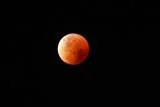
Two weeks after people stepped outside in the middle of the day for the Aug. 12, 2026, solar eclipse, another alignment will bring an eclipse back after dark. Beginning late on Aug. 27, 2026, the moon will spend about three hours and 18 minutes passing through Earth’s darkest shadow during a partial lunar eclipse.
At its peak, the umbra, Earth’s dark central shadow, will cover about 96 percent of the moon’s diameter, according to NASA. Only a narrow rim will remain outside it, while much of the eclipsed surface may take on a rusty copper color.
When to See the August Partial Lunar Eclipse
The Aug. 12 and Aug. 27, 2026, events share an eclipse season, a roughly 34-day window when the moon’s slightly tilted orbit brings it into position for eclipses, according to NASA. On Aug. 12, the new moon passed between Earth and the sun. By Aug. 27, it will reach the full phase on the other side of Earth and enter our planet’s shadow.
The eclipse begins at 8:24 p.m. CT on Aug. 27, when the moon enters the penumbra. The penumbra is the faint outer part of Earth’s shadow, where only some sunlight is blocked. The remaining light makes dimming difficult to notice.
At 9:34 p.m. CT, the moon begins entering the umbra, where Earth blocks direct sunlight. The darkened area grows until 11:13 p.m. CT, when the moon reaches its deepest point inside the shadow. Astronomers call this moment maximum eclipse, according to NASA.
The process then reverses. The moon exits the umbra at 12:52 a.m. CT on Aug. 28, ending the partial phase, and leaves the penumbra at 2:02 a.m. CT, marking the end of the eclipse.
Read More: The 2026 Solar Eclipse Is Just the Beginning — How to Plan for the 2027 'Eclipse of the Century'
Where the Lunar Eclipse Will Be Visible
The eclipse will be visible across much of North and South America and parts of Europe and Africa, according to NASA. Unlike the recent solar eclipse, it does not require observers to stand inside a narrow viewing path.
The moon’s height and the timing of each phase will vary by location. In some western areas, it may be near or below the horizon during the early penumbral stage. The U.S. Naval Observatory’s calculator provides local times, moonrise and moonset information, and the moon’s altitude and direction.
No eclipse glasses or special equipment are required. NASA says a lunar eclipse is safe to watch with the unaided eye, while binoculars or a small telescope can provide a closer view.
The Science Behind the Moon’s Copper Color
Earth blocks most direct sunlight from reaching the eclipsed portion of the moon, but some light passes through the planet’s atmosphere and bends into its shadow. The atmosphere scatters much of the blue and violet light, while more red and orange light reaches the lunar surface, according to NASA. That filtered light is why the moon may appear copper or rusty orange during the eclipse. Dust and clouds in Earth’s atmosphere can influence the exact shade.
The term “Blood Moon” generally refers to a total lunar eclipse, when the entire moon enters Earth’s umbra and appears red or orange, according to NASA. The Aug. 27 eclipse may produce a similar color across much of the moon, but it will not be a Blood Moon because the eclipse never reaches totality.
NASA’s eclipse catalog shows that three penumbral eclipses will follow in 2027, along with two shallower partial eclipses in 2028. The next total lunar eclipse will not arrive until Dec. 31, 2028, making the Aug. 27 event the deepest pass through Earth’s shadow for more than two years.
Read More: Everything You Should Know About Lunar Eclipses
Article Sources
Our writers at Discovermagazine.com use peer-reviewed studies and high-quality sources for our articles, and our editors review for scientific accuracy and editorial standards. Review the sources used below for this article:
- This article references information from NASA: What’s Up: August 2026 Skywatching Tips from NASA
- This article references information from NASA: Partial Lunar Eclipse of 2026 Aug 28
- This article references information from NASA: Eclipse Pair
- This article references information from NASA: The Moon & Eclipses
- This article references information from NASA: March 2026 Total Lunar Eclipse: Your Questions Answered
- This article references information from NASA: Astronomical Applications Department: Lunar Eclipse Computer
- This article references information from the Astronomical Applications Department: Lunar Eclipse Computer
- This article references information from NASA: NASA Eclipse Data