70 pre-schools in S’pore closed each year from 2023 to 2025. What’s driving the closures?
AI generated
SINGAPORE – In November 2025, Pre-School By-The-Park @ Li Hwan told parents it was on the verge of shutting down.
The privately-run centre in Serangoon Gardens had been grappling with falling enrolment and had less than six months to enrol 40 new children to stay open.
Speaking to Insight, its founder Loy Wee Mee said private pre-schools have more leeway to innovate and run their programmes differently. For her centre, she wanted to emphasise connecting with the children.
But this may also mean needing more teachers to support a small teacher-child ratio, and higher costs, she said.
The centre’s experience reflects a changing state of affairs in Singapore’s pre-school sector. After years of expanding capacity and making childcare more affordable, operators are now contending with rising costs, manpower pressures and falling fertility.
For smaller private centres with no government funding and fewer financial buffers, the pressure can be particularly acute. An average of 70 pre-schools in Singapore closed each year between 2023 and 2025, most of them non-government-supported centres.
The Early Childhood Development Agency (ECDA) did not provide the exact figure of pre-schools that closed yearly.
Overall, the total number of pre-school operators fell from 408 in 2023 to 296 in 2026.
In the case of Pre-School By-The-Park @ Li Hwan, a group of concerned parents rallied behind the centre, helping to raise its profile through social media channels and physical banners around the neighbourhood.
“We are not funded, so unfortunately the fees have to be at a rate where it can support operations. Therefore, families have to see the value of this, but we understand that the cost factor does affect many because the price difference is huge,” she said. Monthly fees for the full-day programme are $1,655.
In April, Loy ultimately decided to sell the centre to a pair of parents in the neighbourhood who wanted to keep it going. The centre has since been renamed Wonder Yard Schoolhouse.
Nicole Tai, 33, one of the parents who took over the centre, said: “Coming into this as parents, we were struck by how brutal the economics of running a small, independent pre-school are. In just these few months, we realised how extremely fortunate we are that we managed to save our school at all.”
The centre currently has 23 children enrolled, with five more starting within the year.
“Because this all began as a passion project to save the school, we have more or less accepted our fate to run this like a non-profit,” said Tai, who is running the school full-time and wants to enrol her 10-month-old son there.
Private pre-schools can cost up to two or three times as much as government-supported pre-schools – run by appointed anchor and partner operators – which are subject to a fee cap.
A decade ago, Singapore’s focus was ensuring there were enough places for children, while making early childhood education more affordable and accessible to families.
Today, there are more than 220,000 full-day pre-school places, up from about 135,000 in 2016. The number of licensed pre-schools has also remained relatively stable at around 1,753 as at May, the ECDA said in response to queries. In previous years, the number of pre-schools ranged from 1,885 in 2021 to 1,819 in 2025.
Currently, monthly fee caps for full-day childcare are $610 at anchor operator centres and $650 at partner operator centres, down from $720 and $760 respectively in 2021.
Looking ahead, observers say the challenge may be about keeping centres viable as birth rates fall, matching the supply of places with where children and families are, and determining what quality should look like in a maturing pre-school system.
In 2025, about half of the centres that had ceased operations had been operating at below 40 per cent of their enrolment capacity, said ECDA in response to Insight’s queries.
Most that ceased operations were non-government-supported centres, with the main reasons being a lack of operational viability and non-renewal of leases, the agency said.
ECDA chief executive Ku Geok Boon said smaller operators feel the impact of operational challenges more acutely, adding that some recorded cessations represent mergers, where two operations come together.
Government-supported pre-schools also rationalise centres to ensure long-term viability, she said during a July interview with Insight.
Ku said that operators, whether large or small, face business pressures like manpower challenges, rising costs and rentals, and changing business priorities.
“These then drive how some pre-schools may close, restructure, or even merge for greater economies of scale,” she said.
In a parliamentary reply in February, the Ministry of Social and Family Development said an average of 26 pre-schools per year failed to give at least six months’ notice before ceasing operations in the past five years.
A more coordinated system
The sector was considerably more fragmented before the current system took shape, said Sum Chee Wah, head of the early childhood programme at the Singapore University of Social Sciences (SUSS) and former head of pre-school education at the Ministry of Education.
In the past, communities were underserved, with insufficient places, especially for infant care.
Now, central planning has helped ensure there are enough places for children from two months to six years.
The total number of pre-school places grew from 181,000 in 2019 to 223,000 in 2023. Total enrolment rose from 133,000 to 168,000 over the same period.
The Early Childhood Development Centres (ECDC) Act passed in 2017 was significant, said ECDA’s Ku, because it brought pre-school centres under a common regulatory framework and gave ECDA oversight of both kindergartens and childcare centres.
It laid the standards the sector is expected to work towards, Ku said. She noted that the sector has in the past decade grown rapidly, with affordability, accessibility, and quality being the three broad goals.
Government-supported operator schemes that started in 2014 and 2015 were central to these efforts.
A total of 380 pre-school centres run by 33 operators have been appointed to a five-year partner operator term starting from January 2026. This is an increase of 49 centres from the previous term.
Ku said that fees at some government-supported pre-schools can now be as low as $3 for lower-income families. A family with a monthly household income of $10,000 pays about $235 a month for full-day childcare at an anchor operator after subsidies, roughly half of the 2019 fee.
From 2027, another 60,000 lower- and middle-income families will benefit from higher subsidies when subsidy tiers are revised.
Fresh challenges
Director of Adventure Tree Preschool Morgane Tomassone said finding and retaining manpower is a key challenge.
“As a private operator, it’s difficult to match the salaries offered by government-supported centres, so instead we focus on offering our staff better work-life balance as a way to remain competitive and attract talent.”
Rentals are another major pressure, she added. “Our rental costs have risen by around 30 to 35 per cent over the past five years, which has been quite significant for a centre of our size.”
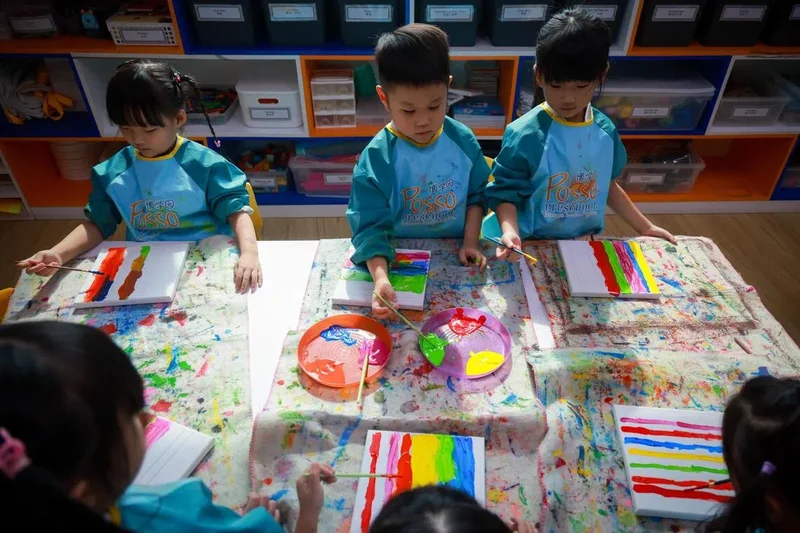
Director of business development for Posso Preschool Jaime Tan said operators also have to consider shifting demographics.
The number of babies born in 2025 fell to the lowest since Singapore’s independence, with a total of 29,864 babies born. The resident Total Fertility Rate declined to 0.87.
Tan said with smaller cohorts of children and more pre-school places, operators have to think further ahead when making investment decisions, like deciding where to open centres.
“Rather than asking whether there is demand today, we increasingly have to ask whether there will still be sufficient demand five, ten or even 15 years into a lease.”
“That means analysing neighbourhood demographics, future housing developments, competing pre-school capacity and long-term sustainability before entering a certain locality,” he added.
Posso divested one centre several years ago after determining its educational model was not the best fit for families in that area, he said.
Lim Tien Hock, chief executive of anchor operator E-Bridge Pre-School, said that while Singapore may have enough places overall, localised matching remains a key task.
About half of E-Bridge’s 31 centres are located in the north-east, including Punggol and Tampines. Its more recent expansion has moved further west into Build-To-Order (BTO) areas like Tengah.
Jonathan Goh, director for finance, governance and business development from Anglican Preschool Services (APS), said national birth-rate trends do not affect every community in the same way. APS operates 18 Little Seeds Preschool centres in Singapore.
Mature estates experience ageing populations and fewer young children, while new housing developments attract young families, he said. Hence, APS focuses on local catchment demographics rather than national figures alone when deciding whether to expand, consolidate or close centres.
Ku said ECDA plans pre-school capacity alongside agencies like the Ministry of National Development, Singapore Land Authority, and the Housing Board ahead of new BTO housing developments.
ECDA “maintains diversity” among anchor operators in each planning area, rather than allowing a single operator to dominate an estate, she added. Anchor operators are allocated centres, whereas partner operators and private operators decide for themselves where to open centres.
Bigger centres, and consolidation
In more recent years, pre-schools have generally grown larger.
Between 2021 and May 2026, the number of smaller centres with a capacity of 100 or fewer children fell from 877 to 692, while centres licensed for 251 or more children grew from 103 to 152.
Combining resources can ease some of the acute pressures faced by smaller operators when enrolment fluctuates, said observers.
Cheong Su Fen, founder of pre-school consultancy social enterprise Preschool Market, noted that these operators face high operating costs, compliance requirements, and recruitment hurdles, without the resources of larger organisations.
Chief executive of APS Sng Yee Kia said mandatory operational baselines, such as requiring one principal per centre regardless of size, financially disadvantage smaller centres.
Goh, also from APS, added that based on operational experience across 18 centres, a capacity of at least 100 children generally offers a good balance between educational quality and financial sustainability.
For APS, consolidation was an intentional strategy.
Formed in 2015 to bring church-based pre-schools under a common platform, APS consolidated its centres under the Little Seeds Preschool brand. This allowed it to share resources, strengthen operations and convert kindergartens into childcare centres to serve dual-income families.
Its 18 centres vary in size, from about 70 to nearly 300 places – a reflection of the different communities and facilities they operate in.
Larger centres benefit from economies of scale, offer more operational flexibility and can invest in specialised learning facilities and programmes. Smaller centres have a close-knit environment with familiarity and personalised attention that parents strongly value, said Goh.
Jane Choy, head of operations at M.Y World Preschool, said gradual consolidation reflects broader economic realities. She noted that larger organisations can spread investments across multiple centres, build dedicated support functions, and tap economies of scale.
Some centres are choosing to remain small. One of them is private operator Adventure Tree Preschool, which stated that it has intentionally chosen not to become a mega centre.
It deliberately capped the number of children for each centre at 75 to maintain a lower teacher-to-child ratio than required by ECDA, which ranges from 1:5 in infant care to 1:25 at Kindergarten 2.
Looking ahead, with quality in mind
Raising quality is top of mind for ECDA, which hopes to further improve the quality of providers and programmes, the skills of educators, and partnerships between parents and pre-schools.
“Thirteen years ago, the challenge we had was building a strong pre-school system. I think today the aspiration is how we continue to raise quality while ensuring every family can benefit from it,” Ku said. She added that ECDA is using tools like Spark 2.0, a quality assurance framework, to encourage pre-schools to take ownership of quality and continuously improve.
Geraldine See, chief executive of the National Institute of Early Childhood Development, said educators are central to this effort. As their roles become more complex, they need time, support, leadership, and opportunities to grow professionally.
Three in four pre-school educators today hold at least a diploma in early childhood education, while one in three holds a bachelor’s degree or higher, according to ECDA data.
Salaries for educators and leaders in Anchor Operator and Partner Operator centres have also risen by at least 26 per cent on average since salary enhancements were announced in 2022.
But experts said sustaining quality will be difficult if workforce pressures are not addressed.
SUSS’ Sum said teacher burnout and attrition are the most pressing issues facing the sector.
Ensuring centres have enough staff so teachers can take proper lunch breaks and at least an hour of non-contact time each day is important, she said. This gives teachers time to prepare lessons and can help prevent burnout and staff turnover.
Christine Chen, founder president of the Association for Child Care Educators, said raising quality also means giving teachers greater trust and autonomy in how they teach.
“I think our teachers need to feel that they can be trusted to give the best to the children and their families... This is a profession of the heart but also of the mind that is determined to go the extra mile.”