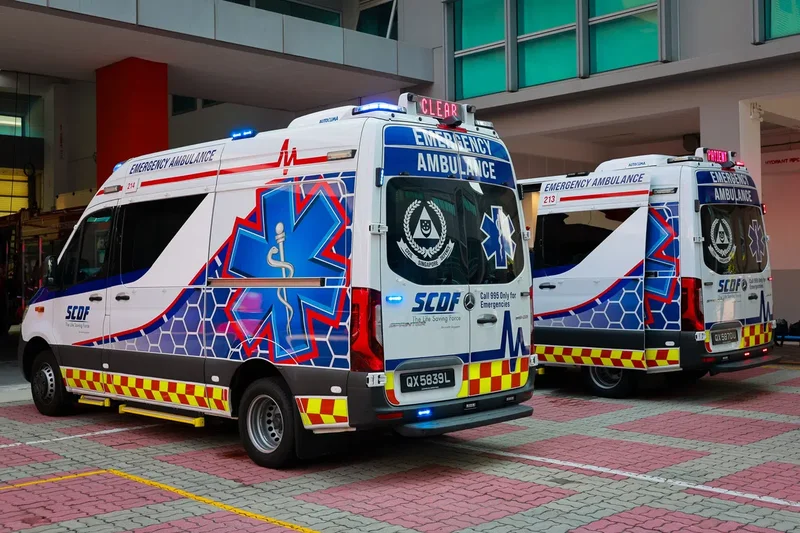
New SCDF ambulance equipped to carry up to two patients; enhanced safety features for occupants
AI generated
SINGAPORE – Emergency services in Singapore will now be more efficient, as a new batch of Singapore Civil Defence Force (SCDF) ambulances can now take two patients instead of one.
The enhanced seventh-generation (Gen 7E) ambulances are the same size as their predecessor model, but their interior has been redesigned and comes with a slew of improved fittings to enhance road safety and allow paramedics to deliver medical care more efficiently.
Since July 9, five Gen 7E ambulances have been operationalised across Singapore and are part of SCDF’s operational fleet of 108 ambulances.
More units will be gradually deployed to replace the sixth-generation ambulance fleet in the coming years, said SCDF.
To keep injured patients stable while en route to a hospital, the Gen 7E ambulance’s patient cabin is equipped with an air suspension system.
The new ambulance’s stretcher platform also has an air suspension system to minimise road vibration, which is critical for transporting patients with spinal injuries or those undergoing chest compressions.
SCDF said the new ambulance was developed based on feedback from paramedics and emergency medical technicians.
It has an improved pulley mechanism on its stretcher loading system, reducing the amount of force the ambulance crew has to use when moving patients in and out of the ambulance.
Other improvements include the installation of side-facing bench seats for paramedics to attend directly to patients while they are seated.
The seats are equipped with high-mobility seatbelts that allow paramedics to lean forward to reach patients without unbuckling themselves.
Frequently used medical equipment and supplies – such as intravenous drips, and gauze and sterile pads – are also kept within reach of the seated paramedic.
Other medical equipment is now safely and securely stored in an overhead safety cabinet, inspired by those in aircraft cabins.
To keep the interior sterile, the new ambulance has a four-tier decontamination system for infection control.
Its air-conditioning ventilation system has photocatalytic oxidation air purification, which disinfects the vehicle throughout the journey.
If needed, paramedics can turn on the antibacterial blue-light system for increased disinfection.
When unoccupied, an in-built system sprays a mist of disinfectant, and an ultraviolet disinfection system can be used to further clean the vehicle.
In the driver’s cabin, the Gen 7E ambulance has driver safety features such as a driver alert system, height sensor, and 360-degree exterior camera.
These improvements are meant to provide greater situational awareness for the driver.
On its exterior, the new ambulance has reflective decals with higher visibility and cover all around the vehicle, compared with those on the older vehicles.
A high-visibility LED display built into the rear of the vehicle alerts motorists if there is a critical patient onboard, or if resuscitation is in progress.
The LED display can also be used to redirect traffic when the ambulance is parked at an incident site.
David Pflug, who is the chief medical officer of SCDF’s emergency medical services department, said: “The Gen 7E sets a new benchmark for pre-hospital care and ambulance crew and patient safety. It empowers our paramedics to perform life-saving resuscitations while remaining safely restrained, ensuring that the highest standards of pre-hospital care are provided throughout the conveyance.
“With the addition of continuous infection control, the Gen 7E also provides a safer environment for both our patients and our emergency responders.”
Emergency calls
The number of emergency medical services (EMS) calls increased from 245,279 in 2024 to 257,158 in 2025, according to SCDF’s annual statistics report released on Feb 11.
Nearly half (49.7 per cent) of these calls involved seniors aged 65 and above.
SCDF said it expects the number of emergency calls to go up in the next five years because of an increase in demand from an ageing population.
In 2026, Singapore is expected to become a super-aged society, where at least 21 per cent of the population is aged 65 or older.
Of the total number of EMS calls, 11,064 were non-emergency calls and 6,239 were false alarms.
Among the 239,855 emergency calls, 188,474 were medical-related, including ailments such as chest pain, breathlessness, unconsciousness and cardiac arrest.
Calls involving road traffic accidents increased from 9,564 calls in 2024 to 10,737 calls in 2025, an average of 29 calls daily.