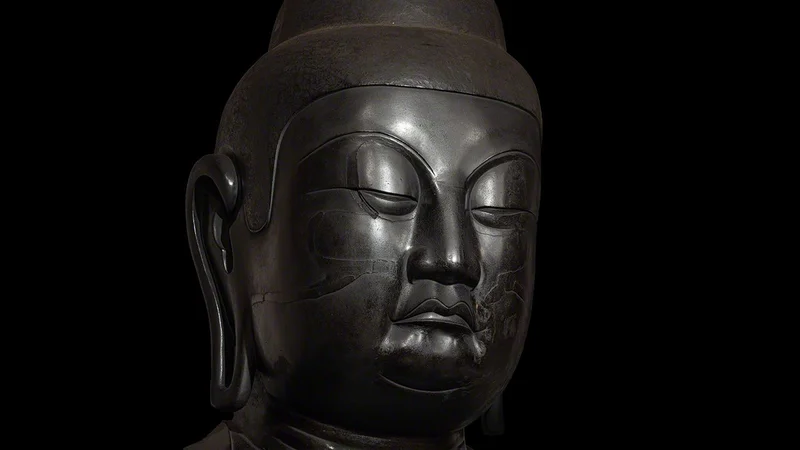
Seated Statue of the Shakyamuni Buddha, Kanimanji, Kyoto Prefecture
Culture History Art Guide to JapanWith its taut cheeks, slender eyes, and somewhat stern expression, this striking statue makes an immediate impression, its mouth drawn tightly into a firm, almost severe line. This seated image of the Shakyamuni Buddha is the principal image enshrined at the temple Kanimanji in Kizugawa, in the southern part of Kyoto Prefecture.
Although the statue now has the dark, lustrous appearance of bare bronze, it was originally a gilded bronze image, its surface covered in gold leaf. Some legendary tellings say the Buddha himself was 4.8 meters tall, and images created on this scale are known as jōroku-butsu, or “one-jō-six-shaku Buddhas.” Seated statues, like this one, were created at only half the height of standing images. Dating from the seventh and eighth centuries CE, relatively soon after the introduction of Buddhism to Japan, these early monumental gilt bronze Buddhas are now extremely rare. Only four survive today: the Asuka “Great Buddha” at Asukadera (important cultural property), the bronze Buddha head at Kōfukuji (national treasure), the seated Yakushi Nyorai at Yakushiji (national treasure), and this image of Shakyamuni at Kanimanji.
According to one theory, this image was once the principal object of worship at the temple Kokubunji in Yamashiro Province (present-day southern Kyoto Prefecture). Built as part of the imperial government’s nationwide promotion of Buddhism in the eighth century, the Kokubunji temples (one in each province) were established in the hope that the power of Buddhist teachings would bring protection and stability to the realm. The severe yet compassionate expression of this image seems to embody that prayer, expressing the hope that it would help to appease the forces that brought calamity and ensure enduring peace.
The thin robes cling close to the well-proportioned body, creating graceful, flowing lines. This treatment of the drapery (emon) closely resembles that of the seated figure of Yakushi Nyorai at Yakushiji, suggesting that a relationship of some kind may exist between the two pieces.
Unlike Nara’s Yakushiji, however, which was founded near the heart of the ancient capital on the orders of Emperor Tenmu, Kanimanji was located far from the capital, and it is unclear why a monumental jōroku Buddha should have been placed in such a relatively remote location. Differences can also be seen in the casting techniques used. Whereas the Yakushiji statue weighs in at nearly five tons, the image of the Shaka Buddha at Kanimanji weighs just under half as much (a mere 2,172 kilograms) and seems to have been cast with considerably thinner bronze.
Kanimanji is also famous as the setting for a famous legend about a crab that is saved by a kind young woman and later repays the favor when she is about to be forced into marriage with a giant serpent, joining forces with the bodhisattva Kannon (Avalokiteśvara) to defeat the monster. Given the temple’s close associations with Kannon, it seems likely that the main image enshrined here would originally have been an image of the bodhisattva, and a persuasive theory holds that the current statue of the Shaka Buddha was moved here at some stage from another temple.
However, during excavations carried out in 1990 ahead of renovations to the main hall, the remains of a giant temple and monastery dating from the Hakuhō period (the latter part of the Asuka period, 592–710) were discovered, giving rise to a theory that this image of Shakyamuni had in fact been here since the temple was founded. From the style of the sculpture, it is likely that the image dates from a period between the late seventh and the middle of the eighth century, although experts disagree about where to place it within this period. Many mysteries surrounding this sculpture remain to be solved.
Photographer Muda Tomohiro remembers that the shoot began while it was still light outside. Sunlight streaming through various openings in the doors and walls struck the bronze statue, while shadows from ritual implements and offerings around it caused further headaches for him. As he moved around the space trying to solve the problem, covering the windows with black cloth and repeatedly changing the camera angle, he suddenly noticed the numerous scratches and marks that covered the face and torso of the statue.
“I don’t know whether they were caused by the relatively primitive casting techniques at the time the image was made, or were left by damage from fires or other disasters later on. But as I photographed the image, they started to look not like painful scars but more like accents that added to the beauty and character of the image. I felt that the faith and affection of the many people who had protected this Buddha image over the centuries had somehow left traces on the image itself, and I said a silent prayer in my heart as I continued to press the shutter.”
Seated Statue of the Shakyamuni Buddha
- Height: 2.4 meters
- Date: Late Asuka–early Heian period (seventh–eighth century)
- Kanimanji, Kyoto Prefecture
- National treasure
(Originally published in Japanese. Banner photo: Seated image of the Shakyamuni Buddha, Kanimanji. © Muda Tomohiro.)