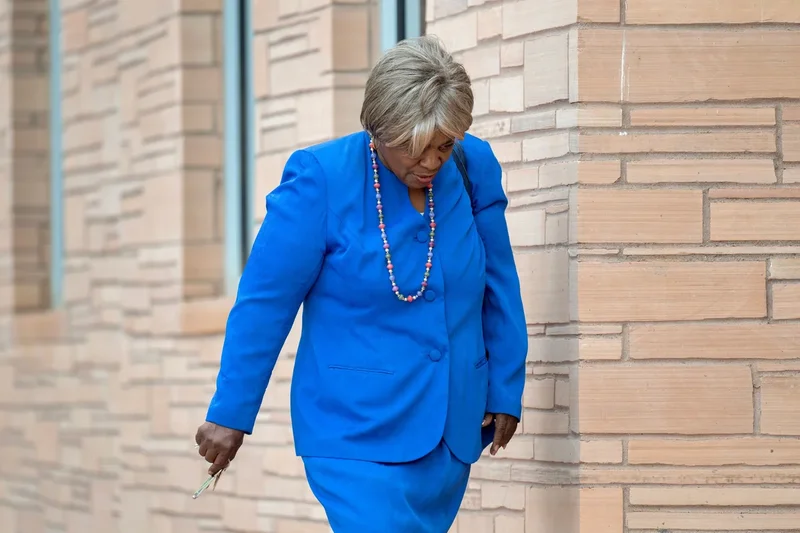
A prominent former Democratic lawmaker in New Mexico has been found guilty on dozens of federal counts after carrying out an extended kickback scheme that siphoned public education funds into a business owned by her friend.
The guilty verdict was returned by a jury on Friday, concluding a trial that featured testimony from investigators, tax specialists, and former associates of Sheryl Williams Stapleton.
Williams Stapleton chose not to take the stand and now faces up to 20 years in federal prison when she is sentenced.
Defense counsel indicated that all options were under consideration, including an appeal.
"We're obviously very disappointed with respect to the verdict rendered by the jury," defense attorney Ahmad Assed told The Associated Press via a text message. "Based on the evidence we put forward, we were hopeful for a different outcome."
In March 2024, a grand jury indicted the 69-year-old Williams Stapleton on more than three dozen counts, including mail fraud, bribery, money laundering, and conspiracy to defraud the federal government.
Those federal convictions follow separate charges brought in 2021 by state prosecutors, including money laundering and racketeering, with a state trial scheduled for October.
Williams Stapleton served as a state House majority leader and held an administrative role within Albuquerque Public Schools, the state's largest school district, after first winning election in 1994.
She stepped down from the state House two days after law enforcement officers executed search warrants at her home in mid-2021, and she was subsequently fired by Albuquerque Public Schools.
According to prosecutors, the school district funneled upwards of $3 million to Robotics Management Learning Systems LLC, a Washington, D.C.-based firm central to both the state and federal proceedings. The majority of that funding derived from federal grants intended for vocational education programs.
In her role as the school district's director of career and technical education, Williams Stapleton ensured that funding designated for those programs was directed to Robotics, which was owned by her friend and co-defendant, Joseph Johnson.
Prosecutors demonstrated that Williams Stapleton steered the firm's invoices through the procurement process. Meanwhile, Johnson supplied blank checks to Williams Stapleton, who wrote roughly 230 checks totaling $1,152,506 "for her own benefit," according to the indictment.
During testimony on Tuesday, Johnson maintained that he was unaware Williams Stapleton had withdrawn over $1 million from his company's bank account between 2013 and 2020. He explained that he lost focus on his business after his son was killed in a car crash in 2016.
Johnson told the jury that he relied on an office manager, claiming she was the person who mailed the blank checks to Williams Stapleton. Johnson was ultimately convicted on parallel charges to Williams Stapleton, including bribery and money laundering.
Williams Stapleton’s attorney, Ryan Villa, argued to jurors that while his client stole money directly from Johnson's enterprise, she did not steal money from state or federal taxpayers as alleged by federal prosecutors.
Evidence introduced by the government also revealed that neither Williams Stapleton nor Johnson reported thousands of dollars in payments from Robotics on their federal income tax returns.
At the start of the trial, Assistant U.S. Attorney Fred Federici highlighted that roughly 73% of the more than $3 million received by the company from the school district and federal vocational funds constituted profit. He stated that the co-defendants split those funds for their personal use.
Inquiries revealed that the bulk of the funds in the Robotics checking account originated from federal education money awarded through contracts with the school district. Prosecutors also displayed video from a surveillance stakeout of the company's post office box in Albuquerque, which caught Williams Stapleton checking mail for the firm.