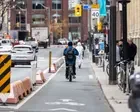
The Ontario government is now free to rip out Toronto’s bike lanes on its busiest streets after the region’s top court ruled in favour of the province on Friday, overturning a lower court’s decision that decreed removing the lanes would violate constitutional rights.
The win is significant for Ontario’s premier, Doug Ford, and his government, who have long railed against Toronto’s bike lanes, blaming the protected zones as the cause of the city’s traffic ills.
In 2024, the Ford government passed legislation that would allow Ontario to axe Toronto’s lanes, despite the recent installation of the infrastructure by the municipality.
But the effort to tear up the lanes covering 19 kilometres of road was paused after cycling advocacy organisations levelled a legal challenge against the province.
Their challenge was supported in July 2025, when a superior court judge ruled removing the lanes was unconstitutional, as it would create a heightened risk of death or injury, in turn violating the right to life and security of the person. Those rights are protected under Canada’s Charter of Rights and Freedoms.
Friday’s decision from the Ontario court of appeal reverses that ruling. Michael Longfield, executive director of Cycle Toronto, one of the groups that launched the legal challenge, said he’s disappointed in the decision.
“This isn’t just about keeping people on bikes safe. It helps pedestrians. It helps other drivers. It has a very strong traffic calming effect that we need in major cities,” he said.
The court of appeal judges in their decision wrote that there is no charter right to bike lanes and the government is free to change legislation on the lanes if it wishes. They explained that courts cannot find legislation unconstitutional because experts predict the government’s policies will fail.
“Neither the government nor the legislature is under any obligation to accept policy advice,” wrote Justice Huscroft in the decision.
In reaction to the ruling, Toronto’s mayor, Olivia Chow, said she has been working with the province to negotiate a path forward “that keeps every road user safe”. There’s hope the municipality will negotiate an alternative with the Ford government that still makes room for cyclists, said Longfield.
Ontario’s transportation minister, Prabmeet Sarkaria, said in a statement the top court’s decision is a “victory for common sense”. The government has not yet announced when or if they plan to remove the lanes.
It was estimated by a city report in 2024 that ripping up the lanes would cost taxpayers an additional C$48m (£26m). Internal briefings obtained by the Trillium also found the province’s own staff reported that bike lane removal would not reduce congestion and could make it worse. Those staff members also warned Ontario may be seen as encroaching on municipal decision-making.
Fundamentally, Ford targeting bike lanes is a gross overreach of the provincial government into city affairs, said Longfield. It’s “frankly ridiculous”, he said, to believe the key to solving urban congestion is barring bike lanes.
“The more we can focus on real, evidence-based solutions … the better it will be,” he said.