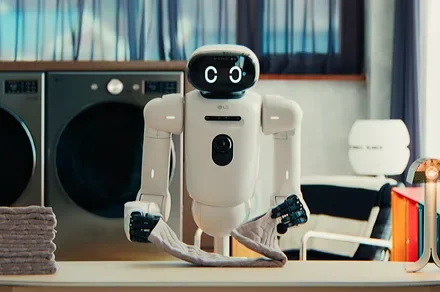
With time, more and more legacy hardware companies seem to be racing to bolt a humanoid robot onto their roadmap. The latest entrant is LG, joining the race with tentative timelines.
The company’s bipedal humanoid, built on Nvidia’s robotics stack, is planned for early 2027, and it’s backed by a broader push into AI factories and self-driving vehicle platforms.
What exactly is LG building with Nvidia?
Earlier this week, LG and Nvidia signed a memorandum of understanding at Nvidia’s Santa Clara headquarters. LG Corp chairman Kwang Mo Koo and Nvidia CEO Jensen Huang were both in the room.
The centerpiece is a bipedal humanoid robot LG plans to reveal publicly in early 2027, timed for CES 2027. From what we know, it runs on Nvidia’s Jetson Thor chip, which powers reasoning, and the Isaac GR00T foundation model for processing. Nvidia’s Halos safety system, billed as the industry’s first full-stack safety framework built for robots, is also onboard.
To make the robots, LG is sourcing actuators, sensors, and batteries from its own Electronics, Innotek, and Energy Solution divisions, which should be both convenient and economical.
However, LG isn’t waiting until 2027 to start real-world testing. This year, the company is deploying its wheel-based robot, LG CLOiD (the home robot showcased earlier this year), as a factory trial. To feed the machines a massive amount of training data, the partnership also includes building a “robot data factory” powered by LG CNS’s PhysicalWorks platform.
What about the AI factories and self-driving push?
Beyond robots, LG is building two factories in the next two years. These include an AI factory reference site on Nvidia’s Vera Rubin platform by mid-2027. It will be followed by an 80-megawatt LG AI Factory in Cheonan, South Korea, by mid-2028.
To me, the goal sounds less like an internal priorities shift and more like an upcoming product that the company could package and sell to other tech giants.
Nvidia’s Halos safety framework is the detail worth watching here, since humanoid robots sharing floor space with human workers have been the industry’s biggest liability question for years.