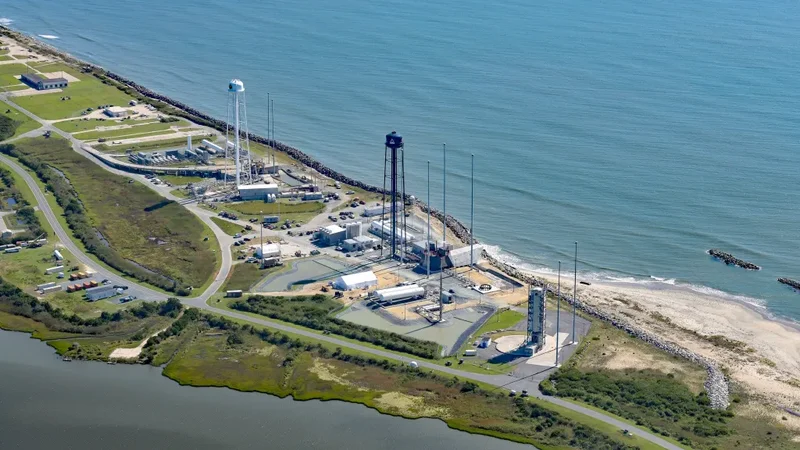
SALISBURY, Md. — With a projected surge in launches from Wallops Island, Virginia, in the coming years, companies and local officials say now is the time to invest in infrastructure improvements to benefit those companies and their workers.
A theme of discussions during an industry day for NASA’s Wallops Flight Facility on Aug. 12 was the expectation that the number of launches from Wallops will grow significantly in the next few years as companies such as Firefly Aerospace and Rocket Lab ramp up operations there.
“If we all get our way, we’re going to be going from a couple of orbital launches out of here a year to maybe one a week,” said Coleman McCord, director of launch site development at Firefly Aerospace. The company plans to launch both its small Alpha rocket and medium-class Eclipse vehicle from Wallops starting as soon as 2027.
A report by NASA’s Office of Inspector General in June predicted that the number of launches from Wallops, including those from pads owned by the Virginia Spaceport Authority, would grow from 17 in 2025 to 44 in 2030. That includes suborbital launches of sounding rockets and Rocket Lab’s HASTE, a suborbital version of its Electron small launch vehicle.
The report said Wallops did not face the same infrastructure challenges as the Kennedy Space Center, where even higher launch rates have strained infrastructure at the center and neighboring Cape Canaveral Space Force Station, affecting roads, power grids and access to consumables such as propellants.
The congestion at Cape Canaveral was one reason Firefly and Rocket Lab chose to launch from Wallops. “The Cape right now has a capacity problem,” McCord said, comparing it to a “sole supplier” that can constrain industry.
However, he said the company saw Wallops as more than just a “relief valve” for Cape Canaveral. “We want to stop talking about Wallops as the other East Coast launch site,” he said. “Wallops is an East Coast launch site, and if you look back at where the Cape was 20 years ago, you’d see a lot of similar conversations and parallels to what we’re seeing today.”
“Wallops does have the can-do attitude,” said Scott Bissett, deputy program director for the MACH-TB 2.0 hypersonics program at Kratos Defense and Security, which has conducted test launches at Wallops. The site is ideal for those tests, he said. “Wallops has been doing that for decades, so they’re very used to that cadence and mentality.”
An increase in launches will put pressure on Wallops. That goes beyond launch pads and range assets, said McCord, extending to “roads and commodes,” or site infrastructure. “How do I get my product from point A to point B? How do I do wastewater treatment? How do I make sure I have redundant power?”
Wallops is working to prepare for higher launch rates, said David Pierce, director of the Wallops Flight Facility, in an interview. That included “Lean Six Sigma” exercises with Rocket Lab to increase the efficiency of range operations. “That helped us drive down our cost by a factor of two in support of Rocket Lab.”
One issue with Wallops operations is that many of the launch pads are located very close together. “We don’t have miles between pads. We have feet,” he said, putting greater emphasis on efficient scheduling of launch operations. “We’re looking at all those kinds of things to be able to up our cadence.”
A recent agency restructuring put Wallops launch operations under the authority of the Kennedy Space Center rather than the Goddard Space Flight Center. Pierce said while that new relationship is just starting up, it holds promise for helping Wallops increase its flight rate.
“It’s going to really enable us to maximize utilization of our assets, and that’s what we’re really excited about,” he said. “We’re going to have unified leadership that’s focused on launch from Kennedy and is going to help us focus on doing what we do best.”
Improving social infrastructure
That projected increase in launch activity has implications beyond the boundaries of the facility. Company executives and local officials said the wider Eastern Shore region needs more amenities to support a growing workforce and its families.
“Housing and community amenities are the current bottleneck,” said Weston Young, chief administrative officer of Worcester County, Maryland, calling it “social infrastructure” that needs to be addressed as Wallops grows.
“If we’re trying to expand or retain the Wallops workforce, we need everything from child care to dry cleaners,” he said, as well as expanded health care services and “maybe eventually something like a Trader Joe’s or a Whole Foods to attract that certain crowd.”
“Wicomico County is facing the same thing: Can we bring families here? Can we retain them?” said Julie Giordano, county executive of Wicomico County, Maryland, which is home to the region’s largest city, Salisbury.
She and others emphasized the need for improved transportation in the region to link Wallops with ports and airports. “We need to maintain our roads to keep Wallops in business,” said Bryant Owens, chair of the Crisfield-Somerset County Airport Advisory Board in southern Maryland. “One of the biggest things with the infrastructure is all the traffic Wallops has going in and out.”
Firefly’s McCord said that also includes simply having enough hotel rooms for those visiting Wallops and restaurants that can accommodate teams working late shifts. “What I need today that I don’t have is a place to go get dinner at 3 a.m. because I just got off a late shift supporting a launch campaign,” he said.
Those efforts require coordination among several local and county governments in both Virginia, where Wallops is based, and Maryland, where much of its workforce lives. “We try to straddle the state lines,” Pierce said. “What we were always trying to do here is raise the level of advocacy and help build an aerospace ecosystem. Those six or seven miles from the facility to the border of Maryland shouldn’t matter.”
McCord said the workforce was a key factor in the company’s decision to launch from Wallops. “Everyone is trying to get to that end goal of getting more things to space,” he said.
“It’s not our idea that Wallops should be the little brother of Cape Canaveral,” he concluded. “The intent is to make it just as capable and, maybe one day, more so.”