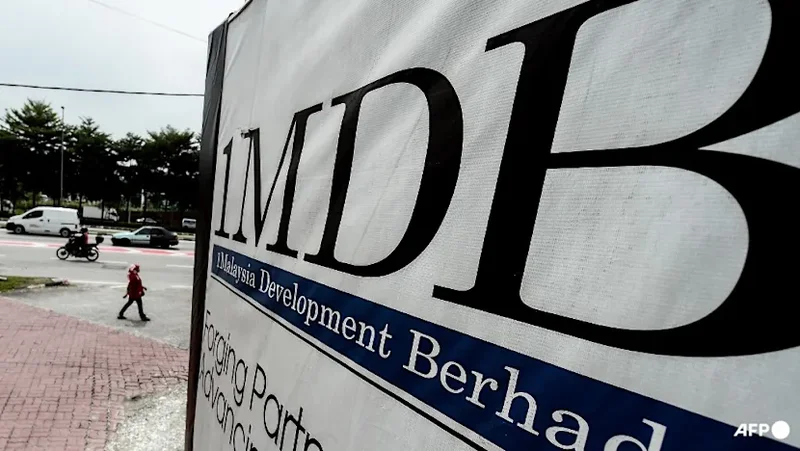
Commentary: Has Malaysia exorcised the 1MDB ghost? The markets say yes but that’s only half the story
A successful US$1.5 billion global sukuk is being read as proof that Malaysia has outrun the 1MDB scandal. But that is only half the story – and the less important half, writes CNA’s Leslie Lopez.
KUALA LUMPUR: For more than a decade, the 1Malaysia Development Berhad (1MDB) fiasco saddled the country with higher borrowing costs in international debt markets and scarred its reputation as an investment destination.
Now, that cost premium appears to have been erased.
For bond markets, 1MDB is now just a footnote, no longer a deterrent.
In late July, Malaysia priced a US$1.5 billion global sukuk at record-tight spreads over US Treasury yields. The issue, oversubscribed by 4.7 times by more than 140 global investors, carried A-grade ratings by Moody’s and S&P Global. A sukuk is a Shariah-compliant investment certificate that serves as an alternative to a conventional bond. Unlike traditional bonds, which pay interest, sukuk generate returns from income earned by underlying assets or projects.
But that is only half the story – the less important half.
The credit verdict is not an institutional verdict.
Markets price what they can see: debt ratios, growth forecast and fiscal discipline, among others. They don’t take into account what they can’t: whether the institutional and oversight failures that allowed the 1MDB scandal to develop have been addressed
The question today is not whether institutional investors trust Malaysia again. They clearly do. The government has paid RM42.5 billion (US$10.4 billion) of 1MDB’s RM51.4 billion in debts and commitments. Asset recovery efforts are ongoing with the Malaysian authorities working closely with international agencies, including the United States’ Department of Justice.
It is these milestones that credit markets have decided to reward.
But when markets stop pricing risk, political pressure to fix what is broken can diminish.
1MDB was not merely a corruption scandal of international dimensions. It was a stress test on Malaysia’s institutional architecture – and the architecture failed.
The urgent question is whether the system that incubated 1MDB has been rebuilt to make sure a sequel does not happen. Here, the record is mixed at best.
Malaysia still lacks a comprehensive political financing law governing party and political donations and requiring systematic disclosure of their sources. Concerns also remain over the independence of regulators from political influence.
SEMINAL MOMENT
To be sure, Malaysia’s return to the international bond markets represents a seminal moment for the country.
Second Finance Minister Amir Hamzah Azizan, who led the Malaysian road show for the bond issue, framed the Jul 23 US$1.5 billion bond issue as a vote of confidence in “Malaysia’s economic prospects and policy credibility".
The bond issue also cements Malaysia’s leadership in the Islamic sukuk market. The country accounts for roughly 35 per cent of outstanding global sukuk bonds issued.
The most recent issue signals that confidence in the country’s Islamic finance ecosystem has remained strong, and credit must go to the administration of Prime Minister Anwar Ibrahim, who is also finance minister.
Central to his rehabilitation of the economy is the Public Finance and Fiscal Responsibility Act (FRA), which was enacted in November 2023 and became effective in January 2024. The legislation essentially imposed binding targets on fiscal deficit, debt and development expenditures.
The results are visible. The deficit is projected to narrow from 4.1 per cent in 2024 to 3.5 per cent in 2026. Mr Anwar has also reformed subsidies, through the painful rationalisation of financial assistance in fuel and electricity tariffs, while directing savings into cash transfers for lower-income households.
As a result, the economy has outperformed. Gross domestic product grew at 5.4 per cent in the first quarter of this year and 5.8 per cent in the second quarter, compared to 4.9 per cent for the full year of 2025.
But fiscal discipline is not structural reform, and Malaysia’s clawback to full market respectability is not complete.
WHAT MORE NEEDS TO BE DONE
The lack of structural reforms has other serious pitfalls. Fiscal discipline can easily dissipate quickly with a leadership change, and bad habits can quickly return without repairing institutional checks.
A good start would be for the Anwar administration to publish a definitive and unvarnished parliamentary white paper on 1MDB, a full accounting of which institutions failed, which individuals were complicit and the laws that were circumvented. It also should be mandatory reading for Members of Parliament and the civil service.
What Malaysia also urgently needs is a comprehensive Political Financing Act with real teeth; one that makes mandatory public disclosures for donations about RM20,000, a prohibition of donations from government-linked entities and criminal liability on political party treasurers who fail to report.
Separately, Malaysia must relook the prime minister-as-finance minister model.
While the model may work fine for other countries, the 1MDB debacle has raised a legitimate question for Malaysia about whether concentrating the premiership and finance portfolio in the same office provides sufficient institutional checks.
Malaysia does not need more statements about 1MDB. It needs structures that make a repeat physically impossible.
Last month’s sukuk bond issues showed that financial markets have forgiven Malaysia. That trust, however, can easily evaporate.