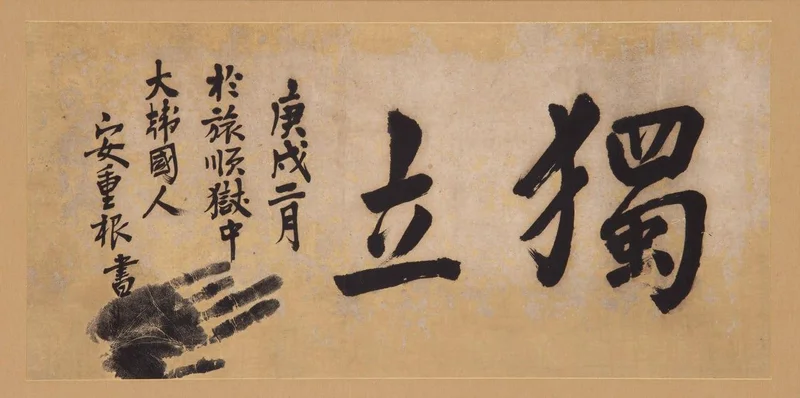
A provincial government’s bid to bring home “Independence,” a calligraphic work by Korean independence fighter Ahn Jung-geun, remains stalled as officials struggle to reach a deal with its Japanese holder.
The Gyeonggi Provincial Government said Friday that its yearlong effort to secure the work’s return has yet to yield a result, adding that it will continue talks through the end of the year as Korea marks the 81st anniversary of its liberation from Japanese colonial rule.
Ahn, a revered Korean independence activist, wrote the calligraphy at Lushun Prison shortly before his execution in 1910 for assassinating Ito Hirobumi, Japan’s first prime minister and resident-general in Korea, at Harbin Station the previous year. He then gave a Japanese guard the work, which is regarded as one of his most symbolically significant pieces.
According to provincial officials, it is now held in custody by Ryukoku University in Kyoto after being entrusted by descendants of the guard.
Provincial officials had initially expected negotiations to proceed smoothly. In 2025, as Korea marked the 80th anniversary of its liberation from Japan’s colonial rule, they sought to acquire two calligraphic works by Ahn from Japanese holders.
To bring “Independence” home, the local government secured 1.3 billion won ($920,000) through a supplementary budget in September 2025 and provided it to the Gyeonggi branch of the Heritage of Korean Independence as a private-capital subsidy.
The work was expected to cost about 2.6 billion won, with the remaining 1.3 billion won to be raised through public crowdfunding. But the campaign has yet to be launched as talks with the Japanese holder remain in limbo.
The provincial government plans to continue negotiations with the Japanese holder through the end of 2026. If no progress is made by then, the Heritage of Korean Independence will be asked to return the money.
Another of Ahn’s works, “Jangtanilseong Seonjoilbon” — meaning “With a long, deep sigh, I offer condolences in advance for Japan’s downfall” — has successfully been repatriated. It was gifted to a senior official of the Japanese Empire’s Kwantung Governor-General’s Office, and it was later preserved by the official’s descendants in Japan.
The provincial government spent 2.4 billion won to acquire the work. It is currently kept in the Gyeonggi Provincial Museum’s storage collection.