Walking through a forest trail lowers the heat strain on the human body significantly faster than walking on asphalt roads in the city, according to a field experiment by the National Institute of Forest Science, a research body under the Korea Forest Service, conducted amid Korea's ongoing summer heat wave.
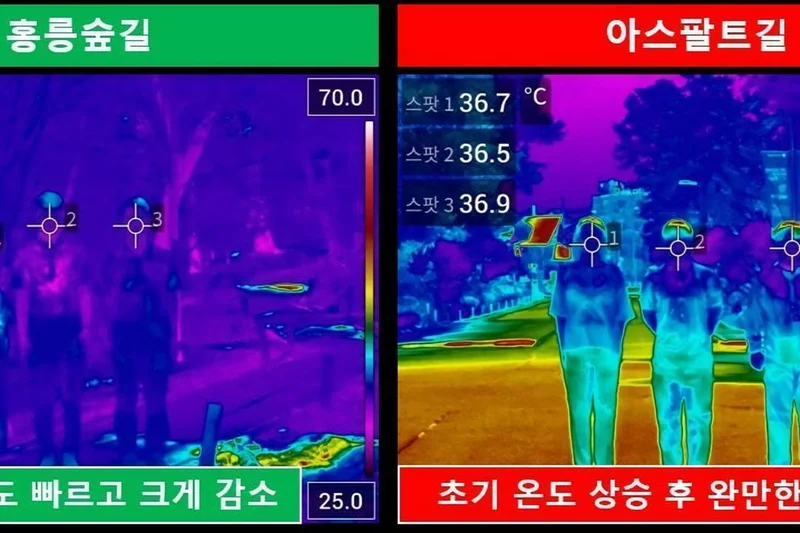
The institute tested the cooling effect of Hongneung Forest, an experimental forest in Dongdaemun District that dates to the Joseon era, by using thermal imaging cameras to compare pedestrians' heat response while walking on a forest trail versus a nearby asphalt road.
Participants who walked the forest trail saw their average facial surface temperature drop by as much as 1.9 degrees Celsius from their starting point, and it stayed about 1.7 degrees lower even after the walk ended. On the asphalt road, by contrast, the average facial surface temperature — 37.0 degrees Celsius at the start — jumped to 38.1 degrees in the first stretch and showed little improvement by the end. Averaged over the full route, facial surface temperatures were 1.1 degrees lower on the forest trail than on the asphalt road.
The institute attributed the cooling effect to dense tree canopies blocking direct solar radiation and to transpiration from leaves, which lowers the surrounding temperature and eases the heat load on pedestrians.
Large green spaces such as Hongneung Forest play an important role in easing heat waves and the urban heat island effect, the institute said, noting the forest's significance is especially pronounced in Dongdaemun District, which has limited green space.
According to the Korea Forest Service's urban forest spatial database, Hongneung Forest spans 35.4 hectares, or about 14 percent of the district's total forested area of 251.6 hectares, making it the largest single forest tract in the district.
An institute researcher at the Urban Forests for Living Environment Research Center said the study confirmed that forests not only lower surrounding air temperature but also meaningfully reduce the heat strain felt by people who use them, adding that preserving the function and value of large urban forests like Hongneung Forest is essential for responding to heat waves and the urban heat island effect.
This article was published with the assistance of generative AI and edited by The Korea Times.