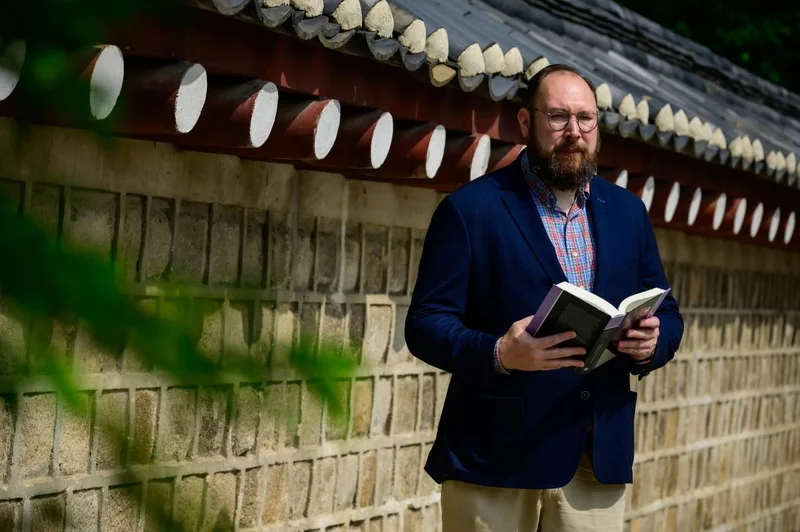
A few decades ago, Korean studies was often treated as an afterthought and viewed as a sub-discipline to Chinese and Japanese studies. Today, a landmark complete English translation of one of Korea’s most important medieval texts is proving how dynamic and indispensable Korean history is to the global literary landscape.
At the heart of this milestone is Remco Breuker, a professor of Korean Studies at Leiden University in the Netherlands and a leading European authority on pre-modern Korean history. He, together with two other scholars — one of whom was his own teacher — to translate "Samguk Yusa," also known in English as "Memorabilia of the Three Kingdoms."
Published by the University of Hawaii Press, his translation is titled "Vestiges of the Three Kingdoms of Ancient Korea." The 570-page work is the first complete and fully annotated English translation of the 13th-century classic.
Compiled primarily by the Buddhist monk Iryeon during the late Goryeo period, "Samguk Yusa" is a collection of forktalkes and legends of the Three Kingdoms period and before.
The newly released volume stands as the fruit of over six decades of dedication spanning three generations of Dutch scholars. The pioneering project was initiated at Leiden University decades ago by Frits Vos (1918–2000), who helped lay the groundwork for Korean studies in Europe.
It was subsequently carried forward by his student, Boudewijn Walraven, before being brought to fruition by Breuker, Walraven’s own student and academic heir.
Translating 800-year-old living classic
Unlike previous English translations, this edition was painstakingly translated in full directly from the original text, which is primarily in classical Chinese, with some elements of "hyangchal" — an archaic writing system that used Chinese characters to represent vernacular Korean. The new book has over 2,000 footnotes, reflecting modern scholarship.
"'Samguk Yusa' is written 99 percent in classical Chinese and one percent in Old Korean poems, preserved through Hanzi phonetics," Breuker, 54, said during an interview with the Korea Times at a cafe in Seoul on July 28. "Older translations were not annotated like this. More importantly, they were translations of translations. If you want to make a proper translation, it needs to be from the original."
Reflecting on his 16 years of effort to finalize and annotate the draft originally started by Vos, Professor Breuker admitted the undertaking was intricate. "Because professor Vos had translated about 90 percent of it, I initially thought we could finish in three years, but that was a miscalculation," he said. "It is personally meaningful to complete the translation, started by the mentor who opened the path for Korean studies."
Beyond its academic significance, he stressed the book remains an important work within contemporary Korean society. "It is a living text; it still matters," he observed. "Almost every year, new translations into Korean appear because people look at the text to decide what their ancestors were like and what the future should look like."
Diversity of Goryeo and Dangun myth
Professor Breuker’s research highlights the Goryeo period's rich culture and open-mindedness.
"The interesting thing about Goryeo is that whether you talk to scholars of Buddhism, Confucianism, Daoism or geomancy, each will tell you their field is the most important," Breuker explained. "All those things coexisted together in Goryeo. In Goryeo, it was seen as different choices to look at the world."
"Samguk Yusa" is also famous for containing the earlist known record of the Dangun legend, which tells the story of the founding of the mythical first Korean kingdom of Gojoseon. Dangun was the son of a heavenly figure and a bear who turned into a human woman after living in a cave while consuming only garlic and mugwort.
According to Breuker, this myth fundamentally reshaped how Koreans viewed their lineage under foreign pressure.
"By starting with the Dangun myth, you completely rewrite Korean history," Breuker noted. "Whether people actually believed Dangun had existed doesn't matter as much as the fact that now you could refer to a common ancestor — one country as the origin of all people on the peninsula."
From ancient storytelling to hallyu
Breuker sees a direct connection between Korea’s ancient storytelling traditions and the modern global wave of Korean pop culture, films, and dramas.
"For the K-pop generation, it shows you how long before BTS or 'Squid Game,' there was a long history of literature worth knowing," Breuker said. "It shows that people are people, no matter the period."
He credited Korea's intense 20th-century history as the incubator for its creative explosion, noting that once censorship lifted, artistic expression surged. He added that Korea's history as a colonized country rather than a colonial power makes its culture non-threatening and uniquely accessible worldwide.
Reflecting on the field's evolution, Breuker celebrated the shift in European academia: "Korean studies used to be the little brother of Japanese and Chinese studies. Now, people can start directly with Korean. I hope this book quenches the long-standing thirst for a deep academic understanding of 'Samguk Yusa.'"