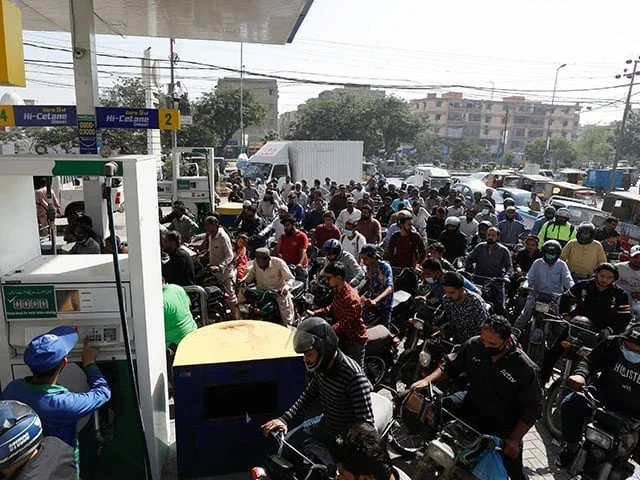
Petrol strike averted as govt gives in to dealers
Hikes owners' profit by 15.5% to Rs10 per litre ECC takes decision in hurriedly called virtual meeting Dealers
ISLAMABAD:
The government on Friday increased profit margins of petrol pump owners by 15.5% in a hurriedly called virtual meeting to avert a strike, as it withdrew a decision to link profits with sales digitisation, partially rolling back an initiative aimed at checking sales of smuggled fuel.
With no member present in the meeting room, the Economic Coordination Committee (ECC) of the Cabinet approved an increase in the dealers' margin on sales of petrol and diesel by Rs1.34 per litre.
With this decision, the existing profit margin of Rs8.64 per litre has jumped to Rs9.98, which would increase the prices of petrol and diesel proportionately. Earlier in December 2025, the federal cabinet had linked the Rs1.34 per litre increase with the digitisation of sales.
Calling the emergency ECC meeting on Independence Day highlights poor governance, as the Petroleum Division had sent the summary on August 7 but the government waited until the dealers decided to observe the strike.
The dealers had threatened a countrywide strike starting August 15 (today). The Pakistan Petroleum Dealers Association (PPDA) on Friday announced it was withdrawing the strike call after the ECC meeting. The association credited the petroleum minister for withdrawing the call.
"Finance minister [Muhammad Aurangzeb] chairs ECC, approves revision in dealers' margins on petroleum products", according to a terse statement by the Ministry of Finance after the ECC meeting. The ministry did not announce the new profit margin rates.
"The ECC considered a summary submitted by the Petroleum Division and deliberated on the matter regarding revision of dealers' margins on Motor Spirit (MS) and High-Speed Diesel (HSD)," it added without giving any further details.
The meeting lasted hardly a few minutes and without much discussion the ECC approved the increase.
Officials said that the Petroleum Division informed the ECC that the federal cabinet in December linked the Rs1.34 per litre increase to achieving the digitisation targets set by the Oil and Gas Regulatory Authority (Ogra).
Ogra, headed by a serving bureaucrat, was responsible for implementing the digitisation drive.
During a meeting between the petroleum minister and representatives of the All-Pakistan Petrol Pump Owners Association and the PPDA, it was demanded that the profit margins should be delinked from the implementation of digitisation which is primarily the responsibility of the oil marketing companies.
The dealers were demanding an 8% per litre margin, compared to the revised one of 3%. This could have caused another Rs30 per litre increase in the prices. The ECC decided that the dealers' margins should be increased to Rs10 per litre but did not revise the OMCs' margins by another Rs1.22 per litre.
The dealers exploit a highly volatile situation, particularly when the government's wrong taxation policies have already kept prices high amid higher global prices.
On August 12, the PPDA issued a 72-hour ultimatum to the government over its failure to fulfil promises made by the petroleum minister to resolve their issues, especially the increase in margin to eight per cent on the retail sale price of petrol.
The association warned that if the government failed to meet its demands within 72 hours, petrol pumps across the country would shut down indefinitely from 6am on Saturday (August 15) and would not reopen until those demands were met.
The government is currently charging an Rs80 per litre levy on petrol, Rs78.3 per litre on diesel, and a Rs5 per litre climate support levy on both fuels.
Before Pakistan even locked the deal with the International Monetary Fund, Petroleum Minister Ali Pervaiz Malik had written to Finance Minister Muhammad Aurangzeb, opposing the new fiscal year's levy collection target of Rs1.7 trillion.
He suggested reducing reliance on petroleum levies, which he said was imperative to cushion vulnerable segments of society. The Petroleum Division had proposed reducing the annual petroleum levy collection target to Rs1 trillion for the new fiscal year.
This was Rs700 billion less than the IMF's projection. As an alternative, Malik had proposed reducing the levy rate on petrol and diesel to Rs50 per litre – a cut of Rs30 from the rates agreed with the IMF. He proposed that the levy rate could be increased from Rs50 per litre only if global prices fall below $60 per barrel.
The Petroleum Division believed that reducing targets and rates was critical to easing the burden on the people and ensuring economic stability. However, the levy appears to be the most favoured tool of the PML-N government.
Data showed that since the Pakistan Democratic Movement (PDM) government came to power in 2022, annual petroleum levy collection targets have been exceeded every year. From July 2022 to June this year, estimated levy collection stands at Rs4.4 trillion.
In the last fiscal year, the government collected Rs1.57 trillion worth of petroleum levy, Rs100 billion more than the IMF target.
(WITH INPUT FROM NEWS DESK)