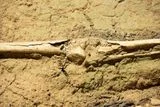
Denisovans, the extinct relatives of modern humans and Neanderthals, may have been much taller and bulkier than we ever realized. These hominins lived across Asia until they disappeared around 30,000 years ago, but having left very few fossils behind, the Denisovans’ stature and physical appearance have been in question ever since they were first discovered in 2010. Two Denisovan leg bones recovered from the seafloor near Taiwan, however, may yield key answers.
In 2010, researchers identified a fossilized femur and tibia from the Penghu Channel, a body of water in the Taiwan Strait. Years later, they’ve now determined that the femur and the tibia are among the largest leg bones of all known hominins in the Pleistocene. The size of the bones, researchers suggest in a new bioRxiv preprint paper, could indicate that Denisovans were significantly larger than other hominins living in Asia.
Read More: 146,000-Year-Old Dragon Man Skull Confirmed as Denisovan Through Dental DNA
Deciphering Denisovan Body Size
Before early modern humans emerged in Africa, several hominin groups had already spread all the way to Asia. One of these groups was the Denisovans, a lineage that split off from the Neanderthals. Fossils of Denisovans have been found in Siberia, Tibet, and Northeast China, though overall, they are few and far between. Previous morphological studies of these fossils have posited that the hominins had large brains, a robust jaw, and large teeth among other distinct features.
The proportions of the Denisovan body have been difficult to reconstruct, but the fossilized femur and tibia found underwater in the Penghu Channel have emerged as valuable resources for estimating Denisovan body size. The femur (named Penghu 2) and the tibia (named Penghu 3) likely date back to 45,000 to 43,000 years ago based on recent radiocarbon dating.
Measuring Fossilized Leg Bones
The researchers involved in the new preprint paper revisited the bones, first confirming that they belonged to two separate Denisovans by analyzing ancient proteins extracted from bone powder samples drilled from the inner part of the femur and tibia.
Then, the researchers made CT scans of the bones, measured them, and compared them with various groups of Early to Late Pleistocene hominins.
Through these methods, they estimated that the original length of the femur was around 19 inches, slightly larger than the average modern human femur (18 inches long). The original length of the tibia, they estimated, was around 17 inches, also larger than the average modern human tibia (15 inches).
The Largest Hominins in Asia
So, who were the Denisovans behind the two bones? The bones’ large dimensions suggest they belonged to males; from these dimensions, the researchers also estimated the full-body sizes of both individuals.
Penghu 2 (linked with the femur) is estimated to have been around 5 feet 11 inches tall and weighed around 183 pounds, while Penghu 3 (linked with the tibia) is estimated to have been 6 feet 2 inches tall and weighed around 200 pounds.
These body sizes, the researchers write, are comparable to the largest known Pleistocene hominins from Africa and Europe. The two Denisovans, however, would have been larger than many other hominins in Asia. A Homo erectus individual known as the Zhoukoudian Homo erectus or the “Peking Man,” identified from fossils in northern China, would’ve been around 8 to 12 inches shorter and weighed around 44 to 66 pounds less.
Then, there’s the diminutive Homo floresiensis from Southeast Asia, otherwise known as the “hobbit human.” These hominins would’ve been even smaller, standing at around three and a half feet and weighing only as much as around 75 pounds.
The Denisovans may have been so large because of their particular need to hunt for meat, which would've required a substantial body size. While there's much we still don't know about the Denisovans, the Penghu 2 and 3 bones have shown how these hominins may have physically stood out among their smaller hominin neighbors in Asia.
Read More: An Important Gene Inherited From Denisovans Helped Modern Humans Survive and Spread
Article Sources
Our writers at Discovermagazine.com use peer-reviewed studies and high-quality sources for our articles, and our editors review for scientific accuracy and editorial standards. Review the sources used below for this article:
- This article references information from a preprint paper published in bioRxiv: Denisovan leg bones from Taiwan reveal large body size