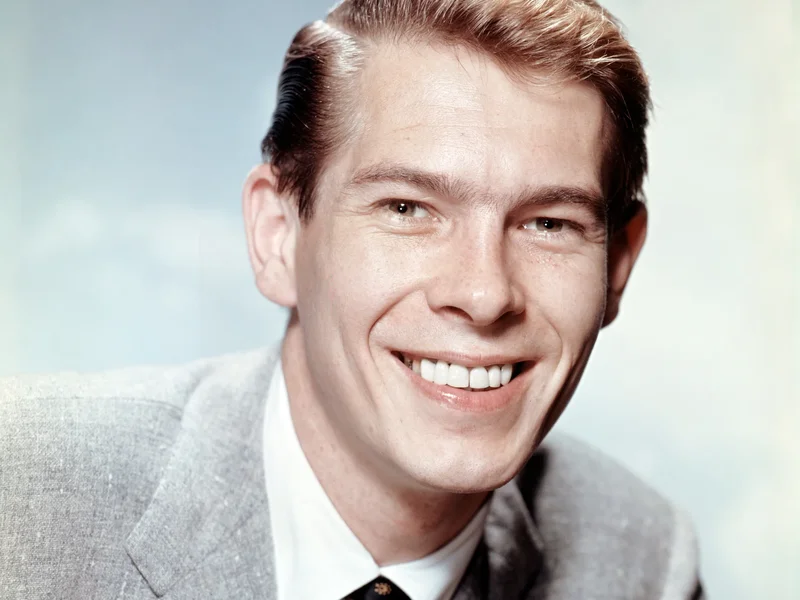
“He was deaf, gay, and cried in all his songs.” Such are the words of filmmaker John Waters describing singer Johnnie Ray in a recent interview with The New Yorker’s Michael Schulman. He adds that Ray “got busted in a men’s lavatory, and he can really sing. He cries and cries.” With those remarks, Waters introduces an audience of thousands to the performer, a teen sensation in the 1950s who today is almost completely forgotten. Did Waters employ a touch of sensationalism? Sure, given that Ray never publicly identified as homosexual, and did in fact get married to women, though his associates often alluded to a possible bisexuality that was never confirmed by the artist. Singer Rosemary Clooney — George’s aunt — once wrote: “Johnnie might be gay, as people said, but clearly not all the time.”
The director of Pink Flamingos is not working on a movie or biographical documentary about Johnnie Ray, and nor is anyone else we know of, despite the fact that there’s dramatic material to spare. Including that which is related to his longest-lasting relationship: alcohol. While Michael cleans up at the box office, becoming the biggest opening of a musical biopic right when the sub-genre appeared to be on the way out, no producer appears to have come to the conclusion that the life of Johnnie Ray deserves to be told on the big screen, or even as one of the millions of films that premiere nearly every day on streaming platforms.
Of course, not all famous people have led lives that are easily exported to the silver screen, due to a host of factors. Film works differently than a biography, like the book about Ray that was published in 1994. He was tremendously influential in the evolution of rock ‘n’ roll, more on the technical and performative level than the symbolic. That’s why today, he is not an instantly recognizable icon to the masses, the kind that is most easily brought to movie theaters. Even outsider artists like Daniel Johnston, or Spain’s Yurena have had greater name recognition, which has led to their lives being portrayed in movies and TV series.
Perhaps his story is not easily simplified into a commercial biopic. Deaf since childhood — he said it was due to an accident, though others dispute this fact — a queer man during an era too hostile for living openly, teen idol and later alcoholic and fallen star, Ray was one of the world’s most famous singers for a brief time. Later, the decadence of his career, driven in part by rumors surrounding his alleged homosexuality, his divorce, but also changing musical trends, led him to being regarded today as a mere curiosity in the history of popular music, and not as the foundational and subversive figure he truly was.
During the post-war years, Ray broke the mold. Known for explosive performances in which he would sing, overcome with emotion, throwing himself to the ground, tearing at his hair, “clenching his fists in desperation,” singing on his knees and weeping (real) tears, Ray reconfigured what a male singer could do onstage. He laid the way for later artists like Elvis Presley — he cited Ray as an influence — who would change the world. His friend Tony Bennett considered Ray the “father of rock ‘n’ roll.”
Critics called him the “Prince of Wails.” His concerts, heartfelt and theatrical, broke with the norms of the time, and his vocal technique expressed exaggerated emotion. Ray did not fit the mold of the traditional singers like Frank Sinatra, and his dramatic and histrionic style was a forerunner for the performative rock ‘n’ roll that would transform the popular genre years later. Ray broke the taboo of the male singer who dared to feel, and adolescent girls went crazy for him. His first hit, not coincidentally called Cry, which was released in October 1951, sold two million copies and was the first of many successes.
Susan Sontag said she saw the song as being a “revelation” when she heard it on the radio, and listening to it today, it still seems an unusual recording, marked by an appealing “ooo-wah ooo-wah ooo-wah” harmonized to simulate crying. Then there’s Ray’s performance, as emotional as the adolescents who immediately connected to the track. A young Bob Dylan was one of them, later saying that Ray had been “the first singer whose voice and style I totally fell in love with.”
The passion awoken by Cry among the era’s teen fans may be linked to the fact that the song is written from the perspective of a woman attempting to console another, its first version having been recorded two months prior by the singer Ruth Casey. “Remember sunshine can be found behind a cloudy sky / So let your hair down and go on and cry,” exhorted its sentimental lyrics written by African American composer Churchill Kohlman, who penned Cry while working at a Pittsburgh dry cleaning factory as the night watchman.
Described as an innate musician, brilliant on the piano since childhood, Ray grew up in a Christian family during the Depression and firmly believed that entertaining was his destiny. Though academic Cheryl Herr said in 2009 that Ray’s condition was likely congenital and that he hid its true origin out of shame, his deafness directly influenced his performance style, and appears to have exaggerated his vocal stylings so as to be able to hear himself. When asked why he got so emotional at concerts, Ray alluded to his early years: “Maybe there’s a sadness in me, from when I was a boy,” he said. “I was half deaf and I still wear a hearing aid. As a kid I couldn’t hear the teachers very well. Other kids got tired of shouting. I was left by myself.”
Ray became an introspective child, but an ambitious one. At the end of the 1940s, he moved to Los Angeles to try his luck in the movies, but he was apparently no leading man by the standards of the time. “I wasn’t handsome,” he said. He worked in bars, singing and playing the piano while he waited to be cast, performing in dives he’d later describe as “upholstered sewers.” He didn’t have much luck and eventually returned to his hometown. There, after a deeply saddened walk along the river, he wrote the song The Little White Cloud That Cried, which would come to define his emotional style. It was released as the B side to Cry, years later. Ray then moved to Detroit, where he worked in various Black bars, in one of which he was discovered by a talent hunter from a record label. His first single Whiskey and Gin (1951) received limited success, but a few months later, Cry turned him into a phenomenon.
His self-titled debut album is considered the first record in the history of music that was released with no title. His name and dramatic appearance on the cover were already enough, turning Ray into a precursor of the pop star as commercial brand. Sudden success, fame, and possibly the era’s professional and moral pressures aggravated his relationship with alcohol, which lasted until his death in 1990 from liver failure at 63 years old.
During the height of his fame, Ray fulfilled another old aspiration: making it in Hollywood. In 1954, he appeared alongside Marilyn Monroe in the musical There’s No Business Like Show Business, his only high-profile cinematic role, which offers proof of the reach of his celebrity at the time. Ray wasn’t just a musical star, but a cultural phenomenon bright enough to share a screen with one of the biggest icons of the era. At the same time, the past returned to torment him when it broke that during his years in Detroit, before fame came calling, he was arrested for sexually propositioning a man who was actually an undercover cop.
His manager Bill Franklin says that the twenty-something Ray took advantage of his time in Hollywood to explore his sexuality: “There were women and there were men. He was a cute little kid with a big dick. He liked to talk about that and people liked to hear about it.” Throughout his life, Ray had lovers of both sexes, though few relationships garnered as much attention as his link with Dorothy Kilgallen, one of the most famous journalists in the United States. Their connection was long-lasting and it was often whispered that Ray may have been the father of Kilgallen’s youngest child. Ray was arrested on other occasions by undercover police officers for so-called “indecent acts,” looking for sex with other men in bars and public places, a practice that seems to followed him from the early anonymous days into fame. His career in the United States never recovered, though he continued to appear sporadically on television and acted internationally.
Ray’s possible bisexuality has made him the subject of queer study, and readings of his lyrics through such a lens (always well after their heyday — it bears mentioning that Ray never publicly confirmed his sexuality, nor sang about it explicitly) suggest veiled allusions. For example, in his 1952 hit A Sinner Am I, in which he refers to an intense and socially prohibited romance. In the song, Ray sang that “a love like this was never meant for man’s imagination,” and expressed something resembling pride: “But I can never be blamed because I’m not ashamed.” His song Don’t Blame Me hews to a similar theme: “Don’t blame me / For falling in love with you / I’m under your spell / But how can I help it.”
Guilty love is one of his favorite themes. Another 1951 hit (Here Am I) Brokenhearted stands out for the way it mentions male and female pronouns, when typically neutral terms would have been used, not alluding to any gender in particular. In the song, Ray mentions having lost “her” and also “him” (“I had to lose him too”), though he refers to her as a “gal” and him as a “pal,” which creates some room for interpretation. A queer reading of his work focuses on that ambiguity, though in the particular context of Johnnie Ray, the tales of his adventures with men relayed by several biographers notably condition any interpretation.
Dramatizing Ray’s life on film is complicated, because he was a figure who moved among grays, not at all easy to sum up in three or four key points. The movie industry requires some guarantee of success, and as biopics about forgotten artists don’t always hit big, their stories are often relegated to other formats like mini-series or documentary. Nor has there been a cultural return to the life and work of Ray the like of which usually piques the interest of show biz. His music hasn’t been sampled, nor have his singles gone viral on TikTok, as vintage hits from the likes of Connie Francis or The Pied Pipers have done. Waters’ mention of Johnnie Ray may be his first high-profile moment in decades. In 1987, Billy Joel referenced him in We Didn’t Start the Fire, and in 1982, Dexys Midnight Runners named him in their massive hit Come On Eileen: “Poor old Johnnie Ray / Sounded sad upon the radio,” they sang. Perhaps only a transgressor like Waters could vindicate a forgotten icon as important as Ray: a complicated superstar, ahead of his time, who remains waiting to be rediscovered.