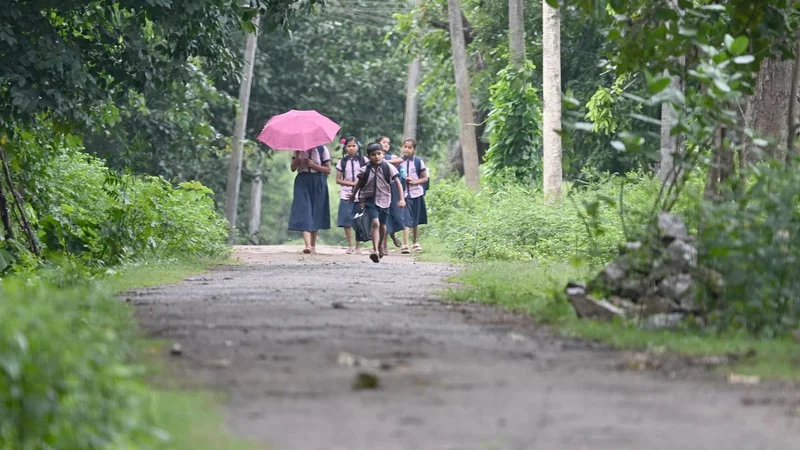
It was about 4.30 p.m. and Lakshmi, Ranjitha and Pallavi, all Class 7 students from Marathi Camp in N.R. Pura taluk, were walking home from their school at Byrapura about 3 km away. They froze as they approached a dry stream. Not very far from them was a leopard.
While the animal went its way, the children have not forgotten this encounter that took place in July. The fear was heightened the following day when a group of parents, on their way to the school to enquire about the incident and seek measures to ensure their children’s safety, spotted what they believed were the pug marks of a tiger along the same route. For the next three days, none of the 28 schoolchildren from the village attended classes.
Though they have since resumed going to school, the incidents in early July have left the village, comprising around 44 families, constantly on the edge.
Anganwadi centre
Following the incident, officials from the N.R. Pura taluk administration decided to open an anganwadi centre in Marathi Camp for 10 children.
“Earlier, even children below six used to walk along the same path to reach the anganwadi centre, which was located in our school premises. Now, they have their own centre in Marathi Camp,” said N. Krishnamurthy, the headmaster. He and his three colleagues have also been advising the children to walk in groups to and from school.
Shabana Anjum, Block Education Officer, told The Hindu that children attending schools from remote areas are eligible for financial assistance of ₹6,000 a year, at the rate of ₹600 a month for 10 months, towards transportation expenses. “The amount for the previous academic year has been credited. The villagers and parents have been told to make arrangements for transportation using the amount,” she said.
Where are the roads?
However, parents face several practical difficulties. Bagu Navilappa, a parent of two children studying at the school and president of the School Development and Monitoring Committee, said a majority of the villagers were daily-wage workers and that arranging vehicles, such as a school van or autorickshaw, with the amount available was impossible. “There is no proper road to our village. Even ambulances can hardly reach us during emergencies. How can we expect to run vehicles to ferry our children?” he asked.
For a couple of days after the incident, some villagers voluntarily provided tractors and autorickshaws to transport the children to school. However, the arrangement did not continue, and the children soon returned to walking along the forest route. A few parents now take their children on two-wheelers along the muddy and difficult stretch through the forest.
When The Hindu visited the village, more than 20 children were seen walking along the same route to school. Some took a shorter path through agricultural fields, where farmers have installed solar fencing to protect their crops from wild animals, including elephants and wild boars. The landowners have allowed the children to use a narrow passage through the fields to reduce their travel time.
Common sight
Takamma, a resident of Marathi Camp, recalled that a leopard had carried away sheep tied to a pole outside the house of Manjunath, another resident of the village. “Wild animals keep visiting our village. I have seen elephants strolling through our streets,” she said.
The incident at Marathi Camp has brought into focus the difficulties faced by children living in remote villages in the Malnad region, where human settlements and agricultural land are surrounded by forests and wildlife habitats. There have been several instances of people being killed in elephant attacks in Hassan district. Similar concerns prevail in parts of Chikkamagaluru, Kodagu and Shivamogga districts, where the movement of wild elephants, Indian gaurs and leopards is common.
What the villagers want are proper roads and reliable transportation facilities. “As our locality is on the fringes of the forest, there are hardly any roads to access it. We have to walk long distances to reach the nearest bus stop. Schoolchildren also face this problem. Once the roads are improved, we can demand a well-planned transportation facility,” said Babu, another resident of Marathi Camp.
Published - August 15, 2026 09:52 am IST