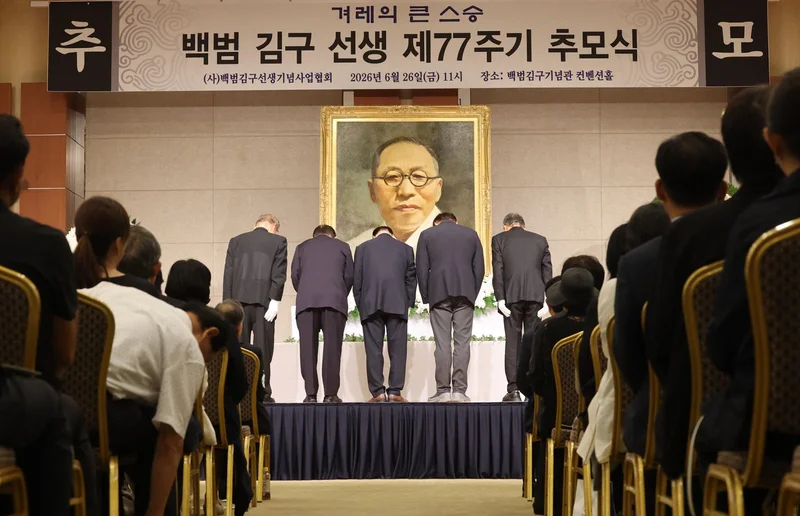
There is a photograph familiar to anyone who studies the Korean independence movement. It shows an elderly man in round spectacles and hanbok, or traditional Korean clothes, his face almost scholarly and his gaze soft behind the lenses. He looks like a retired professor, someone you might pass in a near-empty library.
That face belonged to a man who stood 180 centimeters tall and spent his youth on the run, a rebel leader in a crushed uprising, a man who had killed a Japanese agent and fled through the freezing Korean countryside with a price on his head. His name was Kim Koo. And if you want to understand modern Korea, its soul, its divisions, its improbable cultural triumph, you must also understand him.
**The making of a rebel **
Kim Koo was born in 1876, in the final, flickering years of the 1392-1910 Joseon Dynasty. He came from a ruined yangban (aristocratic) family, but poverty had stripped him of privilege. Asia in his youth was a continent on fire: a cauldron of war, revolution and the boot-heel of Western imperialism. Kim was more sensitive than most to the tremors beneath his feet.
His political awakening came through Donghak, an indigenous religious and social movement that opposed foreign intrusion and challenged the corruption of the existing order. It was a faith that would cost him dearly. When the Donghak uprising was crushed, Kim went into hiding with An Tae-hun, the father of the future martyr An Jung-geun, who would later assassinate the Japanese statesman Itō Hirobumi.
After Japan formally annexed Korea in 1910, Kim joined the New People's Association (Sinminhoe), a republican-minded enlightenment society, and eventually rose to become the head of the Korean Provisional Government in exile, first in Shanghai, then in wartime China. This was not a glamorous post. It was a government without a country, a cabinet without a treasury, a nation reduced to a gathering of determined men in rented rooms.
But Kim never lost faith. His vision for Korea was startlingly modern. He dreamed not of a great power, not of a revenge-driven empire, but of a cultural powerhouse. "I do not wish for my country to become the richest or most powerful," he wrote in his diary, the Baekbeom Ilji. "Having suffered heartbreak from foreign invasion, I do not wish for my country to invade others. The only thing I endlessly desire is the power of high culture. For the power of culture makes ourselves happy and, furthermore, brings happiness to others."
That passage, written in the depths of exile, today reads like prophecy. And the country acknowledges that.
The prophet of division
When liberation finally came in 1945, Kim returned to Seoul as a living legend. But he returned to a nightmare. The Americans and Soviets had already drawn a line across the 38th parallel, and the Cold War was freezing Korea in place.
Kim responded as he believed a nationalist should: he opposed the division outright. He refused to accept a separate government in the South, and he refused to accept a Soviet-style communist state in the North. Instead, he demanded compromise: negotiation and a unified homeland. He even traveled to Pyongyang in April 1948 to meet with Kim Il-sung, hoping against hope that the two sides could find common ground. His journey was a noble failure.
In hindsight, Kim Koo appears almost tragically naive. Did he genuinely believe that Moscow, which controlled Pyongyang's every move, would allow a unified Korea that might tilt toward the West? Or did he know the truth, and simply refuse to accept it? His own writings suggest he saw communism as a "fearful dictatorship" premised on thought control.” Yet still he reached across the divide. He chose principle over pragmatism. And for that, he paid the ultimate price.
On June 26, 1949, the 74-year-old Kim Koo was at home, reading his beloved Chinese poetry. His life had been one of constant movement, danger and exile; now, in his final years, he had finally found quiet. Then the door opened. A young military officer named An Du-hui stepped in, raised a pistol and fired four shots.
The assassination remains the most notorious political murder in modern Korean history. The official story blamed a political quarrel within Kim's own Korean Independence Party. Kim's great rival, Syngman Rhee, was consolidating power in the South, and any public praise of Kim became taboo. It would take the April 19 Revolution of 1960, which toppled Rhee's regime, to allow Kim's legacy to breathe again. Decades later, an investigation by the National Assembly concluded that the killing had been organized rather than the spontaneous act of a lone gunman.
**The irony of history **
History has a wicked sense of humor. Kim spent his life warning against communist tyranny, yet today some of his fiercest champions are on the Korean left, who recast him as a late-blooming visionary who nearly steered the nation away from partition. The right, by contrast, has often kept him at arm's length. Neither side is entirely honest. They have dressed him in their own political colors, when the truth is that Kim defied easy labels: he was not a man of the left or the right, but a man of a single, stubborn creed: Korea itself.
Even in death, recognition proved elusive. In 2007, the central bank chose his portrait for the proposed 100,000 won note, a fitting tribute to a man who prized culture above cannons. The bill never reached circulation though digital images of it can be found online.
Which brings us, at last, to social media.
Today, whenever a Korean achieves something extraordinary on the world stage, when Bong Joon-ho wins Oscars, when Han Kang wins the Nobel Prize in Literature, when BIGBANG sings to stadiums full of fans, some Korean netizens post the same thing:
"Kim Koo seonsaengnim, are you watching?"
They are not mocking him. They are summoning him. They are saying: Old man, you dreamed of a Korea that would be respected not for its armies or its wealth, but for its culture. Look now. Our films are watched worldwide. Our novels are translated into every language. Our music is the soundtrack of a generation. We did not become an empire. We became something better. We became the nation you wanted.
BTS has even carried the reference into the present. In their 2026 song 'Aliens,' RM addresses Kim directly: 'Pardon, Kim Koo seonsaengnim. Tell me how you feel.” The honorific matters. He is being invoked as an adjudicator on the present.
Kim was wrong about many things. He underestimated Stalin's grip on the North. He overestimated the goodwill of the Americans. He died before he could see his dreams realized, and he died at the hands of a fellow Korean, the ultimate tragedy of a divided people.
But on culture, he was not wrong. Not even close. As he wrote in his diary, with the simplicity of a man who had suffered too much to lie: "It is sufficient if our wealth is enough to enrich our lives and our strength is enough to defend against foreign invasion."
He asked for a Korea that could enrich itself, and in doing so, bring happiness to others.
On Independence Day today in 2026, as Korean films, novels and music circulate across the planet, I like to imagine Kim Koo putting down his poetry, adjusting those famous round spectacles, and allowing himself a smile.
Yes, Mr. Kim. Korea is watching. And I think you would be proud.