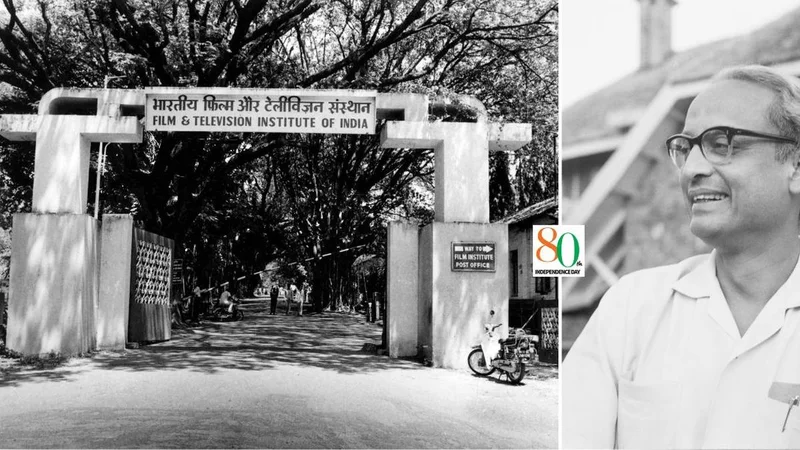
For my father, Jagat Murari, the most important aspect in the “making of a filmmaker” had little to do with the art or technique of filmmaking. It was, instead, about helping each of his young students find their unique voice, and giving them the spunk and spine to use it. As he built the Film and Television Institute of India (FTII; then called the Film Institute of India) — pretty much from the ground up in the 1960s — he put in place a programme that would create brilliant filmmakers who were masters of their craft, but he simultaneously nurtured an environment that would make them free-thinking artists, who would be, as he put it, “even rebels of our time”. His key tools? Debate, dissent, diversity.
The results were more than he had hoped for. FTII went from a shaky start-up to a highly coveted film school within a decade, turning out top talent with unfaltering consistency: Jaya Bachchan, Shabana Azmi, Adoor Gopalakrishnan, Mani Kaul, Subhash Ghai, K.K. Mahajan, and many more. Their impact was transformative. They became the most significant actors, directors, cinematographers, sound designers, and editors of Bollywood. They spearheaded the Indian New Wave, kick-started regional cinema, and ushered television into the country. They won awards by the scores — the National Award functions were only half-jokingly referred to as FTII reunions. Over time, they infiltrated every corner of the film industry, steadily upping its technical and artistic standards, paving the way for Indian cinema to become the global powerhouse it is today.
Our country’s education system stands at a crossroad today. The recent student protests have made it amply clear that we have an acute shortage of college seats. But there is also a silent crisis of “quality” that stalks our system. This is where FTII’s founding model holds lessons that are equally applicable to other fields of education today.
Building a culture of debate
I was two years old when we moved to Pune, and my father became FTII’s principal. I grew alongside the institute, both raised by the same man. More recently, I researched and wrote a book on Jagat Murari and FTII, which gave me the opportunity to analyse his ‘secret formula’ for making brilliant filmmakers. In my interviews of over a hundred alumni and colleagues, the themes that were dominant invariably centred around passionate debate about films, valuing diversity in all its forms, and odd as it sounds, learning to look within and finding your voice. Excellence at your craft was almost a given.
In the start-up years, the Institute’s annual budget was just ₹3 lakh. There were shortages galore. In fact, the teacher shortage was so dire that Jagat Murari could hardly keep the institute running. The solution? He persuaded some of the finest filmmakers to come to Pune as guest faculty. Directors such as David Lean, Satyajit Ray, Ritwik Ghatak, Raj Kapoor, Ismail Merchant, James Ivory, and many others walked through the FTII gates. Cinematographers like R.D. Mathur (of Mughal-e-Azam fame) and Subrata Mitra (Ray’s cameraman) came. Kamini Kaushal and Balraj Sahni taught acting. In the academic year 1963-64, he pulled in 50 such guest lecturers.
The upshot? Students rubbed shoulders with excellence on a daily basis, engaged with a diversity of viewpoints on cinema, and most importantly, learnt to debate them and figure out where their own views stood.
Learning beyond the classroom
How do you foster originality? How do you create social consciousness? How do you broaden the cinematic vocabulary of young filmmakers? In tandem with the high-powered visiting faculty, a very diverse feast of cinema played out every evening in the Institute’s main theatre. Students gorged on global landmarks such as Battleship Potemkin (by Sergei Eisenstein), Citizen Kane (Orson Welles), Bicycle Thieves (Vittorio de Sica), Rashomon (Akira Kurosawa), Pather Panchali (Satyajit Ray), Breathless (Jean-Luc Godard), among others.
Like a potent drug, these films had a mind-expanding effect. Students came out of the theatre, and headed for the Wisdom Tree, where they held discussions, which often got heated. Again, debate and diverse viewpoints chipped away at dogmas, creating a more considered and personal take on not just cinema, but life itself. As Shabana Azmi told me: “I was exposed to international cinema, of the likes of Kurosawa, Bergman, Godard, Bresson… that opened a completely different world to me.”
Finding your own voice
This was the immersive environment within which FTII students learnt their craft. In a country where rote-learning is the norm, the emphasis here was on ‘learning by doing’. Not only were there numerous practical exercises but as the student progressed, there was hands-on filmmaking of increasing complexity. Students were encouraged to think for themselves, and to give their individual personalities full expression. Actors too were taught to reach within their innermost selves to give ‘truthful’ performances based on ‘Method Acting’ principles.
The legendary filmmaker Adoor Gopalakrishnan summed it up well: “The only way to make films is to go back to yourself… Don’t look around, look within. This is the great lesson I learnt there. And I am greatly obliged to Jagat Murari sahab for that.”
If we are to create the future leaders of our country, then we owe them an education that equips them to think for themselves, that worships only at the altar of excellence, and that gives them the courage to look within.
The Dubai-based writer is a columnist and author, most recently, of The Maker of Filmmakers: How Jagat Murari and FTII Changed Indian Cinema Forever (Penguin Random House).
Published - August 15, 2026 12:13 pm IST