Adam Hartstone-Rose didn’t expect his first eclipse to be so interesting. It was 2017, and he was a biologist at the University of South Carolina. A total solar eclipse—when the moon temporarily blocks out the sun—was set to pass directly over him, and he’d been invited to observe how animals at the local zoo would respond to the event. Hartstone-Rose didn't have high hopes for the endeavor: the eclipse would last minutes—not long enough, he thought, for the animals to notice. He figured it couldn't be more disruptive than a passing storm cloud.
“It turns out that I was wrong,” he says.
The eclipse was “amazing,” Hartstone-Rose says. And he saw many unexpected and downright odd animal behaviors: as he and his colleagues went on to describe in a 2020 paper, baboons huddled together; a colony of flamingos circled up around the juveniles; giraffes galloped; a Komodo dragon “ran erratically” around its enclosure; siamangs, a type of gibbon, let out “atypical” barks; and a pair of Galápagos tortoises inexplicably began mating.
On supporting science journalism
If you're enjoying this article, consider supporting our award-winning journalism by subscribing. By purchasing a subscription you are helping to ensure the future of impactful stories about the discoveries and ideas shaping our world today.
Other observations made by Hartstone-Rose, who is now a professor at North Carolina State University, suggest that some animals at the zoo behaved as if it were twilight, starting their “nighttime routines.” Lorikeets, for instance, flew to their nest boxes. Gorillas gathered by the gate to their den, and African elephants drifted toward their barn. Still, some animals didn’t seem to care about the eclipse at all.
At the time, Hartstone-Rose wasn’t sure why the animals reacted in such different ways. Were they stressed or confused? Or was there another reason? On that day in 2017, the zoo in Columbia, S.C. , had been packed with visitors who’d piled in to view the eclipse. Indeed, Hartstone-Rose and his colleagues noted in their 2020 paper that some of the animals could have been startled by the humans, but the researchers weren’t sure.
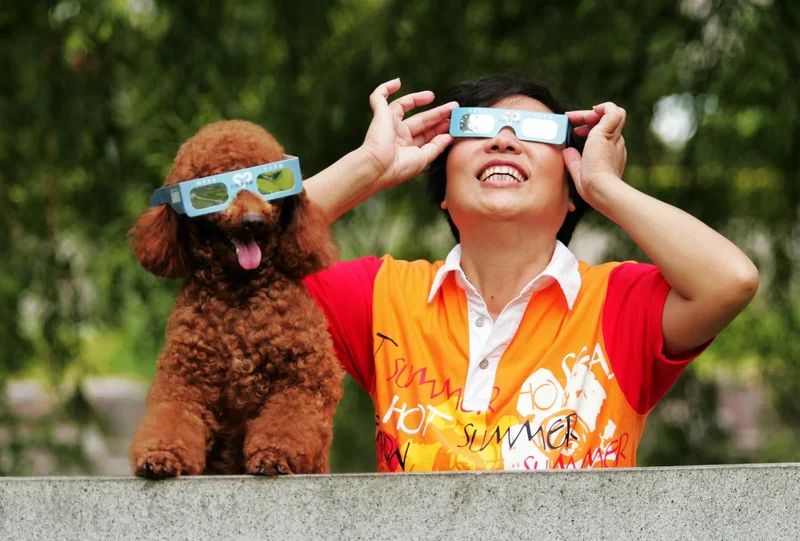
They may have been onto something: human behavior during eclipses, Hartstone-Rose says, may have more influence on animals’ behavior than scientists thought. After all, we tend to ooh and ahh, clap, lie on the ground, gather together and otherwise behave, well, oddly.
“The animals that do the strangest thing during an eclipse, by far, are the people,” he says. “I think that’s actually an explanation for some of the anomalous behavior that we see in animals, too.”
In a recent study published in the journal Zoo Biology, a separate group of Canadian researchers observed zoo animals during 2024’s total solar eclipse, when the zoo was closed to visitors. A few animals seemed to respond to the change in sunlight—the Japanese macaques climbed higher in their enclosure, and the zebras showed "some signs of stress," for example. But most of the observed creatures showed “little response,” the authors wrote.
Indeed, in 2024 Hartstone-Rose performed a similar experiment at the Fort Worth Zoo in Texas. The crowds at the zoo were smaller than they had been in 2017, and the animals’ reactions were also more subdued. The Dallas Zoo, meanwhile, hosted “a huge event,” with massive crowds, and the animals reacted “much more strongly” during the eclipse, he says.
“We don’t think about it, but animals at the zoo are perceptive of what’s happening with the humans, just as the humans are perceiving what’s happening with the animals,” Hartstone-Rose says.
Still, there are some animal behaviors that are perhaps easier to explain, such as mistakenly engaging in dusk or dawn routines. In a 2025 study published in Science, researchers and community scientists analyzed nearly 100,000 bird calls during the 2024 total solar eclipse. Remarkably, about half of the recorded species sang their dawn calls as the sky lightened following the event. Similarly, insects such as fireflies and orb-weaving spiders have been observed during eclipses acting as if it were nighttime.
Eclipses are inherently hard to study. They rarely occur in the same place, with intervals of around 366 years on average, which makes it impossible to replicate an experiment. And that lack of repeatability in part makes it hard to get funding, Hartstone-Rose says. He’s skipping a trip to where this August’s total solar eclipse will occur, in part because of potentially nonideal viewing conditions and a lack of funds.
Still, people care about what happens to animals in an eclipse. In 2024 hundreds of community scientists participated in Hartstone-Rose’s research project, making note of how animals around them behaved during the solar eclipse—from pets to farm animals to wild creatures. Hartstone-Rose and his co-authors also analyzed people’s experience of both viewing the eclipse and taking part in science.
People closer to the path of totality felt stronger feelings of awe, he says. “But what was really mind-blowing [was] that people who observed changes in animal behavior also felt significantly stronger feelings of awe and inspiration, and also stronger feelings of belonging in science, and that they contributed to science.”
If you’re lucky enough to catch this year’s eclipse, Hartstone-Rose recommends paying attention to your environment. If you’re excited or if other people are making a lot of noise or commotion around you, animals might get excited, too.
“As a scientist, I want to get people interested in science and nature and being in the world. And this is just such a cool entryway,” Hartstone-Rose says.