Sign in. It’s quick, free and it’s up to you.
An account is an optional way to support the work we do. Find out more.
SOMETIMES THERE’S SIMPLY no choice but to pay attention to what’s happening across the Irish Sea.
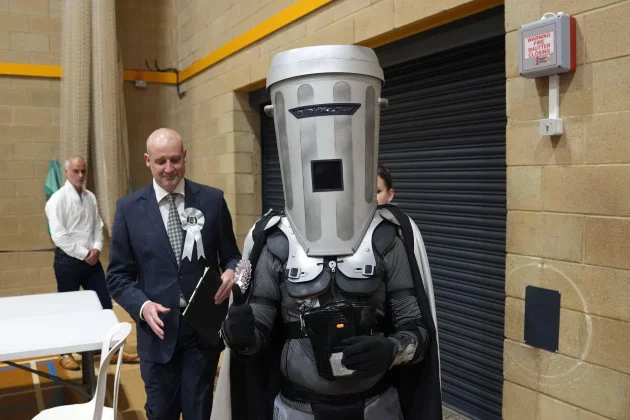
Other times, the architect of Brexit and the rise of the far-right in Britain, who’s under investigation for a £5million donation he received from a crypto billionaire, is in a byelection for his own seat, against a man with a bin on his head who calls himself Count Binface, and it would actually be really easy to not pay attention.
And yet, here we are.
In the end, Reform leader Nigel Farage comfortably defeated the Count in Clacton by over 36 percentage points, putting an end to one of the most meaningless distractions in recent history. He was never going to lose, of course, or come anywhere close. In 2024, Farage chose Clacton precisely because its voters have repeatedly proven their sympathy with Farage’s brutish brand of anti-immigrant rhetoric at the ballot box.
Only a few weeks ago, Farage had stepped down from his role as MP for the same constituency in part to delay the investigation into his finances, and the charade resulted in all the major UK political parties refusing to contest the foregone conclusion. Enter Binface, real name Jonathan David Harley, a serial joke candidate who has now contested seven different elections in character.
As the author of a column that occasionally takes at least some pleasure in the absurdities of modern social and political life, one might imagine that I get a kick out of Count Binface. One would be mistaken. The humour behind Binface is some kind of cross between Monty Python’s Ministry of Silly Walks (spare me) crossed with a knock-off Doctor Who villain. It could only ever gain purchase amongst a population that’s still patting itself on the back and slapping its own knee over the time they voted to name that boat ‘Boaty McBoatface’. Unsophisticated.
Nevertheless, Binface did pick up over a quarter of the votes against Farage, and in fairness to him, outperformed his total from when he ran against Andy Burnham in Makerfield a few weeks ago by 10,000% (95 to 9,455). There’s probably not all that much we can learn from that stat alone, but Binface’s relatively decent showing against Farage does raise the question: How come we’ve never had a Count Binface type in Ireland, and how would such a candidate fare?
Before we proceed, I would once again like to reiterate in the strongest possible terms that I do not find Binface’s whole “independent space warrior” shtick funny. I find it an interesting electoral case study, but it does not amuse me. It’s important to me that you all know that. Great.
So, first and foremost, an Irish Binface would have to adopt a different modus operandi, taking into account the particularities of the PRSTV system. That being said, PRSTV would probably be quite generous to a Binface. In a first past the post system that leaves very little room for taking the piss, you pretty much have to vote for a candidate that has the best chance of keeping the person that you hate out of office. That’s why, in general elections contested by all parties, Binface tends to do so poorly (we’re talking double digits) that you’d wonder why he bothers.
In a PRSTV system, however, a Binface type could really clean up (pun honestly not intended). Binface’s 20-point manifesto is largely a satire of modern political corruption and dishonesty, promising things like ‘I will lower your taxes and raise everyone else’s’. The only promise that suggests any political leaning is a proposal to make oil companies pay for solar panels for everyone, and even that is caveated as a suggestion from ‘Jack, age 10′.
Otherwise, there’s very little in there for anyone to get upset about on an ideological level. Binface also runs against the left, centre and right alike, such as the example of the Makerfield byelection earlier this summer which ended up paving the way for Burnham’s premiership.
At face value, therefore, what Binface really represents is not only a rejection of whichever prominent politician he may be running against, but a protest against the modern political discourse in its entirety. Voting for Count Binface doesn’t really suggest anything about your politics as much as it suggests a deep dissatisfaction with the politics that are available to you.
Binface is running as a joke, and on one level the joke is that he’s a guy with a bin on his head. But on another level, the joke is that politicians make promises they don’t keep, that a lot of the promises don’t even sound that good, and that even the dumbest possible thing you can think of is a viable alternative to the status quo.
Jonathan David Harvey is an imperfect vessel for this message in the sense that he doesn’t really seem to want to do anything with it. It seems evident that he dislikes Nigel Farage more than some of the politicians he’s gone up against in the past, but even so, he didn’t give the voters of Clacton anything real to rally around.
An Irish equivalent could tweak the formula. An independent candidate taking some notes from Binface’s playbook — such as running in a constituency targeting high-profile and vulnerable establishment figures, and avoiding any real scrutiny by framing all public statements as a joke of some kind — could deviate where necessary, and use the inevitable media attention to make some real points (for example, inertia on housing, or the perception that the current government often seems ill-prepared, arrogant and out-of-touch). Neither avenue would really require ascribing to a particular ideology.
We’ve had protest votes mobilise around far-left candidates, we’ve had protest votes mobilise around far-right candidates. Recently, we’ve had protest votes mobilise around a guy whose only real prior public appearance was a sit-down with RTÉ Crime Correspondent Paul Williams in 2003 where he denied a whole bunch of crimes. We’ve never really had anyone take the tack of saying: ‘All you have to do to humiliate those in power is put a higher number next to my name than you put next to theirs’.
The Irish Binface would not necessarily have to target either of our rotating Taoisigh. Where such a candidate might actually cause a real stir would be in the constituency of a high profile cabinet minister likely to struggle, as befell outgoing health minister Stephen Donnelly in 2024.
In such a constituency, the impacts of a clown candidate would present the government with real challenges. There’s the reputational risk of falling behind or being run close by someone who has no intention of winning and is mostly making a fool of themselves. There’s also the difficulty that comes with responding to a focused attack by a candidate who can’t be dismissed on the basis of their party affiliation, the promises of their own manifesto — all while navigating the many other difficulties of an election.
Of course, it would hardly stop them wheeling out their favourite defence – the humble ‘How dare you?’ – but it would be something new for them to deal with.
And to return to the point about PRSTV, one imagines that such a candidate could be highly transfer friendly. The point wouldn’t be to win, of course, but one suspects that a jester would actually fare far better in the Irish electoral system than the United Kingdom’s.
I’ll also admit that in an unexpected turn of events, the more I type the word ‘Binface’, the more it’s growing on me. Maybe it is kind of funny? Maybe it is kind of smart that he cloaks any political intention in a shroud of hackneyed jokes. Maybe this guy is on to something.
Still, if you ever see me walking around your constituency, passing out leaflets with a bin on my head, you have my full permission to whack it as hard as you can with a hurl.
To embed this post, copy the code below on your site