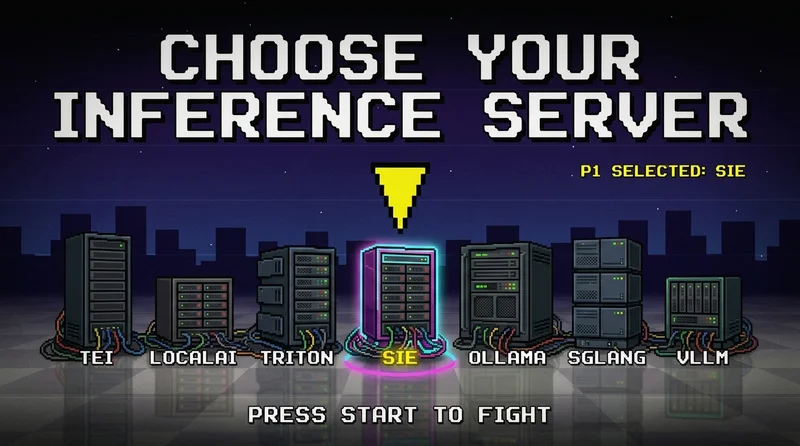
The great decision to self-host has landed. Model weights are free, your data is your own, and no more per-token bills addressed to the accounting dept. Then you open a list of serving options, and there are more than a dozen of them. Not a single one gives you a clear answer to aid with the choice.
The most useful question when picking a self-hosted inference server is not throughput, and it is not which GPU you have. The question is whether you need to serve one or many models. Single-model servers squeeze maximum performance out of one model per instance. Multi-model servers serve a whole fleet from one deployment, which is what most agents actually need.
TL;DRPick inference servers by shape of workload, not brand. There is no single winner, and people (or even AI) telling you otherwise is probably overselling. This guide covers 7 best self-hosted inference servers, specifically for open-source models, for each work case.
Why Even Self-Host Open-Source Models?
Why bother? Quick sanity check before we dive into tools. Self-hosting is work, and you should know why you are getting yourself into it. Still, these are the three main reasons to go open-source:
- Quality:Research from MIT Sloan's Frank Nagle and Georgia Tech's Daniel Yue found open models reach roughly 90 percent of closed-model performance at launch
- Cost: The pricing for self-hosting does not scale the same as for a hosted API
- Data residency: For regulated data, self-hosting is a must
Self-hosting has neat trade-offs. Self-hosting moves cost from a token counter to your own operations time (measured in human $/hr). The goal of a good inference server is to shrink that operational overload, and in return, cash expenditures.
Single-Model vs Multi-Model Servers
A single-model server runs one model per instance with optimizations for that use case in terms of:
- Batching
- Memory paging
- Attention kernels
If you need three models, you would need to run three servers.
A multi-model server holds many models in one deployment and routes each request to the right one. Usually, they share GPU resources between them.
Why does this decide the article? Because an agent is rarely one model. A typical agent request might embed a query, retrieve, rerank the candidates, extract structured fields, run a safety check, and only then generate. That is five or six models, mostly small.
Serve them with single-model servers and you are on five or six deployments, each with its own container, GPU, autoscaler, and dashboard. Serve them with one multi-model server and you have one thing to operate
Rule of thumb:One heavy generative model? Single-model server. A fleet of smaller task models? Multi-model server. Both at once (common)? You will run one of each, and that is fine. 👍
Inference at a Glance
If you are short on time, feel free to use this quick overview of inference servers. Note: they are listed alphabetically, and are not ranked in any particular way.
| Server | Single or multi-model | Primarily serves | Best for | Watch out |
|---|---|---|---|---|
| Single (per instance) | Embeddings, rerankers | Self-hosted retrieval stack | One model per instance | |
| Multi | Text, image, audio, embeddings | Many model types, OpenAI migration | Manual tuning, not tuned for scale | |
| Multi | Any framework (LLM, vision, tabular) | Heterogeneous models at scale | NVIDIA-only, steep setup | |
| Multi (local, swaps) | Local LLMs | Development, prototyping, offline | Low concurrency by default | |
| Single (per instance) | One large generative model | Agent loops, RAG, structured output | Smaller ecosystem than vLLM | |
| Multi | Small models (embed, rerank, extract) | An agent's model fleet, in production | Not for serving one giant LLM | |
| Single (per instance) | One large generative model | Max throughput, broad hardware | One model per instance |
Hugging Face TEI (Text Embeddings Inference)
TEI (Text Embeddings Inference) is Hugging Face's Rust-based server built for one job and doing it well - serving embedding and reranking models.
TEI exposes OpenAI-compatible endpoints, plus a native /rerank. It boots fast, batches dynamically, and runs on CPU or GPU. For a private embedder and a cross-encoder reranker in a private retreival pipeline, TEI is a clean, production-ready choice.
The catch is that it is a single-model server. One TEI instance serves one model, and the Hugging Face guidance is to run separate instances (and separate GPUs) for your embedder and reranker rather than sharing.
Best for:Focused, self-hosted embeddings and reranking. Good for one or two pinned models with a steady load. Simplicity as a feature.
LocalAI
LocalAI is an OpenAI-compatible, drop-in API you run on your own hardware, and its selling point is breadth. It works with many backends (llama.cpp, transformers, Diffusers for images, Whisper for speech, plus embeddings) so it can serve text, image, audio, and vectors from one place. LocalAI runs on commodity CPUs or GPUs and ships as a Docker image.
The flexibility comes with manual config, and performance lacks purpose-built engines (roughly 15-20% slower than Ollama on pure LLM). LocalAI is a versatile generalist, not specifically designed for throughput.
Best for: Teams that need many model types on modest hardware.
NVIDIA Dynamo-Triton (formerly Triton Inference Server)
Dynamo-Triton is NVIDIA's enterprise-grade multi-model server (renamed from Triton Inference Server after NVIDIA folded it into the Dynamo platform in 2025; both names still float around). One process can host a TensorRT-LLM engine, a vLLM engine, a PyTorch model, an ONNX classifier, and a Python pre-processor side by side, behind one HTTP or gRPC API, with dynamic batching and model ensembles.
It is genuinely powerful, and genuinely heavy. It runs on NVIDIA GPUs only, the base image is around 9.9 GB, and the configuration surface is large. It is also not built for serverless-style scale-to-zero. This is a platform-team tool, and in the right hands it consolidates a lot.
Best for:Teams serving heterogeneous models across frameworks at scale on NVIDIA hardware
Ollama
Ollama bundles model management, inference (via llama.cpp, running GGUF (a quantized model file format) weights), and an HTTP server into one binary. You run ollama pull llama3, and you have an OpenAI-style endpoint on port 11434. Ollama auto-detects CUDA, ROCm, and Apple Metal with zero configuration, and it holds several models locally, swapping them in and out on demand. For getting a private model running on your laptop in five minutes, nothing beats it.
The limit is concurrency. Ollama defaults to a handful of parallel requests (built for single-user scenarios). Ollama is good as a development environment,and not really suited for serving thousands of users.
Best for: Local dev, prototyping, and offline or single-user assistants.
SGLang
SGLang is a high-performance server tuned for structured generation and agent-style workloads. Its RadixAttention reuses shared prefixes, which pays off in the patterns agents use multi-turn conversations, RAG, and repeated system prompts.
The trade-off is in the ecosystem size and hardware breadth. SGLang is newer, with a smaller community and narrower hardware support. Still, it is a single-model server, so it serves one large model per instance without a hiccup.
Best for: One large generative model in an agent, RAG, or structured-output pipeline.
SIE (Superlinked Inference Engine)
SIE is the opposite from the single-model crowd. Most inference engines spread one big model across many GPUs; SIE does the inverse, running many small models on shared GPUs and switching between them fast. It serves 85+ pre-configured models (embedding, reranking, extraction, content safety, and small-scale generation) through one API, loading each on demand and evicting the least-recently-used when memory fills.
What makes it a production answer rather than a demo is what ships with it: a load-balancing gateway, KEDA autoscaling, Grafana dashboards, and Terraform for GKE and EKS Superlinked reports the pooled design reaches around 89 percent GPU efficiency against roughly 51 percent for per-worker approaches. Though, SIE is not a tool for serving one giant generative model. It is more suited for a fleet of small models.
Best for:An agent’s fleet of small models, with production stack included.
vLLM
vLLM is throughout workhorse of open-source serving. With paged attention and continuous batching, it can squeeze high concurrency out of a single large model, and it has the broadest reach of the group. Plus, the largest community, and the widest hardware support.
The trade-off is that it is single-model per instance and squarely aimed at generative LLMs. It is the safe default for serving one big model at scale, less so for a mixed fleet of small task models.
Best for:one large generative model at high throughput, on almost any hardware
How to Choose
So, how do you actually pick, without getting stuck in analysis paralysis? Ask what your workload really is. The harder question is production-readiness, and it is where most single-model setups cost the most. Runs on my machine" is not the same as "autoscales, has dashboards, survives a traffic spike, and does not need a dedicated engineer to babysit.”
| If your workload is... | Go with |
|---|---|
| One big generative model, max throughput | vLLM (or SGLang for RAG and agents) |
| Embeddings and reranking only | Hugging Face TEI |
| Local dev, prototyping, offline | Ollama |
| Many model types, modest hardware | LocalAI |
| Heterogeneous models at enterprise scale | NVIDIA Dynamo-Triton |
| An agent's fleet of small models, in production | SIE |
Heading to Production
The inference servers field splits into single-model servers that maximize one model and multi-model servers that run a fleet. The tool choice comes down to the shape of your workload.
If the shape of your problem is an agent’s fleet of small modes, and the part you would rather not build is the production wiring around them, you should aim your direction at SIE.
You can run SIE yourself under Apache 2.0, or let Superlinked run the managed version. For one big generative model, pair it with vLLM or SGLang and you have covered both halves.
See how to put together the LEGOs at Superlinked docs. Try it against your own eval, on your own hardware.
Frequently Asked Questions (FAQs)
What is the difference between a single-model and a multi-model inference server?
A single-model server (vLLM, SGLang, TEI) runs one model per instance and tunes everything for it, so a fleet means several deployments. A multi-model server (LocalAI, Dynamo-Triton, SIE) holds many models in one deployment and shares the GPU between them. Agents usually need many small models, which points toward multi-model serving.
Which inference server is best for an AI agent?
Most agents run several small models (embedding, reranking, extraction, safety) plus one generative model. The small-model fleet is best served by a multi-model server such as SIE, which is purpose-built for it and ships the production stack, too.
Is Ollama any good for production?
Ollama is excellent for local development, prototyping, and single-user or offline use, and it is the fastest way to get a private model running. For high-concurrency production traffic it is not the strongest fit: it defaults to a few parallel requests and trails purpose-built servers on throughput. Use it to build, then serve with vLLM, SGLang, or SIE.
Do I still need vLLM or SGLang if I use SIE?
Often, yes, and they complement each other. SIE is built for the fleet of small models an agent uses; vLLM and SGLang are built for serving one large generative model at high throughput. SIE even uses SGLang as a backend for generation, so the common production setup runs both.
Disclaimer: This article is paid content. HackerNoon’s editorial team has reviewed it for clarity and quality standards, but the views, claims, benchmarks, and comparisons expressed are solely those of the sponsor, and HackerNoon assumes no responsibility for third-party assertions contained in sponsored content.