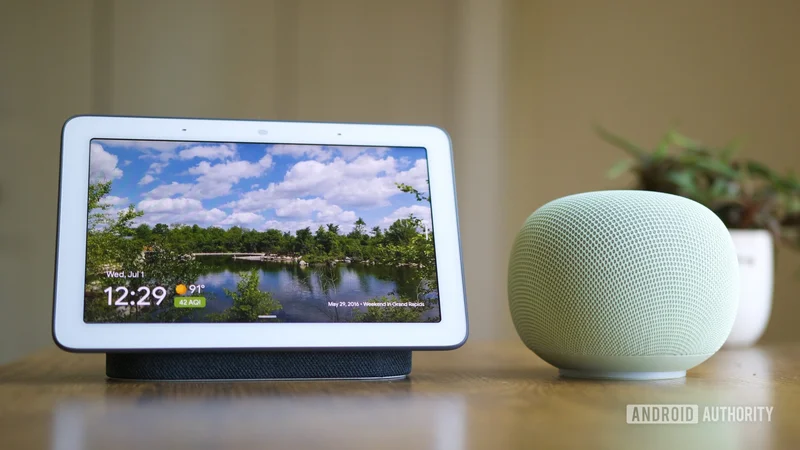
The Home Speaker is the wrong $99 Google Home gadget to buy in 2026
Aug 15, 2026 — 6:00 AM ET
With the launch of the Home Speaker, Google trimmed down its smart speaker and display lineup. The Google Home Speaker costs $99 and replaces the now-discontinued Nest Mini and Nest Audio speakers. If you’re in the market for a new smart home controller compatible with Google Home, the Home Speaker is your cheapest option. However, there’s another $99 smart home controller that is a better addition to your Google Home than the Home Speaker: the second-generation Nest Hub.
Google’s second-generation Nest Hub is somewhat of an afterthought in 2026 because of its age. The smart display was refreshed five years ago, but it shouldn’t be written off just yet. Google still sells and officially supports the Nest Hub, and it runs the same Gemini chatbot as the brand-new Home Speaker.
In fact, I put my Nest Hub up against the Home Speaker, and I always want the display to respond to my requests instead of the speaker. If I could only have one managing my home, I’d pick the Nest Hub over the Home Speaker.
Which current Google smart home controller would you buy?
The Nest Hub’s screen does more than play videos
The obvious advantage of a smart display is that it can play videos and show visual information. I enjoy casting video podcasts, streaming services, and YouTube videos to my Nest Hub to watch at my desk or in my kitchen. Plus, being able to glance at the weather, date, and time is always neat. Beyond content consumption and glanceability, the Nest Hub is also a better smart home controller than the Home Speaker.
The second-generation Nest Hub’s underrated hardware helps explain why. Aside from the 7-inch touchscreen display and 43.5mm full-range speaker driver, the Nest Hub also packs a trio of smart sensors. There’s a temperature sensor, an ambient light sensor, and a Soli sensor inside — none of which are found in the Home Speaker. While all three sensors are handy, the Soli sensor stands out. It detects movement and breathing, making gesture control, presence sensing, and even sleep sensing possible.
Otherwise, the Nest Hub and the Home Speaker are quite similar. Both smart home controllers use three far-field microphones for voice pickup, and they each have a physical mute switch. The Home Speaker has the advantage of a larger, omnidirectional 58mm full-range driver. It sounds better than the Nest Hub, although I’m not sure if sound quality alone is enough to convince me to leave features like ultrasound sensing, sleep sensing, and quick gestures behind.
The same requests result in completely different experiences depending on whether you use a smart display or a smart speaker.
As I used the Nest Hub and the Home Speaker side-by-side, I valued seeing visual confirmations that a smart home command was executed properly. When I changed the temperature setting on my Nest Thermostat using my voice, I’d see the change take effect on my Nest Hub screen. If I decide the temperature I requested isn’t quite right, I have a slider and manual controls automatically opened on the Nest Hub’s touchscreen. By comparison, having to use my voice for every Home Speaker command was tiring after a while — especially considering Gemini’s propensity to reply with long-winded answers.
My favorite ways to use the Nest Hub’s screen in my home had nothing to do with casting videos. They involved mundane requests that were more convenient to monitor thanks to the onboard touchscreen. Both the Nest Hub and Home Speaker can recite a recipe, but only one can display it so I can follow along while making dinner. I can ask the Nest Hub and Home Speaker to test my Nest Wi-Fi Pro connection, but only one can show me the speed test results on the screen.
The same requests result in completely different experiences depending on whether you use a smart display or a smart speaker. Since the Nest Hub and Home Speaker are both priced at $99, I wouldn’t want to choose the latter and miss out on the former’s extra functionality.
Smart displays help you make the most of Nest cameras
Google Home users who only need a smart device to adjust the lights or stream music may find the Home Speaker more useful. The deeper you get into the Google Home and Nest ecosystem, the more valuable a smart display becomes. A few of the visual experiences that sold me on the Nest Hub were possible because I own a Nest Thermostat and Nest Wi-Fi Pro router. The ones that sealed the deal integrated with my Nest Battery Doorbell and Nest Cam Indoor security cameras.
Gemini for Home is incredible at analyzing what your cameras see. The data is used to inform AI-summarized notifications and recaps, but they aren’t very helpful. Instead, Gemini for Home is best at answering specific questions using your Nest camera recordings. I’ll regularly ask what time a package was delivered, and I can specify which carrier dropped it off. The Home Speaker answers the question, but the Nest Hub automatically surfaces the event recording, complete with a timecode and video of the drop-off.
I could pull out my phone and search for the event clip myself, but having a Nest Hub around streamlines the process. If I ask a more vague question, the Home Speaker might struggle with it. The Nest Hub, thanks to its display, shows me a list of possible video recordings related to my request. I can scroll through the related events and tap each one to watch the video recording. After getting used to using a Nest Hub to review my Nest cameras, I wouldn’t want to use them with only a smart speaker.
I’ve used Nest Hub displays to add a peephole and doorbell chime to any room. With a smart display and my Nest Battery Doorbell, I can view a live feed of who’s outside when the doorbell rings — and hear it from anywhere. Without it, I’d have no idea when someone is knocking on the front door from deep inside my apartment. It’s true that the Home Speaker can do some of these things, like make audio announcements. The common denominator is that Home Speaker features feel half-baked after using a Nest Hub display for the same requests.
The Home Speaker does little better than the Nest Hub
The Google Home Speaker is louder, sleeker, and better-sounding than any Nest Hub. The tiny orb-shaped speaker can blend into any space, and it doesn’t scream “smart.” Meanwhile, the Nest Hub sacrifices sound quality to provide all its other features, and there’s no mistaking it for chic home decor. That’s about all the praise I have to give for the Home Speaker, at least in comparison to the Google Nest Hub. The former’s functionality is more akin to the $50 Nest Mini it replaced, whereas the Nest Hub’s capabilities make it worthy of its $99 price point.
I expected the Home Speaker to impress me with its quad-core A55 processor and NPU, which are designed for Gemini. In reality, I didn’t notice my Nest Hub responding that much slower than the Home Speaker. I was willing to wait either way, because the enhanced experience delivered by the Nest Hub’s screen rewarded my patience.
I’ve been asking for a new Nest Hub lineup since January, and my position hasn’t changed. Google should upgrade its smart displays and give us true replacements for the Nest Mini and Nest Audio. Regardless, it’s a mistake to assume that the Home Speaker is the only Google smart home controller worth buying in 2026. If I had $100 to spend, I’d pick up the aging second-generation Nest Hub over the Home Speaker without thinking twice.