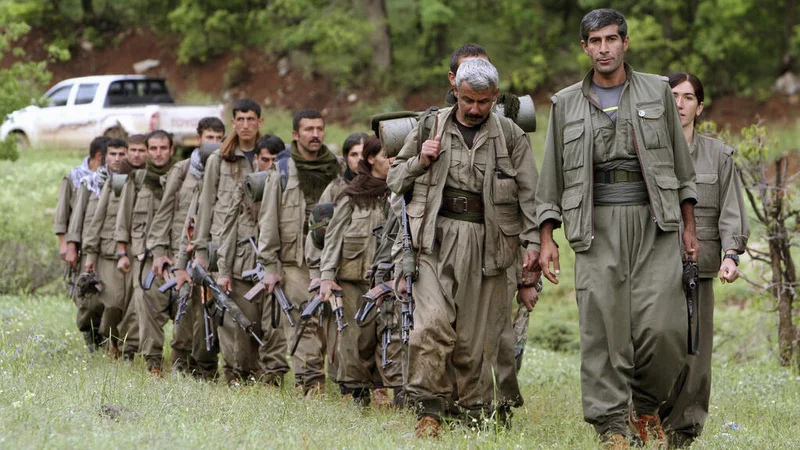
Turkey stands on the threshold of closing a conflict spanning almost 50 years, after the Turkish parliament this week passed a law allowing exiled Kurdish militants to return home and rejoin society. The legislation aims to end the war with the Kurdistan Workers' Party (PKK), which has battled the Turkish state for independence since 1984.
On Monday, legislators voted 468-88 in favour of a law detailing how the PKK will lay down arms, disband and guide most members back into civilian life.
Many see this legislation as a turning point after decades of bloodshed.
“This law in question is going to make a giant contribution,” predicts sociologist Mesut Yegen of the Diyarbakir-based Kurdish Studies Center.
“If the PKK militants are convinced that they can be safe in Turkey, it's estimated that some 15,000 people in Europe, in Syria, in Iraq and in the prisons in Turkey are going to be either released or are going to be able to come back home.”
The PKK leadership, based primarily in Iraq, is not covered by the legislation. Nor is the group's founder and leader Abdullah Ocalan, imprisoned since 1999 in a Turkish jail.
He initiated the peace process and last year called for the disarmament and dissolution of the PKK.
Hope, caution
Istanbul, now the city's with the world’s largest Kurdish population, became a sanctuary in the 1990s as hundreds of thousands fled the violence raging in Turkey's southeast. At the conflict’s peak, the Turkish army destroyed villages in relentless scorched-earth campaigns.
In Istanbul's Bagcilar district, home to a vibrant Kurdish community, conversations reveal a fragile mix of hope and caution.
“This law seems good for the honour of the Kurds and to stop bloodshed,” said 31-year-old Ahmet, who only wanted to be identified by his first name. “Mothers should not shed tears anymore.”
But others were more wary. “The state has been delaying our rights for decades; I do not believe this process will be different,” said Kava, who also preferred not to give his full name. “I do not trust an arrangement in which Kurds do not have legal status.”
Kurds make up around a fifth of Turkey’s population, but are not legally recognised as a minority.
Emotions appear equally divided among Turks. “If they’re agreeing to live under the Turkish flag and love our country, that’s fine – let them,” said 51-year-old Mehmet Tas.
But 40-year-old Ertugral Zengin is unconvinced. “They committed a crime – and now they are to be pardoned? Do I want something like that? No, I won’t accept it.”
Political momentum
The decades-long conflict has claimed 40,000 lives and forced more than 3 million people from their homes.
While major political parties support the peace process, hardline nationalist groups remain staunchly opposed, insisting it rewards a PKK they see as already defeated.
The process hinges on the laborious task of disarming the PKK and verifying its weapons are gone.
Maintaining the current political momentum is vital, warns Asli Aydintasbas, a Turkey expert at the Brookings Institution, a think tank in Washington DC.
“If this drags on, political support for the legislation and for the return of former PKK members, seen by many Turks as terrorists, would become politically problematic for the government. Timing and moving fast is very important to achieve reconciliation,” she says.
The government is expected to face growing pressure to address Kurdish rights, including Kurdish-language education in schools and local autonomy, along with broader democratic reforms.
Social media buzzes with questions: how can PKK members walk free while critics of President Recep Tayyip Erdogan remain behind bars?
Yegen warns that since the new legislation fails to address Kurdish rights and democratisation reforms, the government needs to move swiftly.
“The fact that these two issues are not touched upon by the law has created many doubts on both Kurdish and Turkish sides about whether disarmament will be the government's only agenda,” he says.
For Erdogan, steering the peace process to success could secure the vital Kurdish vote in the 2028 elections. Yet extending Kurdish cultural rights risks alienating Turkish nationalists, and relaxing pressure on the opposition brings its own perils as their electoral strength grows.
For now, the negotiations present a rare window for reconciliation and lasting peace.