One day in June, during the height of the World Cup competition in Vancouver, a team of physicists gathered at the boatyard on the city’s bustling Granville Island.
Like the soccer fans flocking to the city, the researchers were motivated by a beautiful game in which genius and chance can sometimes conspire to produce a wondrous result.
But the physicists’ game is more cosmic in nature. And, unlike soccer, it’s a water sport.
That part, at least, was apparent to onlookers as they contemplated the mysterious cargo delivered to the boatyard that morning.
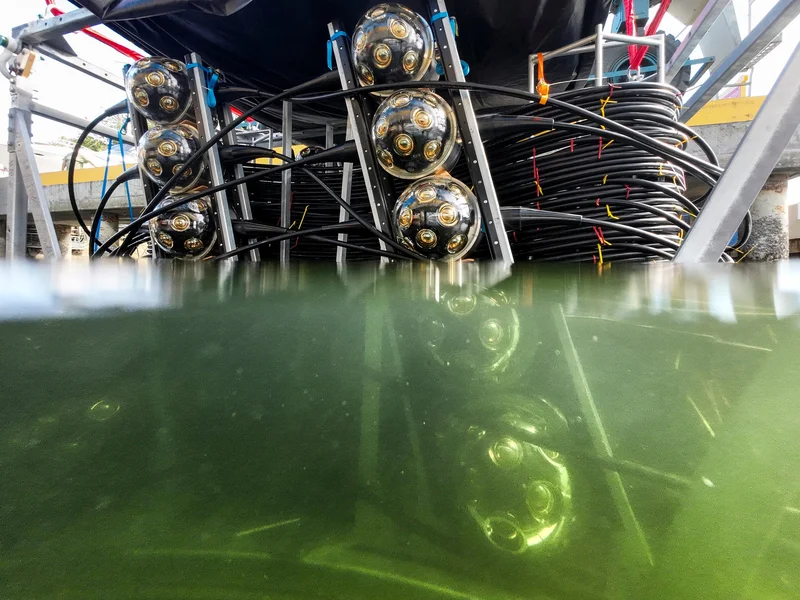
When a shroud was pulled back it revealed an open metal structure the size and shape of a shipping container. Within its rectangular frame sat an elaborately coiled stack of black cable carefully woven around columns of beach-ball-sized glass spheres.
“This is fascinating,” said Paul Stoodley, the boatyard manager who directed a large boat hoist that was wheeled into position around the strange apparatus. Noticing the puzzled glances from tourists on their way to a whale-watching cruise, he added, “I don’t think people realize how big of a deal this – this is history over here.”
History is what scientists hope to make once their gear is deployed at sea.
The cable and spheres are the first instalment of a larger project known as the Pacific Ocean Neutrino Experiment, or P-ONE. As the name suggests, its aim is to detect neutrinos, the lightest and strangest particles of matter known to science.
The purpose of P-ONE is twofold. First, it is to discern what neutrinos at the highest energies can reveal about tumultuous events far off in space. In doing so, it may also help illuminate why neutrinos are the oddballs of the Standard Model of particle physics, the current scientific description of matter, and possibly uncover clues to a deeper theory.
“Our expectation is not only to see the universe with neutrinos, but to potentially find evidence and explanations for where the Standard Model breaks,” said Matthias Danninger, who holds a Canada Research Chair in experimental particle physics at Simon Fraser University in Burnaby, B.C., and is spokesperson for P-ONE.
Neutrinos are everywhere. They are made in nuclear reactors, in the sun’s core and in exploding stars, among other places. Trillions of them are flying through your body every second, though this is nothing to worry about since neutrinos interact so rarely with other forms of matter that neither people nor planets pose much of an impediment to them. It’s precisely because neutrinos are so hard to stop or deflect that they have become intriguing to scientists.
For generations, astronomers have relied on light of different wavelengths to learn about phenomena in the distant universe. But light can be absorbed by clouds of interstellar dust and gas, which means some corners of the cosmos are forever hidden from view.
Somewhere out there, the universe is also producing fast-moving electrically charged particles – electrons, protons and atomic nuclei – that travel to us from distant locales and are collectively called cosmic rays. But cosmic rays can be blocked by dense matter or diverted by magnetic fields that thread through our galaxy.
None of these barriers or detours affect neutrinos. Of all the particles we can detect, only neutrinos travel undeterred, in straight lines, from precisely where they were made. And that means the highest-energy neutrinos we can detect offer a direct measurement of nature at its most extreme. “Neutrinos are unique cosmic messengers pointing directly to the universe’s most powerful and enigmatic particle accelerators,” Dr. Danninger said.
But to learn what high-energy neutrinos have to tell us, they must first be caught. And to do that, as on any fishing expedition, the net must be seaworthy. For P-ONE this is literally true, because the experiment is designed to operate in the ocean. It’s this detail that brought Dr. Danninger and a team of collaborators from across Canada and Europe to Granville Island for a crucial test that would show whether the detectors they built can function at sea.
As the researchers set about strapping their equipment to the boat hoist, Dr. Danninger said, “This is really our last check to make sure we’ve done everything possible to have the best shot at success.”
Deep sea probe
The completed P-ONE experiment will consist of 1,400 photodetector units anchored to the Pacific Ocean floor in a one-cubic kilometre array. When a high-energy neutrino arriving from deep space interacts with a molecule of ocean water, it can generate a burst of light that the sensors pick up, revealing the energy and direction of the incoming particle.
Vancouver
Island
Vancouver
P-ONE
experiment
location
CANADA
U.S.
Victoria
Seattle
P-ONE ARRAY
Will consist of seven string clusters
String cluster
STRING CLUSTER
Each cluster will have 10 strings
Floats to keep the cables taut
Photodetectors: With 20 per string, P-ONE will consist of 1,400 digital optical modules distributed across 70 strings
1,000 m
Anchors, where the electrical and data lines plug in
200 m
MURAT Yükselir / the globe and mail,
Source: Technical University of Munich;
OPENSTREETMAP
Deep sea probe
The completed P-ONE experiment will consist of 1,400 photodetector units anchored to the Pacific Ocean floor in a one-cubic kilometre array. When a high-energy neutrino arriving from deep space interacts with a molecule of ocean water, it can generate a burst of light that the sensors pick up, revealing the energy and direction of the incoming particle.
Vancouver
Island
Vancouver
P-ONE
experiment
location
CANADA
U.S.
Victoria
Seattle
P-ONE ARRAY
Will consist of seven string clusters
String cluster
STRING CLUSTER
Each cluster will have 10 strings
Floats to keep the cables taut
Photodetectors: With 20 per string, P-ONE will consist of 1,400 digital optical modules distributed across 70 strings
1,000 m
Anchors, where the electrical and data lines plug in
200 m
MURAT Yükselir / the globe and mail, Source:
Technical University of Munich; OPENSTREETMAP
Deep sea probe
The completed P-ONE experiment will consist of 1,400 photodetector units on the Pacific Ocean floor in a one cubic-kilometre array. When a high-energy neutrino from deep space interacts with a molecule of ocean water, it can generate a burst of light that the sensors pick up, revealing the energy and direction of the incoming particle.
Vancouver
Island
Vancouver
P-ONE
experiment
location
CANADA
U.S.
Victoria
Seattle
P-ONE ARRAY
Will consist of seven string clusters
STRING CLUSTER
Each cluster will have 10 strings
Floats to keep the cables taut
String cluster
Photodetectors: With 20 per string, P-ONE will consist of 1,400 digital optical modules distributed across 70 strings
1,000 m
Anchors, where the electrical and data lines plug in
200 m
MURAT Yükselir / the globe and mail, Source: Technical University of Munich; OPENSTREETMAP
Wired for light
The vision for P-ONE is a bold one.
It consists of a forest of one-kilometre-long strings of cable that are anchored to the ocean floor. At their free ends, the strings are attached to floats that keep them vertical and taut.
Positioned along the strings at 50-metre intervals are the spheres, each one about the size of a beach ball, made of thick borosilicate glass. The spheres are packed with photosensors designed to pick up telltale flashes of light that are produced whenever a high-energy neutrino collides with a water molecule.
Because such collisions are rare, the only practical way to observe them is with a detector of enormous volume. The frigid, dark waters of the Pacific are ideal for this. When completed, P-ONE will have 70 strings with 20 optical modules each for a total of 1,400. Together, they can monitor about one cubic kilometre of water for signs of incoming neutrinos.
The location selected for the experiment lies on a smooth, underwater plain called the Cascadia Basin, at a spot some 200 kilometres off the coast of Vancouver Island and 2.6 kilometres deep.
“To most people it would seem pretty bare – you don’t see a lot of schools of fish down there,” said Benoît Pirenne, corporate innovation and technology officer for Ocean Networks Canada.
The organization has been able to offer a key ingredient that is necessary for P-ONE’s success: connectivity. Since 2009, ONC has maintained an underwater network 800 kilometres long so devices that measure ocean conditions can feed data back to researchers on shore.
The plan is for P-ONE to hook into ONC’s network via a 30 km-long extension cable. This will keep it clear of a designated marine protected area that might otherwise limit access to the experiment. Current plans call for a ship to head out to the location as early as September to install both the extension cable and the first prototype string.
It’s that prototype string that was coiled up and brought to Granville Island for a submersion test to ensure all of its electrical connections function as planned underwater. If there is a problem, the goal is to identify it here, before the string ships out to sea.
Mr. Pirenne and two ONC engineers were also at Granville Island to participate in the submersion test and to watch the outcome “of a long process of design and development,” he said.
But to get the test under way, the equipment first had to be hoisted up and slowly guided across the boatyard to the water’s edge.
While P-ONE aims to push the frontiers of particle physics, this particular operation presented some hurdles that resembled a problem in first-year mechanics.
Once aboard ship, the rectangular cage carrying the cable is meant to be lowered to the ocean floor using a crane with a single point of attachment at the top. The six-tonne structure is designed with this in mind. At the boatyard, however, the cage had to be suspended from four corners. Before committing to the manoeuvre, the team first had to be sure the metal frame could handle the distribution of forces involved.
“I would say lifting safely was more challenging than we probably expected. But I think we have a good plan now,” said Dr. Danninger, midway through the day.
By the afternoon, the precious load hung suspended over the lapping waves of False Creek. Dr. Danninger and his crew connected the cables that supplied power and sent real-time data to their temporary control centre in the back of a U-Haul truck.
Once everything was ready, the entire contraption was slowly lowered into the water one section at a time. Soon, pockets of air held within the endless loops of cable escaped and bubbled up around the glass spheres, temporarily making it seem as though the equipment was descending into a pot of boiling water.
Eyes on the skies
Canada has a remarkable legacy in neutrino physics thanks to the Nobel Prize-winning work of Arthur McDonald and others more than 25 years ago at an underground laboratory near Subury, Ont.
It’s there Dr. McDonald and his team employed 1,000 tonnes of heavy water inside a 12-metre-wide acrylic tank to detect neutrinos from the sun. The data helped to confirm key properties of the elusive particles, which come in three varieties, including the fact that neutrinos have a small but non-zero mass.
The celebrated experiment was possible in part because solar neutrinos are abundant. When it comes to high-energy neutrinos from distant objects in the universe, it’s a very different story. Such particles are few and far between, which requires different detection strategies and experiments of much larger volumes.
Among them is IceCube, a U.S.-built detector located in Antarctica, where long strings of photosensors have been melted into the thick glacier that sits atop the South Pole. Beneath the layer of snow near the top of the glacier, the ice becomes dense, clear and stable, making it ideal for spotting flashes of light created when neutrinos strike frozen water molecules.
Completed in 2010, IceCube was the first experiment to show that high-energy neutrinos exist and can be linked to astronomical sources. A prime example is the active galaxy M77, which houses a supermassive black hole at its centre.
It is possible to infer such a connection because the experiment can sense what direction a neutrino is coming from based on the orientation of the resulting light flash. (The flash expands in a cone-shaped pattern, rather like the wake of a speedboat.)
However, scientists using IceCube face a challenge because the experiment is bombarded by cosmic rays that are far more numerous than high-energy neutrinos and produce a similar effect in the detector. To distinguish neutrinos from cosmic rays, they disregard the particles that come from above and measure only those arriving from below. Unlike cosmic rays, neutrinos can penetrate the thousands of kilometres of solid rock that make up the bulk of the Earth’s mass and reach the experiment from an upward direction.
Ironically, this means that IceCube, although located at the South Pole, is actually detecting neutrinos that reach us from a portion of the northern sky. To cover neutrinos coming from other directions in space, scientists need to build similar experiments in other parts of the world.
Two that are currently in operation include Russia’s Gigaton Volume Detector in Lake Baikal and the European-led Cubic Kilometre Neutrino Telescope, or KM3NeT, located in the Mediterranean Sea, off Toulon, France. Both use deep water rather than ice as a detection medium.
In 2025, KM3NeT reported the electrifying measurement of a neutrino with the highest energy ever recorded. Because other explanations cannot be completely ruled out, it remains an ambiguous find. But such a tantalizing result helps build the case for another large neutrino detection experiment – ideally in a northwest location where it could see particles coming from directions not covered by other facilities.
That increases the odds of an experiment like P-ONE making interesting discoveries, said Jodi Cooley, executive director of SNOLAB, the Sudbury-based facility that grew out of Art McDonald’s solar neutrino work.
No stranger to particle physics on a large scale, Dr. Cooley said that Canada’s track record in the field and the fact there is already infrastructure in the deep ocean that can support a giant neutrino detector further bolsters the case for P-ONE.
“I think it’s promising,” she said. “But it’s going to take perseverance.”
Testing the waters
Granville Island is not the Cascadia Plain, but for the purpose of the submersion test it was exactly what the P-ONE team needed.
The point of the exercise was not to replicate the crushing pressure two kilometres below the ocean or to switch on the photosensors to search for neutrinos. Had they done so, the amount of light present in the environment would have completely blown out the delicate instruments made to operate in total darkness.
(Indeed, P-ONE is so sensitive to light that one of its expected side benefits is providing data on the faint light generated by bioluminescent creatures living in the deep ocean.)
For now, physicists simply needed to make sure there were no ground faults in the string – short-circuits caused by water getting into places it shouldn’t. But once the string was immersed, the team also planned to make the most of the opportunity.
“If there’s a ground fault will see that very fast,” Dr. Danninger said. “But for us it’s also interesting to operate and communicate with the line, check every instrument, check the data network, check the timing.”
In the end, the testing lasted well into the night. As the lights of the Vancouver skyline danced on the surface of the water, the giant cable and glass sphere were sitting just below, in constant communication with researchers until the apparatus was pulled out of the water close to dawn.
“This was a huge milestone,” Dr. Danninger said. Handling the equipment in a marine environment and successfully operating it for testing “really demonstrates that our prototype string is ready.”
Others involved in the test reflected a growing sense that P-ONE is finally transitioning from a laboratory project to a data-gathering tool at work in the world.
“This is very special,” said Konrad Kopanksi, a physicist with the Polish Academy of Sciences in Krakow, Poland, who worked on the Lake Baikal facility before moving to P-ONE. “Every experiment which takes place in a real natural environment is exciting.”
It invariably takes many years to mount such an effort, and years more to get meaningful data. It also takes funding. Once the prototype string is successfully deployed, team members estimate that the cost of the full-scale experiment will be on the order of $100-million.
“Our goal is that we develop and strengthen the Canadian marine technology industry with this investment as we grow this experiment,” Dr. Danninger said.
For the youngest members of the collaboration, the chance to be involved at the beginning of a major physics experiment was the key selling point.
“I like the idea of building a telescope to do physics. That’s very cool – and getting our hands on everything, starting from the ground up,” said Annabelle Grimes, a graduate student at Simon Fraser who has been working on a system that will allow P-ONE’s photosensors to know exactly where they are relative to each other when a neutrino is detected.
For fellow graduate student Vincent Jourdenais, the experiment’s underlying purpose was the main attraction.
“There’s something that really interests me about how we use the lightest, smallest and hardest-to-detect particle to study the most unfathomably big objects in the universe,” he said. “I just, I think there’s a lot of beauty in that.”
The definite particle: More on physics and space
Video: A Snolab informer
Three years ago, The Globe went deep below Sudbury to learn more about SNOLAB’s groundbreaking work in physics. Here’s how the facility studies neutrinos, dark matter and other mysteries of the universe.
The Globe and Mail
The Decibel podcast
Canada is not a spaceport powerhouse like some of its G7 counterparts, but Ottawa wants to change that. Science reporter Ivan Semeniuk spoke with The Decibel about a recent launch in Nova Scotia and the bigger picture for Canadian science sovereignty. Subscribe for more episodes.