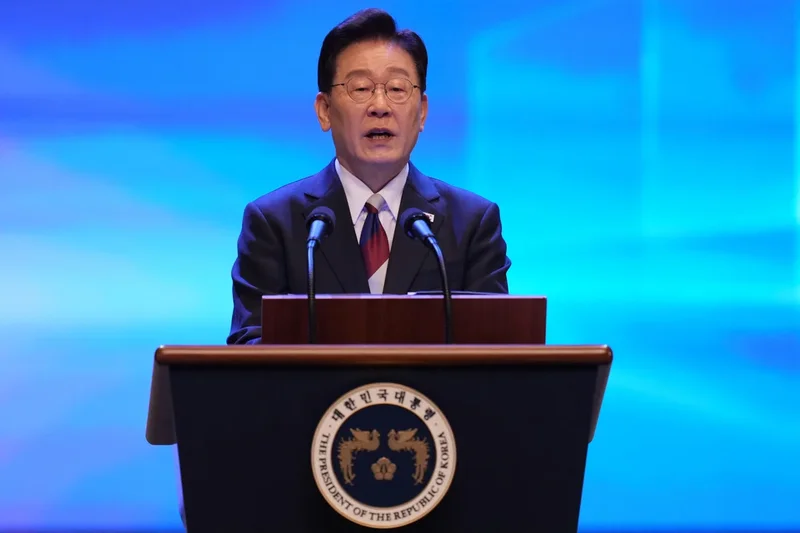
South Korean leader Lee Jae Myung called for talks with rival North Korea to “pursue peaceful coexistence”, urging the need to replace the Korean peninsula's armistice with a "peace regime".
The Korean War of 1950-53 was stopped by a ceasefire and not a peace treaty.
In a speech marking the 81st anniversary of Korea’s liberation from Japanese colonial rule at the end of World War II, the president called for dialogue to end the war once and for all.
Mr Lee said Seoul and Pyongyang must “sit down together to pursue peaceful coexistence and shared growth”.
“Rather than a concession,” the president said, “this would mark the start of coexistence.”
“We’ll embark on a journey to end war and transform the Korean Peninsula’s unstable armistice into a peace regime. Let’s drop all intentions of threatening one another and initiate dialogue among directly concerned parties in order to conclude this long war,” Mr Lee said, adding that talks could also explore ways to curb Pyongyang's nuclear capabilities.
The president assured that Seoul would take the steps needed to ease tensions on the peninsula and build safeguards to contain escalation.
“Peaceful coexistence on the Korean Peninsula is a duty, not a choice,” he said.
Pyongyang’s relations with Seoul remain broken, with North Korean leader Kim Jong Un labelling the rival nation as the most hostile state and ordering stronger frontline defences.
Pyongyang has criticised Seoul’s joint military drills with the US and its plan to build nuclear-powered submarines as grave provocations.
Speaking about his country’s ties with Japan, Mr Lee said cooperation between the two countries was “more important than ever”.
He said that Seoul and Tokyo had broadened cooperation in recent years in supply chains, energy and advanced industries.
“Guided by pragmatic diplomacy centred on national interests,” he said, “my administration will continue to broaden the horizons of cooperation in pursuit of our shared interests and pool our collective wisdom to resolve common challenges.”
The leader called for confronting the past while leaving open the future when it came to dealing with the memory of Japanese colonial rule and hoped to launch 60 years of peace and prosperity with the "close neighbour".
“Trust is formed through mutual empathy and a sincere recognition of one another’s pain,” he said. “To this day, victims and bereaved families are still living with the wounds and pain of the past.”