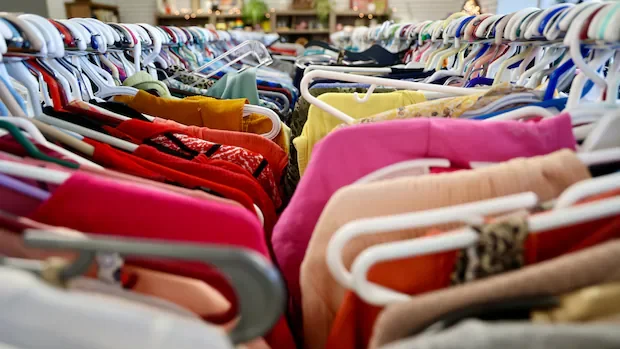
Why more clothes donated to charity are going in the garbage
‘We need to turn off the tap,’ says textile circularity consultant
Kathy Broussard pulls back a curtain to reveal a mountain of plastic bags stuffed with used textiles. It’s a quarter — no, she self-corrects, an eighth — of all the donations her store has recently received.
The basement is also full, and two custom-made extra-large donation bins outside the store fill up every day.
“It’s a treadmill. It doesn’t end, it keeps coming and going,” she said.
Broussard’s staff and volunteers sort through the bags and sell what they can. Items that do not sell within about a month are put into bins where people can take them for free. Garments spend a day in the free bins before going in the dumpster.
“We need to find somewhere for it to go besides the landfill and I don’t know where that’s gonna be,” said Broussard, executive director of Hand in Hand, a non-profit thrift store in Halifax whose proceeds go to the Society of Saint Vincent de Paul.
For decades, many charity thrift stores across the country sold their surplus clothes to other non-profits, which would in turn sell the goods in bulk to support their own charitable causes. But in recent months, those arrangements have been falling apart.
Hand in Hand hasn’t had a buyer since February, and Broussard said she’s searched high and low for an alternative, without success. Dumpster pickups at her store have increased 50 per cent, and every pickup comes with a fee that eats into the charity’s bottom line and undermines Broussard’s desire to be a good environmental steward.
“Clothes really shouldn't go in the dumpster. But there's just so many clothes being generated now with fast fashion,” she said.
CBC News spoke to four other charity thrift operations that are in the same bind as Hand in Hand, but did not want to speak about it on the record.
‘That market is rupturing’
Charlotte Genge, a textile circularity consultant, works with people in the used clothing industry across Canada. She said charity thrift stores are facing the same problem coast to coast: options are dwindling for getting rid of unsold stock.
“We're seeing just such an abrupt end to that collection mechanism. And it's really throwing people off, not only because they want to be environmentally friendly, but also because it costs them money to do it,” she said, referring to dumping fees.
Without a fix, she said she expects the volume of textiles going to local landfills to swell in the coming years.
“It almost needs to get worse before it's going to get better because it's been so out of sight, out of mind for so long.”
Genge said used clothes in Canada have historically cycled through thrift stores until they’re deemed unsellable, and then followed two possible paths: they’re repurposed (usually into industrial rags, stuffing or insulation) or they’re exported.
“But that market is rupturing and because of that, it's having all of these downstream effects,” she said in an interview.
The National Diabetes Trust, which is the clothing donation program that supports Diabetes Canada, collects used clothing from donations bins and from charity thrift stores to sell it wholesale and support its cause.
The National Diabetes Trust said it has "temporarily paused” pickups from thrift stores in five provinces: Nova Scotia, Ontario, Manitoba, Saskatchewan and British Columbia.
“Like many organizations involved in textile collection and reuse, we are experiencing changing market conditions that have affected inventory levels and processing capacity,” they said in a statement, adding they’re seeing increased donation volumes.
Value Village’s role
A common buyer for non-profit collectors is Value Village. While it is not a charity, it is enmeshed with the charitable used clothing sector. Purchases from non-profit partners used to account for nearly half the items Value Village took in, but in recent years, it’s been shifting how it sources its goods.
Recent annual reports from the company say it's cheaper and therefore more profitable to supply stores with items that are donated directly to Value Village, rather than buying bulk from non-profits.
Last year’s report said the company has been “strategically focused” on getting more donations, and demonstrates the strategy bearing out: direct donations to the thrift giant grew from 53 per cent of all the goods it processed in 2019 to 78 per cent in 2025.
CBC News made multiple interview requests but the company would not make anyone available. In email exchanges, a spokesperson did not directly answer questions about changing its buying practices or about sending textiles to landfills.
On buying practices, they said they value working with their non-profit partners.
On landfilling, they said “most” of the items that don’t sell in Value Village stores continue “through the global reuse economy.”
The global context
Steven Bethell says his company, Bank & Vogue, is the biggest exporter of used clothing in Canada, buying from charities across North America and shipping to more than 30 countries around the world.
“Canadians are buying more and more clothing,” he said in an interview from his Ottawa head office. “There's more and more of a problem out there.”
His company’s mission is to find solutions to that problem, which he calls “the crisis of stuff.” He said the export business is “very strong,” but he also described some acute challenges that help explain why some thrift stores are struggling with a backlog.
One challenge is that the cost of rounding up used clothes for export is rising because of inflation and this year’s war-driven spike in fuel prices, he said.
“To go around and collect the product and bring it back to a central place, the costs have literally doubled or tripled in the last few years.”
He said exporters are also grappling with new “war risk” fees for freight going through or near the Middle East and Eastern Europe, new levies on used clothing imports to some African countries, and increasing competition in the international used clothing marketplace.
Bethell said the Chinese, in particular, have made the used clothing market more competitive, having rapidly shifted from consumers of second-hand clothes to producers of it.
“About 10 years ago, 70 to 80 per cent of the clothes in Kenya were either from the U.S. or Canada. Now 70 per cent of that clothing is not from the U.S. or Canada, but comes from China,” he said.
He described the current challenges as “dramatic,” but said he expects the international marketplace will normalize and thrift operators will adapt.
“It is always a dynamic environment and especially when you're working with the developing world, markets are in continual flux. It's just part of the nature of the trade,” he said.
The solution
For Genge, the bottom line is that Canadians are consuming too much new clothing, making it increasingly unrealistic to keep up with the ever-growing volume of donated garments.
“The real problem, it's just that we need to turn off the tap,” she said.
Genge said every level of government needs to take action. She pointed to extended producer responsibility — a policy that puts responsibility for end-of-life management of products onto the manufacturers — as one possible solution. Another, she said, would be to enforce the use of recycled content.
“There are very limited recycling operations happening in Canada right now,” said Genge.
Recycled textile materials cannot compete on cost with virgin materials, but a government mandate could change that, she said.
“Waste is a resource. And we should be looking at not waste management, but resource development from the waste perspective.”
WATCH | Why more clothes donated to charity are going in the garbage:MORE TOP STORIES
- Day parole extended for Hells Angels hitman
- VideoAre these whale sightings rare for Nova Scotia?
- Swimming not advised at 2 N.S. beaches due to high bacteria levels
- Province should consider changing rules for novice motorcyclists, committee says
- Bail bid for man suspected of making bomb threat against U.S. Consulate delayed again