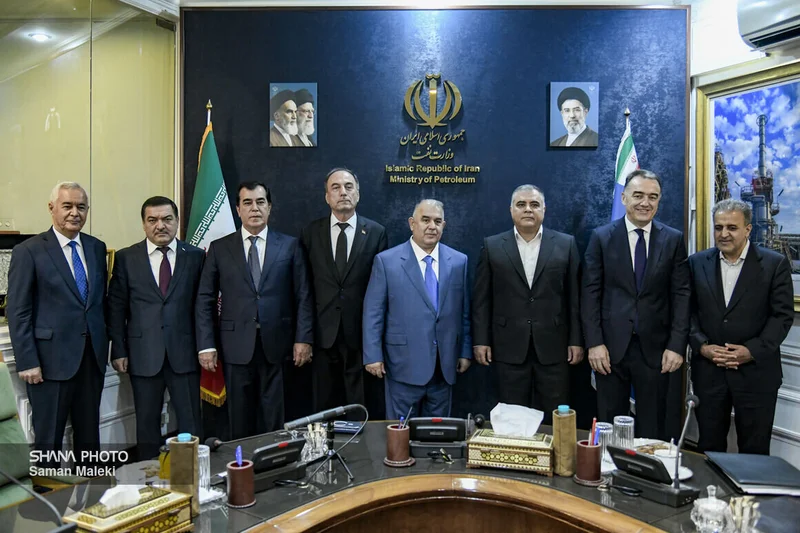
Iran, Tajikistan agree on mechanism for oil product exports, crude supply
TEHRAN- Iran and Tajikistan have taken a significant step toward deepening their energy partnership, with both sides agreeing to establish a working group to examine mechanisms for exporting Iran's surplus oil products and supplying crude oil needed by Tajikistan's refineries.
The agreement, announced on August 15 following high-level talks in Tehran, marks the latest in a series of accelerated diplomatic and economic engagements between the two Persian-speaking nations over the past year.
Mohsen Paknejad, Iran's Oil Minister, met with Dalir Juma, Tajikistan's Minister of Energy and Water Resources, and Azim Ibrahim, Tajikistan's Minister of Transport, to review cooperation capacities. Speaking after the discussions, Paknejad described the meeting as "a very good opportunity" to explore partnership potential with Tajikistan.
"The bulk of these discussions focused on the possibility of exporting Iran's surplus oil products, so that we can help address some of the issues and problems facing our friendly and brotherly country Tajikistan, which it is currently encountering in this area," Paknejad stated.
The Oil Minister confirmed that various mechanisms have been considered for this cooperation and that a working group will be formed to examine the issues and enter into technical discussions. "Our basis is to be able to draft a long-term contract framework with Tajikistan regarding fuel supply and the supply of crude oil needed by its refineries," he added.
Paknejad noted that this was the third time in two years he had met with Tajikistan's Energy Minister in Tehran, and that the matter had been seriously pursued by both sides with groundwork laid for implementation. "A significant portion of this cooperation is currently being implemented, and related operations are underway," he said.
Regarding the potential volume of bilateral trade, Paknejad said it depends on logistics conditions and will be implemented in accordance with available capacities.
For his part, Dalir Juma emphasized that Tajikistan, given the global energy situation, is seeking to increase imports of oil products from Iran. He described the meeting as productive and noted that a high-level Tajik delegation had traveled to Tehran specifically to examine ways to boost imports, particularly at a time when many countries face energy challenges and Dushanbe has been affected by these conditions.
Juma confirmed that details of cooperation, including product type and required quantity, were reviewed during the talks. He noted that Tajikistan's Transport Minister, who also chairs the Joint Committee for Iran-Tajikistan Cooperation, was present to discuss transport and logistics capacities. "Cooperation in the oil sector can become one of the most important axes of bilateral cooperation between Tajikistan and Iran," Juma emphasized, expressing confidence that energy trade development would positively impact overall economic and commercial relations.
- Transport and logistics cooperation gaining momentum
The energy agreement builds on a series of bilateral engagements that have gathered pace throughout 2026. Just a month earlier, in mid-July, Iran's Minister of Transport and Urban Development, Farzaneh Sadegh, met with Shayesteh Saeed Moradzadeh, Tajikistan's Deputy Minister of Transport, in Tehran to emphasize the development of transportation, transit, and logistics cooperation.
The July 13 meeting, held in the framework of following up on agreements from the visit of Tajikistan's President to Tehran, saw both sides review the latest status of bilateral cooperation and discuss solutions to strengthen cooperation in the transportation and transit of goods, the development of logistics infrastructure, and the enhancement of regional connectivity.
The two sides examined existing capacities for expanding logistics cooperation, developing transit, and utilizing the capacity of Iran's ports. They emphasized accelerating the implementation of joint agreements and making maximum use of existing capacities in the path of developing transportation relations.
Solutions for developing cooperation in the field of transit corridors, facilitating the movement of goods, enhancing regional cooperation, and creating the necessary platforms for increasing trade and transit exchanges among regional countries were discussed. The two sides also emphasized the continuation of consultations and holding joint meetings at various levels, especially at the ministerial level.
The development of air transport cooperation, increasing flights between cities of the two countries, exchanging technical expertise, as well as expanding rail cooperation, increasing freight transport capacity, and examining new rail routes were among other topics discussed.
- Trade and industrial ties on the rise
In early June, Iran's Minister of Industry, Mining and Trade, Seyed Mohammad Atabak, and his Tajik counterpart, Sherali Kabir, met on the sidelines of the Shanghai Cooperation Organization's Industry Ministers' Meeting. The two sides emphasized the development and facilitation of trade exchanges between Tehran and Dushanbe.
Atabak and Kabir aimed to maximize the utilization of capacities and strengthen mutual economic ties, emphasizing the acceleration of the implementation process of previous memoranda of understanding and operationalizing agreements. Increasing the level of trade exchanges between the two countries, attention to Iran's extensive capabilities in mineral reserves, mineral processing, pharmaceutical industries, and textiles were examined.
The industry ministers agreed on the necessity of facilitating administrative processes to expedite trade and industrial relations between Tehran and Dushanbe, and emphasized the need to utilize the capacities of the Shanghai Cooperation Organization as a transformative platform for industrial convergence among member states.
- Joint Economic Committee sets ambitious agenda
The 18th meeting of the Iran-Tajikistan Joint Economic Committee, held in Dushanbe on May 26, set the tone for much of the year's progress. Addressing the closing ceremony, Tajikistan's Minister of Energy and Water Resources, Dalir Juma, noted a significant increase in trade between the two countries in the first quarter of 2026 and called Iran Tajikistan's most important partner in the region.
Juma referred to Iran as a friendly and brotherly country, stating: "We consider the role of Iran important for peace and stability in the region and the world. Tajikistan evaluates cooperation between the two friendly and brotherly countries as beneficial, and relying on the principle of good faith, considers Iran one of its most important partners in the region and the world."
He added: "Deep historical, cultural and linguistic commonalities have provided the ground for beneficial cooperation in technology, industry, energy and many other fields between the two countries." Citing official statistics, Juma noted that trade between Iran and Tajikistan in the first quarter of 2026 had increased significantly compared to the same period last year.
Iran's Minister of Energy, Abbas Aliabadi, pointing to the favorable political relations between the two countries, called upgrading trade and economic relations a primary duty. "The end of this session is not the end of the work, but the beginning of a heavy responsibility on the path to realizing the agreements," he said.
Aliabadi, referring to the deep bonds between the two nations, stated: "Today, relying on the deep linguistic, cultural, religious and social bonds between the two brotherly nations, we stand on a new path of cooperation." He emphasized that developing relations with neighboring and Muslim countries has always been a strategic priority, with Tajikistan holding a special place.
"Enemies should know that this 6,000-year culture of the two nations is unbreakable," Aliabadi declared. He stressed that the document resulting from the session was not just a collection of words but a covenant for action, and called for the timely operationalization of executive mechanisms.
Aliabadi also emphasized the formation of joint technical committees and a follow-up committee without delay. He highlighted capacities for cooperation, particularly in exporting technical and engineering services, using transit capacities, and selling oil and oil products to Tajikistan.
During this trip, Iran's Minister of Energy also met with Tajik President Emomali Rahmon, reviewing current cooperation especially in economic, industrial, energy, agricultural, road construction and transport sectors. President Rahmon noted that tensions in West Asia can only be resolved through diplomatic tools and negotiation, and emphasized Tajikistan's firm stance in support of ongoing political efforts and constructive dialogue.
- Presidential backing and $1 billion trade target
In a telephone conversation, Iranian President Masoud Pezeshkian told Tajik President Emomali Rahmon that Iran is ready to further develop bilateral cooperation with Tajikistan in all fields, especially in economic, energy, transport and cultural sectors, referring to the expanding relations between Tehran and Dushanbe.
Back in mid-February, Iran's Minister of Industry, Mining and Trade, Seyed Mohammad Atabak, announced that Iran and Tajikistan had set a target of raising bilateral trade to $1.0 billion in the near future. During a visit to Dushanbe, where he met with Prime Minister Qohir Rasulzoda and other senior officials, Atabak said economic relations and trade exchanges between the two countries were on a positive and expanding trajectory.
The two sides agreed to pursue a roadmap aimed at accelerating the implementation of existing agreements, facilitating private sector engagement and strengthening export capacity, technology transfer and bilateral infrastructure. In the mining sector, they agreed to form a joint working group to expand the presence of Iranian companies in Tajikistan's mining and mineral industries.
Masoud Sami'e Nejad, head of IMIDRO, said the task force would focus on reconstructing Tajik mining industries through Iranian engineering and design teams, training Tajik engineers and establishing structured engineering systems for mineral processing industries.
- A partnership entering a new phase
From energy and transport to industry and mining, Iran and Tajikistan are systematically building an economic relationship that reflects their deep historical ties. The August 15 agreement on oil product exports and crude supply, combined with the establishment of a technical working group and the pursuit of a long-term contract framework, represents the latest milestone in a year of sustained diplomatic engagement.
As both countries continue to navigate regional and global challenges, the expanding cooperation between Tehran and Dushanbe appears set to deliver tangible benefits for both sides—while reaffirming that 6,000 years of shared culture remain a foundation for practical, forward-looking partnership.