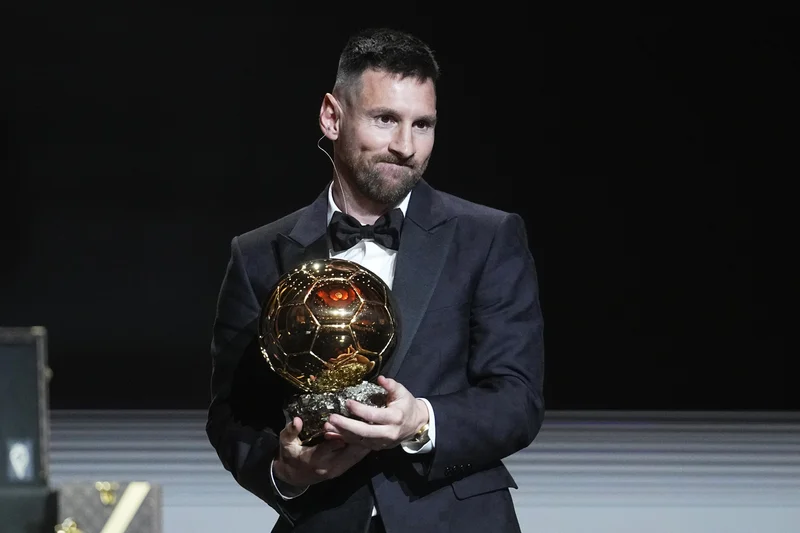
The Ballon d’Or has spent nearly seven decades measuring football greatness, with its winners ranging from pioneering legends such as Stanley Matthews and Alfredo Di Stefano to modern icons Lionel Messi and Cristiano Ronaldo.
Presented by France Football since 1956, the award is widely regarded as the most prestigious individual honor in men’s football. Its scope has changed significantly over the years. It initially recognized the best European player, before eligibility was expanded in 1995 to players of any nationality playing for European clubs and then opened globally in 2007.
The award was temporarily merged with the FIFA World Player of the Year between 2010 and 2015, creating the FIFA Ballon d’Or. France Football resumed sole presentation of the award in 2016. No award was given in 2020 after the COVID-19 pandemic disrupted the football calendar.
Since 2022, the award has assessed performances primarily over a football season rather than a calendar year. UEFA and the Amaury Group, which owns France Football and L’equipe, have co-organized the ceremony since 2024, while France Football has retained control of the voting system.
The 2025 edition added another chapter to that history when Paris Saint-Germain forward Ousmane Dembele was crowned the men's Ballon d’Or winner. Dembele finished ahead of Barcelona teenager Lamine Yamal and PSG teammate Vitinha after a season in which he helped PSG win its first Champions League title, a domestic double and finished with 37 goals and 15 assists.
Messi remains the record holder with eight Ballon d’Or victories. Cristiano Ronaldo has won five, while Johan Cruyff, Michel Platini and Marco van Basten each claimed the award three times.
Alfredo Di Stefano, Franz Beckenbauer, Kevin Keegan, Karl-Heinz Rummenigge and Ronaldo each won twice. Messi's eight victories span Barcelona, Paris Saint-Germain and Inter Miami, making him the first player to win the award while playing outside Europe when he claimed the 2023 prize with Inter Miami.
Lev Yashin remains the only goalkeeper to win the men's award, doing so in 1963 with Dynamo Moscow. George Weah became the first African winner in 1995, and he remains the only African player to have lifted the men's Ballon d’Or.
Brazilian Ronaldo was the youngest winner at 21 when he claimed the award in 1997, while England's Stanley Matthews remains the oldest, having won the inaugural award at 41 in 1956.
1950s
1956: Stanley Matthews, England, Blackpool
1957: Alfredo Di Stefano, Spain, Real Madrid
1958: Raymond Kopa, France, Real Madrid
1959: Alfredo Di Stefano, Spain, Real Madrid
1960s
1960: Luis Suarez, Spain, Barcelona
1961: Omar Sívori, Italy, Juventus
1962: Josef Masopust, Czechoslovakia, Dukla Prague
1963: Lev Yashin, Soviet Union, Dynamo Moscow
1964: Denis Law, Scotland, Manchester United
1965: Eusebio, Portugal, Benfica
1966: Bobby Charlton, England, Manchester United
1967: Flórián Albert, Hungary, Ferencváros
1968: George Best, Northern Ireland, Manchester United
1969: Gianni Rivera, Italy, AC Milan
1970s
1970: Gerd Müller, West Germany, Bayern Munich
1971: Johan Cruyff, Netherlands, Ajax
1972: Franz Beckenbauer, West Germany, Bayern Munich
1973: Johan Cruyff, Netherlands, Barcelona
1974: Johan Cruyff, Netherlands, Barcelona
1975: Oleg Blokhin, Soviet Union, Dynamo Kyiv
1976: Franz Beckenbauer, West Germany, Bayern Munich
1977: Allan Simonsen, Denmark, Borussia Mönchengladbach
1978: Kevin Keegan, England, Hamburger SV
1979: Kevin Keegan, England, Hamburger SV
1980s
1980: Karl-Heinz Rummenigge, West Germany, Bayern Munich
1981: Karl-Heinz Rummenigge, West Germany, Bayern Munich
1982: Paolo Rossi, Italy, Juventus
1983: Michel Platini, France, Juventus
1984: Michel Platini, France, Juventus
1985: Michel Platini, France, Juventus
1986: Igor Belanov, Soviet Union, Dynamo Kyiv
1987: Ruud Gullit, Netherlands, AC Milan
1988: Marco van Basten, Netherlands, AC Milan
1989: Marco van Basten, Netherlands, AC Milan
1990s
1990: Lothar Matthaus, Germany, Inter Milan
1991: Jean-Pierre Papin, France, Marseille
1992: Marco van Basten, Netherlands, AC Milan
1993: Roberto Baggio, Italy, Juventus
1994: Hristo Stoichkov, Bulgaria, Barcelona
1995: George Weah, Liberia, AC Milan
1996: Matthias Sammer, Germany, Borussia Dortmund
1997: Ronaldo, Brazil, Inter Milan
1998: Zinedine Zidane, France, Juventus
1999: Rivaldo, Brazil, Barcelona
2000s
2000: Luis Figo, Portugal, Real Madrid
2001: Michael Owen, England, Liverpool
2002: Ronaldo, Brazil, Real Madrid
2003: Pavel Nedved, Czech Republic, Juventus
2004: Andriy Shevchenko, Ukraine, AC Milan
2005: Ronaldinho, Brazil, Barcelona
2006: Fabio Cannavaro, Italy, Real Madrid
2007: Kaka, Brazil, AC Milan
2008: Cristiano Ronaldo, Portugal, Manchester United
2009: Lionel Messi, Argentina, Barcelona
2010s
2010: Lionel Messi, Argentina, Barcelona
2011: Lionel Messi, Argentina, Barcelona
2012: Lionel Messi, Argentina, Barcelona
2013: Cristiano Ronaldo, Portugal, Real Madrid
2014: Cristiano Ronaldo, Portugal, Real Madrid
2015: Lionel Messi, Argentina, Barcelona
2016: Cristiano Ronaldo, Portugal, Real Madrid
2017: Cristiano Ronaldo, Portugal, Real Madrid
2018: Luka Modric, Croatia, Real Madrid
2019: Lionel Messi, Argentina, Barcelona
2020s
2020: No award
2021: Lionel Messi, Argentina, Paris Saint-Germain
2022: Karim Benzema, France, Real Madrid
2023: Lionel Messi, Argentina, Inter Miami
2024: Rodri, Spain, Manchester City
2025: Ousmane Dembele, France, Paris Saint-Germain
UEFA's official historical record confirms the complete winners' list through Dembele's 2025 victory.
The modern Ballon d’Or is based on three principal considerations: individual performance, team achievements and the player's conduct, including fair play. The men's award is decided by an international jury of specialized journalists, with representatives from the top 100 nations in the FIFA rankings. Each voter ranks 10 players, with points awarded on a descending scale of 15, 12, 10, 8, 7, 5, 4, 3, 2 and 1.
The evolution of the voting system mirrors the globalization of the sport itself. What began in 1956 as an award restricted to European players eventually became a worldwide honor, allowing stars such as Weah, Ronaldo, Ronaldinho, Messi and Dembele to compete on the same stage regardless of nationality.
The early years were dominated by European stars, with Matthews, Di Stefano, Kopa, Eusebio, Charlton and Best among the players who established the award's prestige.
The 1970s brought the influence of Dutch football, most notably Cruyff's three victories, while Beckenbauer and Rummenigge helped define a powerful German era. Platini then became the first player to win three consecutive awards, taking the prize in 1983, 1984 and 1985.
The 1990s ushered in a more global era. Weah's historic 1995 victory followed the expansion of eligibility and was followed by the emergence of Brazilian stars Ronaldo and Rivaldo, along with Ronaldinho and Kaká in the next decade.
Then came the Messi-Ronaldo era.
Beginning with Ronaldo's 2008 victory and Messi's first triumph in 2009, the two superstars dominated the award for more than a decade. Messi won four straight between 2009 and 2012, Ronaldo claimed back-to-back awards in 2013 and 2014, Messi won again in 2015, and Ronaldo followed with victories in 2016 and 2017. Luka Modrić interrupted their run in 2018 before Messi won again in 2019.
Messi's later victories added further milestones. He won in 2021 with Paris Saint-Germain and again in 2023 after Argentina's 2022 World Cup triumph, this time while playing for Inter Miami. Rodri broke the Messi-Ronaldo dominance in 2024 after Manchester City's historic season and Spain's European Championship victory.
Dembele continued the post-Messi-Ronaldo era in 2025, becoming the latest PSG star to claim the game's most coveted individual prize after a season highlighted by Champions League success.
The 2026 Ballon d’Or will be presented Oct. 26 in London, marking the award's 70th edition and its first ceremony in the British capital.