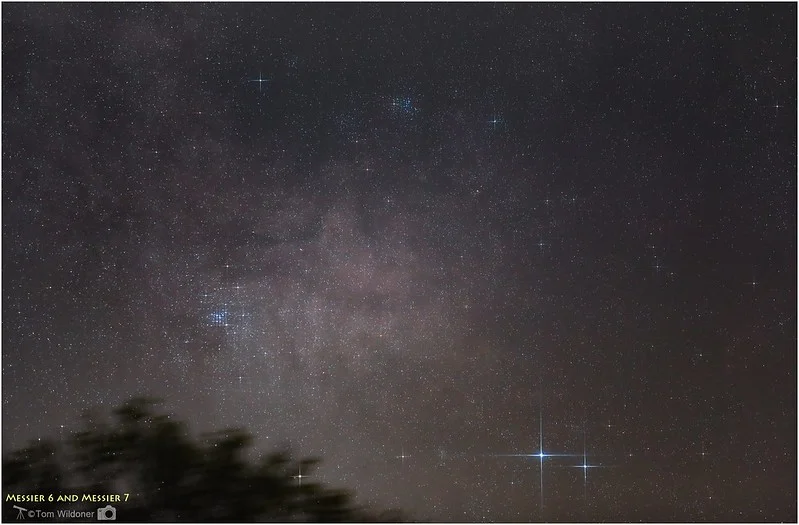
In a dark sky, you’ll see 2 famous star clusters – M6 and M7 – in the constellation Scorpius the Scorpion. In this photo, Messier 7 – aka Ptolemy’s Cluster – is above the tree on the left. Messier 6, the Butterfly Cluster, is a bit smaller, positioned near the center top of the image. And Shaula and Lesath, the stinger stars in Scorpius, are prominent in the lower right. Image via Tom and Jane Wildoner/ Dark Side Observatory/ Flickr. Used with permission.
- The star clusters M6 (Butterfly Cluster) and M7 (Ptolemy’s Cluster) are near the tail of the Scorpion in the constellation Scorpius. Look for them on dark Northern Hemisphere summer nights!
- Both M6 and M7 are open star clusters, which means they are groups of stars that formed together from the same cloud of gas and dust, making them like star siblings.
- You can spot these clusters with your unaided eye on a dark, moonless night, but they look even more beautiful through binoculars.
M6 and M7: Open star clusters in the Scorpion’s Tail
Two spectacular star clusters glitter near Scorpius the Scorpion’s stinger stars, Shaula and Lesath. Messier 6 and Messier 7 – or M6 and M7 – are open star clusters. Each cluster is a group of stars formed from the same huge cloud of gas.
These two clusters are visible on summer evenings in the Northern Hemisphere, or winter evenings in the Southern Hemisphere. They’re best viewed in a dark sky, and are a stunning sight through binoculars.
The constellation Scorpius with the positions of the star clusters M7 and M6 marked. Chart by EarthSky.
How to find M6 and M7
These star clusters are easy to spot in a dark sky near the curved tail of the constellation Scorpius the Scorpion. Scorpius is shaped like the letter J. And the two stars, Shaula and Lesath – at the end of the curved part of the J – mark the end of the Scorpion’s Tail. They’re known as the Cat’s Eyes, or the stinger of Scorpius.
Plus, if you draw an imaginary line from Lesath through Shaula, you’ll find M7, which is the brighter and larger of the two star clusters. Then from M7, you find M6 only a short hop away.
And although M6 and M7 are visible to the unaided eye on a dark, moonless night, the brilliance and beauty of these deep sky objects is magnificent through binoculars.
If you’re in the northern U.S., Canada or a similar latitude, you’ll need an unobstructed horizon toward the south to find M6 and M7. They are highest in the sky when due south, and even then never climb very high in the sky. Meanwhile, from latitudes like those in the southern U.S., the clusters are easy to spot at their highest in the south, above the Scorpion’s Tail. Generally, Scorpius is much easier to view from the equator and most of the Southern Hemisphere.
View at EarthSky Community Photos. \| Dr Ski captured this image from the Philippines and wrote: “The Scorpion’s stinger is comprised of Shaula and Lesath. These stars point the way to magnificent Ptolemy’s Open Cluster (M7). Just 3 degrees to the northwest is the Butterfly Cluster (M6). Binoculars will show you these clusters, along with all the dark nebulae snaking around this region!” Thank you, Dr Ski!
Best time to view
Consequently, in mid-June, these clusters are visible in the sky around midnight (1 a.m. daylight saving time in the U.S.). And keep in mind that all the stars (and star clusters) return to the same place in the sky some four minutes earlier with each passing day, or two hours earlier with each passing month. Therefore, M6 and M7 appear highest in the sky at about 10 p.m. (11 p.m. daylight saving time) in mid-July, and 8 p.m. (9 p.m. daylight saving time) in mid-August.
M6 and M7 science
Even though M6 (Butterfly Cluster) and M7 (Ptolemy’s Cluster) appear close together on the sky’s dome, they are far apart in space. Indeed, M6 is about 1,600 light-years away and shines at magnitude 4.2. M7 is about 980 light-years and shines at magnitude 3.3. So, the clusters are not related to each other, but only appear near each other along our line of sight.
But, within each cluster, the stars are related. Each cluster was born from a single interstellar cloud of gas and dust. The hundreds of stars in each cluster are indeed sibling stars, in that they are gravitationally bound to one another and travel in the same direction through space. Therefore, astronomers call such a collection of stars an open star cluster.
Messier 6 through a wide field telescope and camera. Image via Fred Espenak. Used with permission.
Messier 7 through a wide field telescope and camera. Image via Fred Espenak. Used with permission.
The clusters are in the thick of the Milky Way
M6 and M7 reside near the galactic equator, the region on the sky’s dome rich with star clusters, star clouds and nebulae. Once you find M6 and M7, try locating other deep-sky binocular doubles, such as M8 and M20. And also check out M16 and M17. These deep-sky wonders loom farther away. Also, M6 and M7 are open star clusters. But M8 and M20, and M16 and M17, are nebulae where stars are forming.
Bottom line: Messier 6 and Messier 7 are striking star clusters near the tail of Scorpius. M6 and M7 are best in dark sky conditions through binoculars.
Bruce McClure
About the Author:
Bruce McClure served as lead writer for EarthSky's popular Tonight pages from 2004 to 2021, when he opted for a much-deserved retirement. You can still find many articles at EarthSky.org that were originally written by Bruce, and which the EarthSky editors still update regularly. Bruce is a sundial aficionado, whose love for the heavens has taken him to Lake Titicaca in Bolivia and sailing in the North Atlantic, where he earned his celestial navigation certificate through the School of Ocean Sailing and Navigation. He also wrote and hosted public astronomy programs and planetarium programs in and around his home in upstate New York. Bruce he loves cycles of all kinds! You can still find many articles at EarthSky with Bruce's name on them, exploring the various, intricate cycles of the sky.
EarthSky Voices
About the Author:
Members of the EarthSky community - including scientists, as well as science and nature writers from across the globe - weigh in on what's important to them.