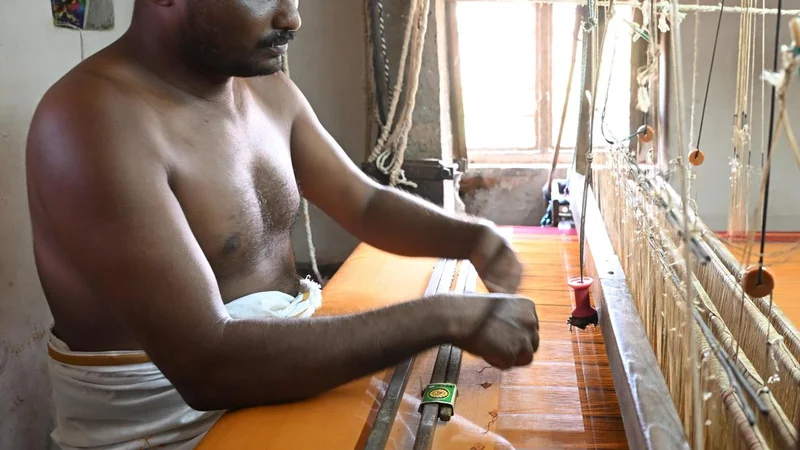
K. Jothimani cuts eight strands of red thread from a bobbin with a razor blade, and carefully tucks them one by one into the warp of an orange sari, at equal intervals across the matrix. He moves the shuttle at least 10 times horizontally on the weft, carefully adjusting the placement of the red thread, until a delicate butta in the shape of an eye emerges on the fabric.
Mr. Jothimani, 33, is one of the many handloom weavers keeping alive the art of manually creating butta (flower in Persian) on saris, at Thiruengoimalai in Thottiyam taluk of Tiruchi district.
As a member of the Maragathaleswarar Handloom Weavers’ Cooperative Society, Mr. Jothimani has his order books full with motif-laden saris this year. “The ‘eye’ is just one of countless buttas we can weave. The maangani (mango), for instance, has multiple variations. For the more ornate saris, we have mayil (peacock), yaanai (elephant) and the teppakulam (temple step well) buttas, all worked by hand,” Mr. Jothimani told The Hindu, showing a collection of hand-drawn motifs on graph sheets.
His wife uses a repurposed bicycle wheel and pedal to spin the yarn and prepare the spindles of thread for Mr. Jothimani and his mother, the other full-time weaver in their home.
“Young people lack the patience to learn weaving, especially when there are better paying jobs in other sectors. I hope we will be able to preserve these skills for posterity,” said Mr. Jothimani.
Diversification
Despite lack of new blood in the ancient craft, the cooperative is one of the weaving clusters in Tiruchi district that has created a handloom product called the ‘Manamedu’ sari.
Manamedu is a village in Thottiyam taluk with a historical link to weaving. Artisans living in and around Manamedu have come up with a composite genre of lightweight and colourful cotton saris that has revived the fortunes of at least 10 weaving societies in the region.
P. Dhandapani, cooperative’s manager, said that an ongoing contract with Co-optex (Tamil Nadu Handloom Weavers’ Co-operative Society) has helped increase diversification.
“Earlier, we were doing just plain saris. We started offering handwoven buttas in our saris four years ago, based on customer feedback. The buttas are less perfectly finished than powerloom products, but that is a mark of their authenticity, like a weaver’s signature,” he said.
Experienced weavers use punched jacquard cards sourced from Salem that guide threads to weave buttas into the pallu and body of the saris. “We have added block-printing to enhance the look of the butta sari. Nowadays, our handloom saris come with blouse material attached, and measure up to 6.20 metres, on a par with powerloom products,” said Mr. Dhandapani.
Weavers can expect to earn between ₹500 and ₹650 per sari. “However, what costs ₹1,300 in a home-based unit, can be marked up and resold for ₹2,500 in bigger stores in cities. Many connoisseurs of handloom prefer to buy from us directly so that the weavers benefit from their labour,” the official said.
Published - August 15, 2026 07:04 pm IST