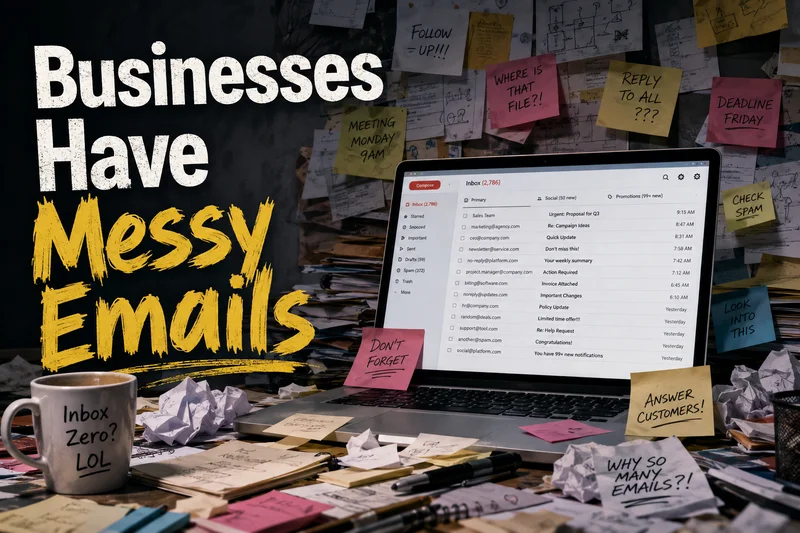
Years ago, I came across an infographic called Businesses Have Messy Data.
It visualized something every growing company eventually discovers: data becomes chaos.
Different departments use different tools. Information gets duplicated. Contacts live in spreadsheets, CRMs, inboxes, Slack channels, and random databases nobody remembers creating.
Looking at that infographic made me think about emails.
Not email as a communication tool. Email as a business asset. And that's when I realized something:
Most companies don't have messy emails.
They have messy systems.
The Email Thread From Hell
Let's start with something nobody enjoys.
Long email threads. You've seen them.
Twenty replies. Multiple people copied. Half the messages collapsed behind an "Expand Thread" button. Nobody remembers who promised what, and finding a specific attachment feels like an archaeological expedition.
It's so productive!
Over the last decade we've built Slack, Teams, Discord, WhatsApp, Messenger, CRMs and dozens of project management tools.
Yet, email remains the backbone of business communication.
Customers use it.
Partners use it.
Lawyers use it.
Governments use it.
Like it or not, email isn't going away.
Your Business Lives Inside Email
Think about how many email addresses you've had throughout your life.
I've probably lost access to ten of them.
Most were personal accounts.
A few contained valuable business relationships.
When those accounts disappeared, some contacts disappeared with them.
For individuals, that's inconvenient.
For businesses it's dangerous.
Many companies unknowingly allow critical business relationships to live inside personal inboxes.
The moment an employee leaves, years of conversations, context, and contacts can walk out the door with them.
The CRM Problem Nobody Talks About
Imagine a small company with a few salespeople.
No proper CRM.
Or a CRM that requires constant manual updates.
How do you know every prospect has been entered correctly?
How do you know every conversation is being tracked?
How do you know opportunities aren't disappearing?
You probably don't. This isn't a technology problem. It's a process problem.
Businesses often assume customer data is being managed properly because everyone is busy.
In reality, many customer relationships exist only in someone's inbox.
Every Message Represents Your Brand
Years ago, I encountered a prospect who became angry during a sales conversation.
At one point, he literally replied:
"Fuck you, Arthur."
I stayed professional and ended the conversation. But it made me think.
What would have happened if I had responded emotionally?
What if that screenshot became public?
One careless message can damage years of brand building.
I saw another example when my salesperson sent a politically charged joke (about murderer Putin) in an outreach email to a prospective client.
Fortunately, we had visibility into outgoing communications and caught it quickly.
Many companies don't.
This is one reason why businesses increasingly invest in reputation management.
A company's public image can be damaged by a single employee, a single screenshot, or a single bad interaction.
The internet never forgets.
Your Newsletter Form Is Probably More Complicated Than You Think
Let's look at something as simple as a newsletter signup form.
You add a form to your website.
A visitor submits their email address.
~~Simple, right?~~
Not really.
Questions immediately appear:
- Where is the data stored?
- Who has access to it?
- Is it encrypted?
- Can it be exported?
- Is it backed up?
- Is it compliant with privacy regulations?
- What happens if your website is compromised?
Many businesses don't know the answers.
The form works.
People subscribe. Everyone moves on.
Until something breaks.
Data Ownership Matters
One of the biggest mistakes businesses make is assuming that because they can access data, they own it.
Those are not the same thing.
Your newsletter may live inside Mailchimp.
Your audience may live inside LinkedIn.
Your followers may live on Instagram.
Your content archive may live inside Substack.
Your customer records may live inside a SaaS platform.
What happens if you decide to leave?
Can you export everything?
Can you migrate it easily?
Can you recreate your business somewhere else?
Many companies never test this until it's too late.
The Hidden Cost of Growth
As businesses grow, they accumulate lists.
Customer lists.
Prospect lists.
Newsletter subscribers.
Product users.
Event attendees.
Partner databases.
The questions become more difficult:
- Are these lists synchronized?
- Are they updated?
- Are duplicates removed?
- Are they secure?
- Can they be exported?
- Does anyone know where all of them are located?
Most companies would be surprised by the answers.
Employees Build Databases Too
Here's another interesting problem.
Recruiters spend years building LinkedIn networks.
Salespeople spend years building prospect lists.
Partnership managers spend years building relationships.
What happens when they leave?
In many cases, those relationships leave with them.
The company paid for the time spent building those networks.
Yet, the asset itself often belongs to an individual account.
Businesses rarely think about this until an important employee resigns.
Migration Is Harder Than You Think
One client of mine ran a newsletter business for years.
Over time she changed email providers.
Templates changed.
Links changed.
Systems changed.
Eventually, she wanted to create a searchable archive of every newsletter she had ever sent.
Sounds simple - It wasn't.
Seven years of campaigns were scattered across multiple providers.
Some data was missing.
Templates were inconsistent.
Links were broken.
Content had to be reconstructed manually.
What should have been a straightforward project became a massive migration effort.
The lesson is simple: Archive everything.
Export your campaigns.
Keep backups.
Store them in multiple locations.
Future-you will be grateful.
Marketing Creates Data Silos
Here's a situation I've seen repeatedly.
A marketing team launches a campaign.
They create a landing page.
They build a new signup form.
They run advertisements.
The campaign ends.
Everyone moves on.
Months later, Google is still sending traffic to that page.
People continue submitting forms.
Nobody notices.
Nobody receives the leads.
The page becomes a silent leak in the business.
Not because anyone made a mistake.
Because nobody owned the entire system.
Different departments often create different pieces of infrastructure without considering what happens afterward.
Over time, these abandoned systems accumulate.
The Real Problem
Businesses don't have messy emails.
Emails are simply where the symptoms appear.
The real problem is fragmented data.
Customer information lives in dozens of places.
Ownership is unclear.
Processes are inconsistent.
Systems aren't documented.
Backups don't exist.
Nobody knows where everything is.
The larger a company becomes, the harder this gets.
The businesses that handle growth successfully aren't necessarily the ones with the best software.
They're the ones that understand where their data lives, who owns it, and how to move it when needed.
Because sooner or later, every business discovers the same truth:
Managing email is easy.
Managing everything connected to email is the hard part.