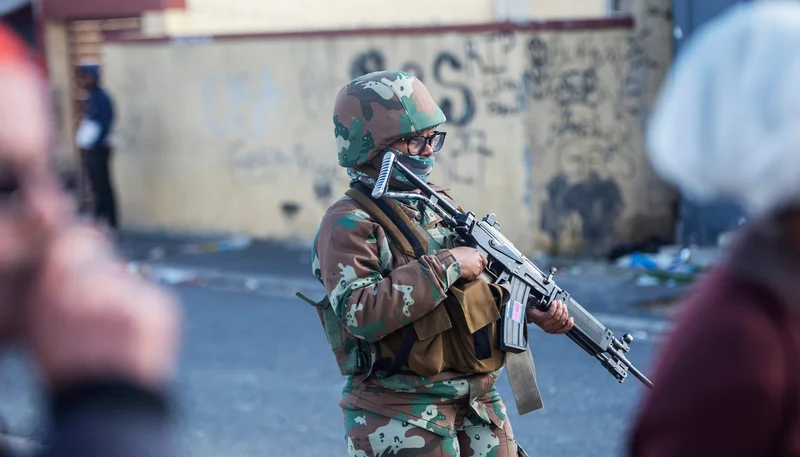
In the wake of President Cyril Ramaphosaâs 2026 State of the Nation Address in February, 2,200 soldiers were deployed from 1 March to support police operations against crime, gang violence and illegal mining across five provinces.
After an outcry from residents of Gqeberhaâs Northern Areas, Acting Police Minister Firoz Cachalia announced that the deployment, called Operation Prosper, had been extended to the Eastern Cape. It is expected to cost more than R800-million and run until March 2027.
The recent killing of two Gauteng Anti-Gang Unit officers and two civilians, as well as 70 recorded killings in the Western Cape between 2 August and 9 August, raise huge questions about the efficacy of the presidentâs intervention.
Despite the deployment of the SA National Defence Force (SANDF), the state has yet to break the grip of gangs on some of the countryâs most crime-ravaged communities, showing that the problem runs deeper than a shortage of boots on the ground.
The government has acknowledged weaknesses. Briefing Parliamentâs police portfolio committee on 4 March, Cachalia cited long-standing capacity problems in the South African Police Service (SAPS), particularly detectives and crime intelligence.
Military intervention in the fight against crime has failed in the past. The last such deployment to tackle gang violence in the Western Cape took place in 2018.
Gauteng: from hope to bloody reality
In Gauteng, the deployment is due to run until the end of April 2027, with 500 troops committed at a cost of R80-million.
When the army arrived, there was excitement in some communities. On Wednesday, 11 March, a convoy of at least 25 SANDF vehicles drove through Riverlea in Johannesburg, prompting residents to cheer. Schoolchildren lined the streets.
But five months later, the bloodshed in Reiger Park offered a sobering reality check.
On Friday, 7 August, two Gauteng SAPS Anti-Gang Unit members, Constable Thapelo Tlomatsane (29) and Constable Sphiwe Sibeko (28), were killed alongside two civilian women, Rolene Lessing and Jaydin Magerman, in an apparent ambush.
The killings exposed the limits of a military deployment in confronting a criminal ecosystem that operates beyond the reach of soldiers on patrol. They also sent a disturbing message: even specialised police officers can become targets.
But before this, on Tuesday, 9 June, one of Gautengâs bloodiest mass shootings unfolded when a heavily armed gang stormed the gated Jumpers informal settlement in Cleveland, Johannesburg. They opened fire indiscriminately, killing 13 people.
The SAPS initially said it was too early to link the mass shooting to illegal mining, but community leaders and political parties say syndicates refining illicit gold in the area are a primary driver of local bloodshed.
The response from Cachalia to the Reiger Park murders was revealing. In the aftermath, he called for the state to âreclaim our streetsâ and âreclaim our communitiesâ, and acknowledged the scale of the challenge.
âA few months ago we put more resources to strengthen the Anti-Gang Unit, but we are not winning, and I wonât rest until I have a final victory,â Cachalia said.
This admission â âwe are not winningâ â raises the central question: If 500 soldiers, a reinforced Anti-Gang Unit and a heavily policed environment are still failing to contain gang violence, what will it take?
Cape Town: gangs still in control
The killing of 70 people in gang violence and mass shootings across the Western Cape between 2 August and 9 August has raised serious questions about Operation Prosperâs effectiveness. The police said no arrests had been made.
The bloodshed comes as newly appointed Western Cape Police Commissioner Lieutenant-General Sizakhele William Dyantyi has vowed to intensify the fight against gangs, illegal firearms and extortion.
Benedicta van Vuuren, DA Western Cape spokesperson on police oversight and community safety, said the provincial death toll for the year so far amounted to 2,641 killings, or about 12 people murdered every day. Of these, 1,658 were related to gang activity and crime.
âIf communities continue to experience such devastating levels of violence, the government must ask whether the current approach is delivering the results residents deserve,â Van Vuuren said.
A recent Daily Maverick visit to Leonsdale in Elsies River offers perhaps the clearest illustration of the scale of the challenge. During a two-hour walkabout through areas largely controlled by the Terrible Josters gang, residents gave a grim assessment of the army deployment.
Their message was stark: the soldiers are visible, but the gangs remain in control.
Chief Hamish Arries, outgoing chairperson of the Elsies River Community Police Forum, said army patrols often amounted to little more than vehicles passing through. âItâs a nice gesture, but⦠itâs not addressing the problem.â
Gert Davids, a former 28s gang member, said poverty, unemployment and the lack of legitimate opportunities were helping to sustain the cycle of crime.
âGangs have been in this area for years, but it wasnât always this bad,â he said, pointing to deeper social problems feeding the cycle. For young people, this reality can translate into gang recruitment and drug dealing.
Two former Elswood High School matriculants said finding work after graduation had proved almost impossible. For them, gang control means more than the threat of violence. Gangs control movement through narrow alleys, creating invisible territorial boundaries.
âWe canât walk where we want to walk. Every time we turn, we have to wonder where theyâre going to shoot from, or when we are going to be robbed,â they said.
Eastern Cape: different effects
Meanwhile, in the Eastern Cape, the experience of the SANDF deployment exposes a more complicated picture. In Gqeberha, community activists and policing forums complain that soldiers are barely visible in the gang-ravaged Northern Areas. In Humansdorp, by contrast, residents say the presence of troops has helped disrupt gang activity and restore some calm.
Nelson Mandela Bay Community Police Board chairperson Eddie Alexander criticised authorities for failing to involve communities in the operations.
For Alexander, the real test is whether the deployment is producing tangible results in the Northern Areas, where residents have long called for military intervention against gangs and drugs.
âI cannot say there have been any significant changes when it comes to arrests linked to drugs. I also have not seen much progress, or any detailed feedback, on efforts to tackle gang-related crime in the Northern Areas.â
Helenvale community activist Audrey Hitzeroth echoed his concerns about the lack of troop visibility.
âWhen they first arrived there was a lot of excitement. You could see a difference â there were fewer gunshots and people felt safer. But suddenly these gangsters are back to their old ways,â Hitzeroth said.
Her account points to a recurring problem: a temporary reduction in violence is not necessarily the same as dismantling gang control. Hitzeroth said soldiers often appeared to respond only after shootings or when information about a drug den was received.
But the experience in Humansdorp offers a striking counterpoint. Community activist Chandrion Windvogel said residents had welcomed the soldiers with jubilation. According to Windvogel, joint operations involving the army and police had disrupted gang activity and contributed to a significant reduction in shootings.
The contrasting experiences of Gqeberha and Humansdorp raise an important question about Operation Prosper: Is the problem related to how effectively the soldiers have been deployed in collaboration with police and communities?
Rights infringements, a missing state
The depth of the crisis becomes even clearer when viewed through the prism of constitutional rights. Author and former Western Cape head of detectives Major-General Jeremy Vearey argues that in communities in the grip of gangs, constitutional freedoms can become little more than words on paper.
âThe Constitution and the Bill of Rights do not exist in terms of freedom of movement, association or economic activity in a gang-ridden area. There are no such rights there,â Vearey told Daily Maverick.
The problem, he argues, cannot be separated from the poverty and unemployment that allow gangs to recruit and sustain their influence. Vearey believes a far broader state response is required.
âThatâs why I say a state of disaster should be declared. Then you can bring all forces to tackle the problem at every level. If you bring in the army, they are only a small factor. They do not make a difference,â he said.
Institute for Security Studies analyst Willem Els argues that the gang crisis is, at its core, a crisis of governance rather than simply a crime problem.
Elections are meant to forge a social contract in which the state delivers basic public goods such as safety, services and economic opportunity. When these obligations are repeatedly unmet, he says, the resulting vacuum is filled by alternative systems of power and control.
Crime prevention, Els underlines, largely falls to the police, but many drivers of gang violence â poverty, unemployment, inadequate housing, drug markets and addiction â lie beyond their mandate. The result is that the police are expected to contain violence while lacking the tools to address many of its causes.
The vacuum also reshapes communities, Els says, allowing gangsters to become sources of status, power and income where legitimate opportunities are scarce.
Els argues that the SANDF is ill equipped to break this cycle. The army is not a policing institution and lacks the investigative mandate and capacity to dismantle criminal networks. Its role is to support, not replace, the police.
âAt best, operations can stabilise an area briefly. But without continuous presence and broader intervention, the pattern repeats, like a wave that recedes and returns.â
Parliament confronts deeper crisis
The growing recognition that military deployments alone cannot solve SAâs gang crisis is now reaching Parliament. On Tuesday, 11 August, the institutionâs Portfolio Committee on Police began a public inquiry into gang-related violent crime, bringing together victims, civil society and community organisations.
Committee chairperson Ian Cameron said public participation had to go beyond a Ââtick-box exerciseâ and that the inquiry was seeking practical solutions and greater cooperation between the government, communities and civil society.
âGang violence has far surpassed crisis levels, and far-reaching solutions are not only necessary, but urgent,â Cameron said.
The committee will hold a solutions-based summit on 19 August to examine the causes of gang violence, the resources needed and ways to sustain collaboration. Before the summit, the portfolio committees on police and defence and the Joint Standing Committee on Defence will conduct an oversight visit to assess the impact of the SANDF deployment in Cape Town.
Cameron cautioned against seeing military intervention as a long-term solution: âWhile the intervention might be necessary in the short term, the scourge requires long-term and collaborative measures.â
Operation Prosper: the R823-million question
The governmentâs flagship military intervention against gang violence and illegal mining faces an awkward problem: the money promised for Operation Prosper had still not reached the Department of Defence by the end of July.
Acting Department of Defence Chief Financial Officer Edem Abotsi told Parliamentâs Standing Committee on Appropriations that the department had not received the R823-million allocated for the 12-month deployment of 2,200 SANDF personnel.
The department says it warned the National Treasury twice, on 1 April and 28 May, about the funding required and the risks of delays. The Treasury subsequently requested detailed costing information, and the Appropriation Act was only assented to on 14 July. Yet, according to Abotsiâs 5 August presentation, the R823-million had still not been received.
The funding delay raises a broader question about the sustainability of Operation Prosper. The state has committed thousands of soldiers to tackle some of SAâs most entrenched security problems, but the financial machinery required to sustain the deployment appears to be lagging behind the political announcement. DM
This story first appeared in our weekly DM168 newspaper, available countrywide for R35.