Sign in. It’s quick, free and it’s up to you.
An account is an optional way to support the work we do. Find out more.
THE IRISH SOLDIERS who fought at the Siege of Jadotville have not been honoured with the State’s highest bravery medal because of a cover-up to protect bad choices by politicians and senior Irish military leaders, a new book claims.
The book’s author is military historian Dan Harvey, a retired Lieutenant Colonel in the Irish Defence Forces.
In Jadotville – Benchmark for Bravery, he analyses the events that surrounded how the 156 Irish soldiers found themselves in a situation where they were attacked and why, when they returned home, they were snubbed by the State they served.
There has been a previous book on the topic by Declan Power and assessments in other publications. The story of the siege inspired a major Hollywood action movie starring Jamie Dornan.
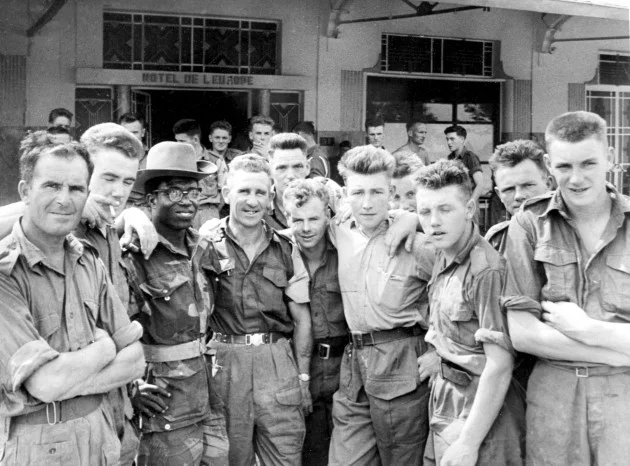
The peacekeeping soldiers were part of A Company of the 35th Irish Battalion and were led by Colonel Pat Quinlan. In September 1961 they were sent to secure an isolated United Nations base near the mining town of Jadotville, in the Democratic Republic of Congo.
Their fight to survive at the outpost during a battle that lasted four days is seen as the perfect example of a defence of a besieged position.
While a Jadotville medal has been presented to the roughly 30 or so survivors still alive, the campaign to have them awarded the Distinguished Service Medal, Ireland’s highest honour, has been ignored by the government. A review recommended only Quinlan to receive it posthumously.
Harvey says behind the scenes a sinister international high stakes game of geopolitical strategising put the Irish into the crosshairs of local Katanganese militia fighters and Belgian mercenaries.
He believes the decision to deploy the Irish troops to Jadotville, now known as Likasi, was taken by the UN in response to lobbying by the Belgian Government Foreign Minister Paul Spaak. Harvey said that the plan was to expose the poorly equipped Irish troops to an attack so that they would become hostages to be used as a bargaining chip.
The big strategy behind it was that the UN would be undermined and would leave the area free for Belgian mining interests who were alligned with the Katangese in the Congo.
Harvey that Ireland learned a hard lesson because of the battle and that was to not be naive about the intentions of other, normally friendly, nations.
“There are important lessons to be learned from Jadotville, and one is to be very politically aware,” he said.
Operation Morthor was launched by the UN in the hopes of taking control of communications and arresting the militants, but it ultimately failed. Harvey believes this was a major strategic mistake and guaranteed an attack on the Irish based at Jadotville.
Harvey has determined that this strategic failing was key. By leaving the Irish troops exposed it enabled what happened next.
“Without getting melodramatic. You’d wonder why there wasn’t a court-martial over it, because you can’t put people in danger and purposely not give them the full situational awareness of what’s happening,” he said.
The soldiers held out for four days against 3,000 enemy fighters. At least 300 of the attackers were killed in the ensuing battle but no Irish were killed.
In the end they were forced to surrender but under the guidance of Quinlan the Irish survived.
Regardless of the impact of their captivity the real insult happened back home in Ireland, Harvey said.
A sinister effort behind the scenes in the Irish Defence Forces hierarchy and official Ireland, including the Department of Defence, refused to honour the soldiers as they returned home.
Harvey said the motivation on the surface was that the Irish troops surrendered but that underneath it was a more complex effort to protect the decision makers who put the troops in the situation where they had to fight.
He said he has found there was, after the battle, an effort to erase Jadotville from the record.
“Quinlan had to surrender, but they were able to use the surrender as the basis for brushing it under the carpet, whereas really, what they were trying to keep from the public was their inadequacy, their strategic inadequacies that led them there in the first place,” Harvey explained.
The historian said that it is notable that the Force Commander in the Congo at the time was Sean McKweon who would return and go onto be the Chief of Staff of the Irish Defence Forces.
Harvey said that he believes, at some level, that this appointment created the scenario where the medals for bravery were withheld because to talk of Jadotville would have exposed McKweon’s inadequacies as a leader.
The author said the atmosphere at home left its mark on the soldiers of A Company, and they suffered when they returned.
A campaign is continuing for the peacekeepers to receive their DSM honour some 65 years later. For Harvey there should be no doubt that the soldiers “met the benchmark for bravery” and to refuse those medals is to “undermine the rationale for having the awards in the first place”.
“At a human level to be recognised gives you strength. Not to be recognised, to have your efforts questioned, diminishes the soul,” he said.
Jadotville – Benchmark for Bravery is published by Menma Books. It will be in the shops and available online at the end of this month.
To embed this post, copy the code below on your site