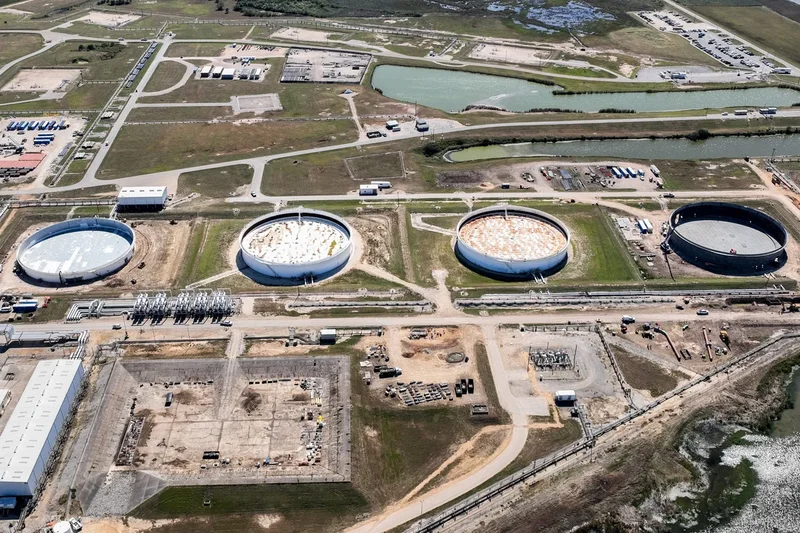
America’s emergency oil stockpile has dropped to its lowest level in 40 years, with experts warning that ongoing withdrawals for the war with Iran could permanently damage the underground caverns holding the crude.
The warnings arrive as American drivers face unprecedented gas prices for late summer. Today’s AAA National Average for a gallon of regular gasoline sits at $4.07, marking the highest levels on record for mid-August.
Concerns over the physical limits of the Strategic Petroleum Reserve center on the unique geology of its storage network. The crude is held within 60 salt caverns thousands of feet below ground at four sites across Texas and Louisiana.
To extract crude, operators pump fresh water into the bottom of a cavern to force oil up to pipeline intakes. However, petroleum engineering professor Siddharth Misra of Texas A&M University told CNBC that repeated rapid drawdowns wash away salt walls.
This process “creates flatter, less stable roof and severely thins the critical salt pillars that separate adjacent caverns, greatly increasing the geological risk of a structural cave-in,” Misra said.
Misra noted that while 70 million barrels is the absolute threshold needed to keep intake pipes under oil rather than water, “the practical operational floor for the crude inventory is between 250 million and 300 million barrels.”
Below 300 million barrels, the risk of structural damage increases while the system loses its ability to pump oil at high speeds, as thinning oil layers allow rising sludge to reach upper intakes.
The reserve was designed to handle five full drawdowns over its lifespan. Instead, it has undergone dozens of cycles over 40 years.
Misra told CNBC that “because the system was not designed for this many cycles, the repeated injection of water and extraction of oil have caused severe cavern deformation, accelerated the rate of massive salt falls from the ceilings, and significantly weakened the overall structural integrity of the aging reserve.”
Department of Energy data released Monday showed SPR inventories dropping below 300 million barrels for the first time since the initial fill in the early 1980s. The current release of 172 million barrels will leave the reserve at roughly 243 million barrels upon completion.
Market analysts at Rapidan Energy estimated the reserve’s functional minimum sits around 170 million barrels, after which “cavern integrity and pumping infrastructure limitations argue against further draws.”
The Department of Energy rejected claims that the facilities were at risk.
Energy Department spokesman Ben Dietderich told CNBC in a statement that assertions regarding cavern collapse were false.
“The caverns are always full. All that changes is the ratio of oil and water that is filling them,” Dietderich said, asserting that the Trump administration was “responsibly managing the SPR as the critical national security asset it was designed to be.”
Worries about structural integrity have been voiced by both major political parties.
Republican lawmakers cited cavern health in 2022 when the Biden administration released 180 million barrels following Russia’s invasion of Ukraine. That release dropped the SPR below 350 million barrels in 2023, before inventory was built back up to approximately 415 million barrels prior to the start of the Iran war.
Government oversight reports highlight long-standing physical strain on the facility. In a May report, the Government Accountability Office stated that “repeated partial drawdowns followed by refill can leach a single part of a cavern repeatedly, leading to undesirable shapes.”
While most caverns remained in “very good condition” after the 2022 release, the office noted that “every drawdown cycle expands cavern volume and reduces the spacing between caverns within the salt dome, which ultimately reduces their long-term viability.”
Energy Department officials previously told the accountability office they were “holding the SPR infrastructure together with ‘Band-Aids,’ and that it is uncertain how long they will hold.”
As of December 2025, more than a quarter of the reserve's capacity was unavailable due to ongoing cavern and construction outages.